
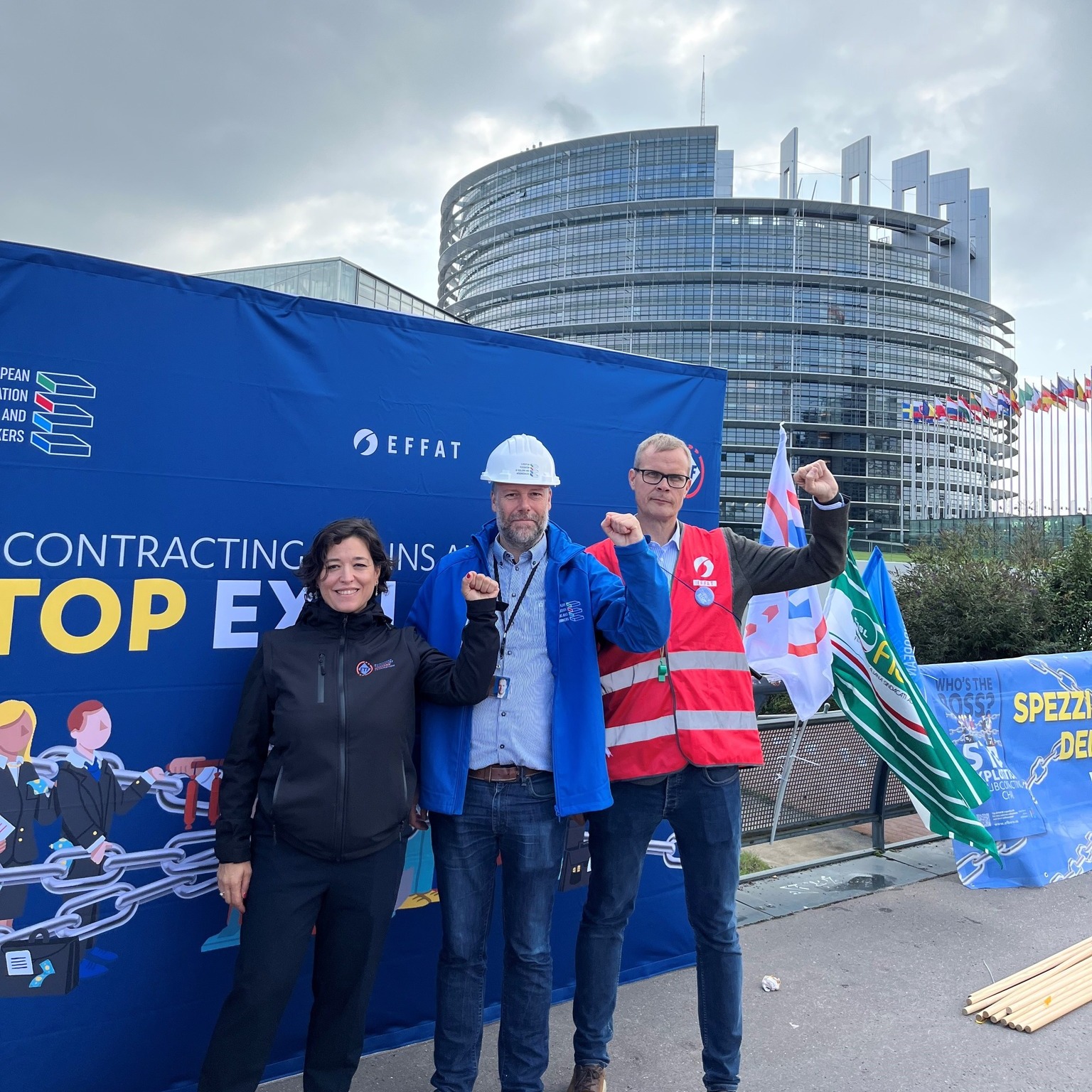
On 17 September, in conjunction with other European trade union federations, you organised a demonstration outside the European Parliament in Strasbourg, calling for better supervision of subcontracting. So, what are your demands?
A new legislature, together with a new European Commission and a new European Parliament, is now coming into being, and from the outset, we wanted to remind the European institutions to put the battle against social dumping on the agenda, with a view to finding solutions. We absolutely must have legislation designed to limit subcontracting chains. The current legislative framework doesn’t allow us to combat social dumping effectively. We’re seeing an increase in abusive situations, which – in an increasing number of cases – are involving third-country nationals, whose circumstances are particularly precarious. They’re vulnerable to various forms of human trafficking and forced labour. These abuses are in addition to the more traditional phenomena of unpaid wages and workers being housed in unsanitary accommodation. There’s no technical reason why long subcontracting chains should be allowed. The only reasons why they exist are to hide these phenomena, to evade social legislation and to make it harder to conduct inspections, especially when these take place in a crossborder context. So what we need to do is: firstly, force companies to reduce subcontracting chains; secondly, make the main contractor jointly and severally liable for what goes on; and thirdly, regulate the role played by intermediaries such as temporary work agencies and other placement services.
Other IR Share Services
We are called upon to devise training programmes based on needs expressed by a number of companies; we publish analyses and create tailor-made training activities for groups, works councils, trade unions and law firms. Our most recent projects are described here
IR Research
As Eurofound’s National correspondent, IR Share provides information on working conditions, industrial relations and the labour market to support the EU institutions and bodies, Member States and social partners in shaping social Europe, as well as promoting social dialogue on the basis of comparative information and research.
IR Training
Members of the IR Share team are regularly called upon to devise training courses. We deliver these either directly or working together with partners, to ensure that the training is tailored to the exact needs expressed.
IR Doc
IR Doc is a multilingual resource centre providing documentation on labour law and industrial relations at European Union and Member State level, including collective agreements concluded by the social partners at European, sectoral and transnational company level.
IR Club
Since 2011, the European Works Councils Club has sought to co-construct the foundations of a European social dialogue that can meet the social and environmental challenges faced by transnational companies.
IR Notes: an independent, reliable and balanced briefing note
IR Notes is an independent, reliable and balanced briefing note on industrial relations and labour law in Europe.
Published in 6 languages and sold by subscription, this newsletter gives you access to concise, targeted and practical information on the major themes of social Europe and transnational social dialogue.
With our experts and national correspondents, we adopt a dynamic, practical and useful approach to European social monitoring. We select the most relevant topics, which are a source of cross-disciplinary and inspiring ideas.
Get in Touch
Follow us on Social Media