Lead story
A revamp for coordination of social security regimes in the EU
Under pressure from European social partners and certain political groupings in Parliament, the revised regulation on the coordination of social security systems was at last definitively adopted by Parliament on 7 July.
To solve the thorny problem of freedom of movement for workers in the EU – a principle enshrined in the EU Treaty as early as 1958 – while at the same time maintaining Member States’ right to manage their own social security system, the EU has built up a novel body of legislation that is designed to coordinate, rather than harmonise, national social protection regimes, using regulations that were passed initially in 1958, and subsequently in 1971 and 2004, with Regulation 883/2004. This arrangement allows each country to retain its own rules and control the levels of the benefits it pays, but the regulations state which country is liable for these payments and how entitlements acquired in several countries are to be factored in. The aim is to ensure that workers who exercise their European mobility are not penalised, for example by losing some of their entitlements. Thus when a worker decides to draw their retirement pension in a given State, all of the periods they have spent in other EU countries are included in their pension calculation.
For around ten years now, Member States and Parliament have been tearing themselves to pieces trying to make adaptations to this text, mainly over matters where a great deal of money is involved – for example, Luxembourg has historically refused to pay unemployment benefits to workers who returned without a job to their home country, after working there. Under pressure from European social partners (see Joint statement of 23 March 2026) and certain political groupings in Parliament, the revision was at last definitively adopted by Parliament on 7 July (see press release and IR Notes 273). The Council has yet to formally adopt the text, following which it can be published in the OJEU. The text updates the criteria used to determine which country’s legislation applies to the 16 million or so European citizens who live or work in another Member State: unemployment benefits payable to mobile workers, a common definition of long-term care, a clearer distinction for family benefits in cash, and stricter supervision of posting, which is capped at 24 months, provided the worker has been affiliated to their home country’s social security scheme for at least three months. The text adopted states that for workers carrying out activities in two or more Member States, the updated law will determine the employer’s “registered office or place of business”, to establish which country’s social security legislation applies. To this end, relevant factors include the place where key decisions are taken, where turnover is generated, and the places where general meetings are held. The regulation also strengthens cooperation between authorities in the fight against fraud.
This step forward has been welcomed by European social partners: for example, the European Trade Union Confederation notes with approval that “the revised Regulations pave the way for more legal certainty and stronger tools against fraud and error in cross-border situations” (see press release). Speaking for the employers on 23 April, after the compromise had been reached in the trilogue, BusinessEurope welcomed the exemption of business trips and short-term postings of up to three days from prior notification requirements – except in the construction sector – and called both for the provisional agreement to be swiftly approved, and for further simplification measures in the upcoming labour mobility package (see press release).

 Legislation
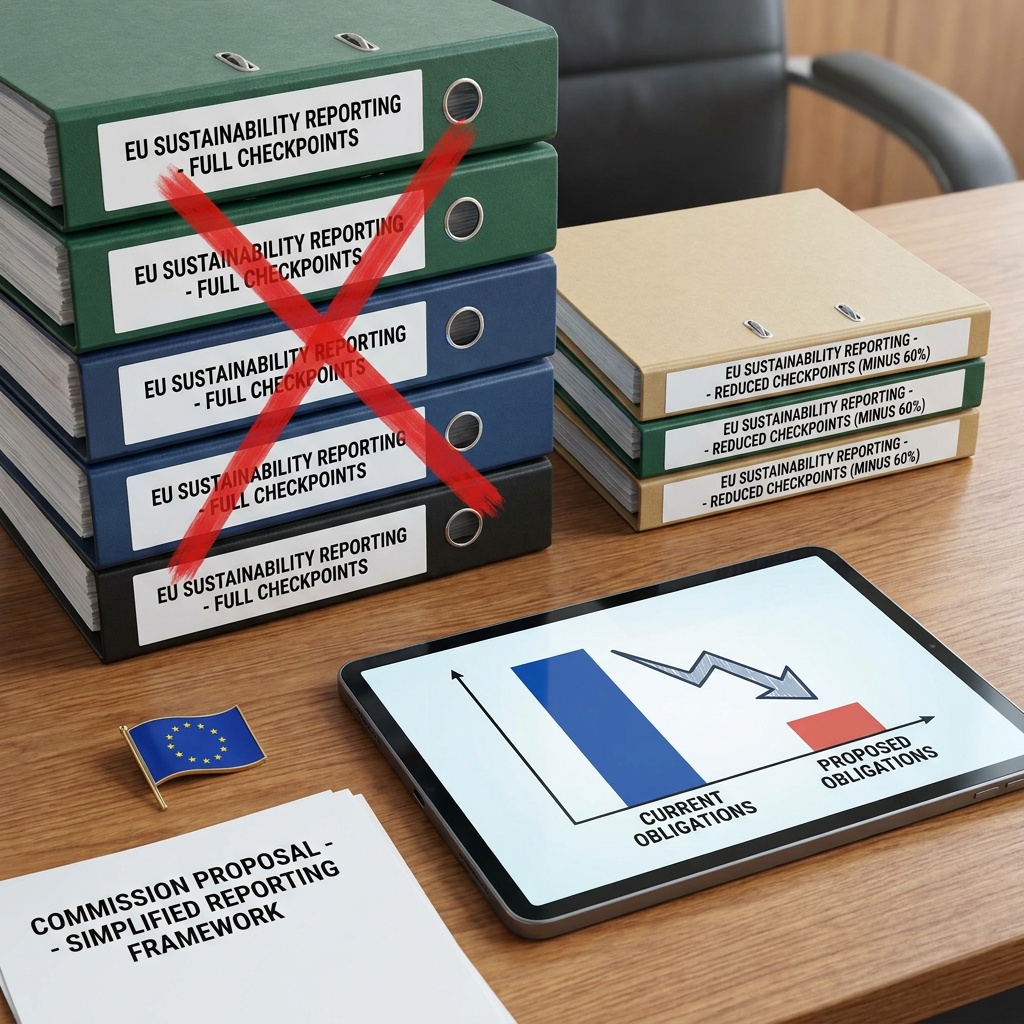
Further progress on simplifying sustainability reporting: On 3 July, the European Commission approved the simplification of social and environmental reporting standards for companies, following the adoption of the Omnibus I Directive, which revised the sustainability reporting directives applicable to companies in the areas of sustainable development and due diligence. More specifically, the Commission has adopted a delegated regulation on sustainability reporting (ESRS) (see also annexes) and a delegated regulation on voluntary reporting for small companies (see also annexes). These texts will now be submitted to the European Parliament and the Council of the EU for scrutiny. At the end of a two-month scrutiny period, which can be extended for a further two months, the regulations and their annexes will be published in the OJEU and will then apply immediately. These standards are intended to provide information for investors and other stakeholders, so that they can understand the sustainability-related risks to which companies are exposed, and their impacts on people and the environment (see press release). Even though the number of mandatory datapoints has been reduced by over 60% according to the Commission, the fact remains that companies will have to publish information that will continue to be relevant, including for European Works Councils and employee representative working for companies wishing to set up such a body, as they will have to indicate, among other things, the number of employees for each of the countries in which they have 50 or more employees and which are among their ten largest countries in terms of employee numbers.
A guide to applying the rules on forced labour: On 26 June, the European Commission published guidelines concerning the application of Regulation (EU) 2024/3015 on prohibiting products made with forced labour on the Union market. The IndustriAll Europe trade-union federation welcomes this publication but stresses that important gaps remain (see press release).
Social update
Fate of “voluntary” EWC agreements: The group of experts set up to facilitate the transposition of Directive 2025/2450 of 26 November 2025 revising the 2009 European Works Council directive, has published the minutes of its third meeting held on 16 April and 17 April this year, in the wake of those adopted for the previous two meetings (23 March and 24 March – 12 February and 13 February) (see IR Notes 273). The Commission’s representative has clarified the legal nature of the voluntary agreements that existed prior to the directive, emphasising that the bodies created by these agreements do not constitute EWCs within the meaning of the directive. Consequently, the rights and obligations of the parties to these agreements and of the members of these bodies do not come under EU law, but arise from the terms of the agreements themselves or from the national labour law applicable, from private contract law, etc., depending on the case. Nevertheless, the improvements made to these agreements by incorporating provisions contained in the directives are not undermined by abolishing the exemption that previously applied to voluntary agreements, which remain legally binding. As to the question of whether these “voluntary” agreements would automatically come to an end when a new EWC is created or whether they could last indefinitely, the Commission has not ruled out the possibility that a body created by a voluntary agreement could continue to function in parallel with an EWC newly established under Articles 5 and 6, if the parties to the voluntary agreement do not abolish it under the terms of the said agreement. We understand that the group of experts’ final report will be published in October.
Irish EU Presidency unveils its social programme: Ireland assumed the Presidency of the EU on 1 July and will hold it until the year-end. Its programme places the emphasis on the Quality Jobs Roadmap and the Quality Jobs Act, and the forthcoming series of measures making up the Fair Labour Mobility Package. “The Quality Jobs Act” will seek “to update EU rules protecting workers while supporting productivity and competitiveness”. The programme echoes an argument often put forward by European employers, emphasising that “often the demand for new legislation comes not because there is a legislative gap but because existing rules and regulations are not fully interpreted and enforced.” It therefore plans “to promote a discussion on how to ensure the EU’s implementation and enforcement agendas support real protections for the rights enshrined under EU law.”
European Globalisation Adjustment Fund interventions: On 16 July, the European Commission proposed to mobilise 6.5 million euros from the European Globalisation Adjustment Fund (EGF) to support 1,928 workers dismissed following redundancies at the Cora hypermarket in Belgium and in the car industry in Spain (see press release).
European social dialogue
Second-phase consultation on quality jobs: On 20 July, the European Commission launched the second-phase consultation of European social partners on the forthcoming “Quality Jobs Act”, which it plans to adopt at the end of the year (see also the Commission’s staff working document accompanying the consultation document).
Across Europe

 Germany
Plans to modernise the labour market and the employment service: On 1 July, the government coalition unveiled a programme of reforms that also affects the labour market (see programme). One of the key proposals is to allow, over a maximum period of four years, up to six renewals of a fixed-term contract without providing reasons — compared to the current maximum of two years and three renewals (see press release). Other measures include: tax relief on severance pay in cases where an employee quickly finds another job; abolishing the practice of issuing sick notes to employees over the phone; and introducing a requirement for employees to submit a sick note on their first day of sick leave, rather than on the fourth day as at present, accompanied by tougher penalties for bogus sick notes. On 15 July, the government also adopted a bill on modernising and digitising employment promotion, which seeks to facilitate digital access to the services of employment agencies (see press release). The trade union Verdi has criticised these reforms: its President Frank Werneke argues that “showing a lack of trust in employees and expanding the madness of fixed-term contracts will not create growth” (see press release).
 Netherlands
Law improving flexible workers’ job security now definitively adopted: The Chamber of Representatives passed this law on 12 May, and it was definitively approved by the Senate on 7 July (see IR Notes 274). This law forms part of a package of measures concerning the labour market (see press release). Zero-hours contracts are being replaced by variable-hours contracts (specifying a minimum and maximum number of hours, with a cap on the gap between the upper and lower limits), except for pensioners, students and young people who have a second job; equivalent working conditions, which were already introduced in January to ensure those of temporary workers match those of workers employed on a permanent contract, are being extended to wages as soon as 31 December 2026. The FNV trade union welcomes the passing of this law but emphasises the need for a global package, among other things to tackle the problem of bogus self-employed workers (see press release).
Netherlands
A new system of leave: The government has put out for consultation a bill establishing a simplified leave regime (see press release). Based on advice from SER (the tripartite consultative body bringing together employers, trade unions and self-employed members), the executive proposes to split leave into three categories: leave linked to child birth and child care; leave for the purpose of looking after close family; and personal leave.
 Denmark
Government strengthens efforts to combat social dumping in the construction industry: The government has presented two bills intended to combat social dumping and tighten control of foreign labour. One of the two plans relates to the requirement to carry an identity card (id-kort) on large building sites (projects valued at more than 13 million euros) (see press release), while the other creates a new wage threshold regime (“beløbsordning”) based on collective labour agreements, with the aim of facilitating access to “supervised” foreign labour. This scheme, which was announced in 2025 (see press release), is expected to facilitate the recruitment of foreign workers. It requires the company to be covered by a collective agreement concluded between the employers’ confederation DA and the trade-union confederation FH. The arrangement is limited to nationals of specific countries with which Denmark has an economic and trading relationship, such as the USA, the UK, China, India or Montenegro and Serbia. Both texts are supported by the social partners.
Company updates

 European works councils
Use of AI prompts fears for jobs: The wholesale deployment of AI at Amex GBT (22,000 employees) is worrying the EWC of this American Express spin-off, which is specialised in business travel management. On 4 May, the company announced a 6.3 billion dollar takeover by Long Lake Management, which is paying a premium of more than 60% per share to purchase it (see press release). An Amex GBT spokesperson said this change of owner “would not have any negative impact on resources”. For his part, Long Lake’s CEO, Alexander Taubman, explained in May, on the No Priors podcast, that AI makes employees 30 to 40% more productive, enabling the company to serve more customers with the same workforce, rather than cutting jobs. The EWC asked for a meeting to be held before the end of June, but its request was rejected: management’s position is that this is not a transnational subject, because it concerns only one country, namely the USA, where shares are simply changing hands, without any changes of management or strategy. The EWC is nevertheless maintaining its request to be informed and consulted, in a social dialogue context that has degraded since the Covid-19 crisis: this had already led to mediation between management, the EWC and a Dutch mediator at the start of the year. The EWC also called for the arbitration clause in the agreement establishing the EWC to be triggered, but management refused this request, too. The matter was referred to a lawyer, who was instructed to demand the opening of an information-consultation procedure, given that workforce representatives want to find out more about the consequences of greater use of AI on work organisation, skills and jobs.
European company works council
Clariane’s new European Works Council agreement develops a national social dialogue: The healthcare group Clariane (70,000 employees) has voted, unanimously and with the support of the EPSU European trade-union federation, to renew the agreement governing its European company works council (CE-SE). The text, signed on 2 July, makes a number of marginal changes to the previous agreement, which was reached in 2022 after Korian (which later became Clariane) was converted into a European company. The main change relates to the ways in which European social dialogue and national social dialogues are interlinked. The agreement now stipulates that at least one annual meeting must be systematically organised, in each country, between the local HRD and that country’s designated CE-SE members. This provision implements a commitment enacted in a European Charter for the Fundamental Principles of Social Dialogue, signed with EPSU in October 2023. It involves discussing the deployment, at national level, of commitments made at European level, and boosting the dissemination and visibility of the council’s work in each territory. “Meetings like this have already existed in Spain for some years now, and they’ve proved their worth by helping to build a mature social dialogue”, says Mathilde Tabary, the group’s Head of Social Relations. This renewal follows on from a highly productive first term: since 2020, in addition to the charter referred to above, the work undertaken by the body has resulted in a European guide to preventing absenteeism, a European agreement on health and safety in the workplace and a Charter to accelerate the reduction of carbon emissions. During this new term, management and the council are planning to set up a permanent working group on artificial intelligence and to draw up a European memorandum of understanding on occupational health and security for the purpose of onboarding new employees. This text “will introduce actions at the four stages involved in onboarding a new colleague, i.e. before they start work; D Day; Day D+1 to D+10; and subsequent monitoring actions”, says Mathilde Tabary.
Airbus workers’ return to the office derailed: Confusion reigns at Airbus SE, following the internal message sent to employees by CEO Guillaume Faury, announcing that they would be moving from two days of telework per week to just one, with effect from 1 September 2026. This unilateral announcement fell foul of the various systems of social relations in place in the EU. In France, the trade unions quickly challenged this announcement, forcing management to admit, at the European Works Council meeting on 7 July, that the French agreement on quality of life and working conditions, providing for two days of telework per week, would be honoured through to its expiry date, on 31 August 2028. In Spain, the announcement led directly to a strike, starting on 1 July, at the Getafe (Madrid) plant, called by the SIPA trade union, which was quickly joined by UGT, CGT and subsequently CC.OO (which is the majority union at Airbus Spain). The mobilisation subsequently spread to all of the company’s sites, in support of wage claims and the demand to maintain two days of telework, among other things. An agreement was reached between management and the CC.OO trade union on 17 July, but it was rejected by the other trade unions, on the grounds that pay increases were not large enough. In Germany, on the Hamburg site, the atmosphere is equally tense. The plant’s workforce representatives were quoted by the Hamburger Abendblatt daily as saying “this won’t go unopposed”. The issue of telework is subject to codetermination and the company agreement setting out details of how it works, and it cannot be changed by simply sending out an email.
Data and reports

 Confusion reigns in the way social legislation is applied in the air transport sector
On 8 July, the European Labour Authority (ELA) published a very detailed report on application of the rules relating to labour mobility and social security coordination for aircrew employed in the civil aviation industry (see press release and annexes). Airlines use a wide and often complex range of employment relationships and organisation methods. The report emphasises that it may prove difficult for EU national authorities to check that labour and social security rules are being followed properly – especially given that, on average, at least four bodies in each country are responsible for overseeing this sector. The report comes up with recommendations, such as the adoption of clearer guidelines in terms of applying regulations in the air transport sector and better information for aircrew and employers. The European Transport Workers’ Federation (ETF) thinks these recommendations are inadequate and is calling for legislative interventions (see press release). Josef Maurer, Head of Aviation and Maritime at the ETF, deplores the continuing legal uncertainty surrounding the application of posting rules to aircrew and the development of atypical forms of employment in the aviation sector, noting that “in some Member States, almost all newly recruited pilots and a large majority of cabin crew are engaged under self-employment arrangements”.
Key Statistic
21
Between January 2016 and January 2026, 21 of the 22 Member States with a statutory minimum wage saw a rise in the purchasing power of their employees who are paid the minimum wage.
Only France witnessed a fall in this purchasing power, according to an article based on a Eurofound study of the minimum wage in Europe, due to be published in September.

Editorial

 Dear readers,
This is the last edition before the summer break! The whole IR Notes editorial team wishes you a lovely summer and will be back with you on 10 September for the next edition (no. 279).
In the space of just one year, we’ve created a new website, submitted the winning bid to be the France correspondent for the European Foundation for the Improvement of Living and Working Conditions (Eurofound) for the next four years, and refreshed IR Notes with a shorter newsletter format and a more comprehensive and easier-to-read web version. We’ve earned a break, haven’t we? 😉
We’re keen to continue improving the services we provide, and we invite you to respond to a satisfaction survey on our new format, so that your feedback can be taken into account and we can return in September with an even better offering. We sent you an email link at the beginning of the week, and here it is again, so that you can access the survey directly: https://forms.gle/VoJ8kbWuThx4M5nM8
The IR Notes editorial team
IR Dictionary
Multisectoral agreement
The European social partners of several business sectors can negotiate collective agreements covering a number of industries under the provisions of articles 154 and 155 of the Treaty on the Functioning of the European Union. The first and only agreement of this kind concluded so far is the "Agreement on workers health protection through the good handling and use of crystalline silica and products containing it" signed on 26 April 2010 by the social partners representing 15 industrial sectors and some 2 million employees. However, several business sectors have also adopted the « Multisectoral guidelines to tackle third-party violence and harassment related to work " dated 16 July 2010, following a cross-sectoral negotiation; the content of this document is very similar to what could have been a European collective agreement. These guidelines were revised on 6 May 2025.
Upcoming Events
22 July
Brussels
European Pillar of Social Rights:
The European Commission is due to adopt the new action plan on the European Pillar of Social Rights (see agenda).
16 to 18 September
Oslo
Inequality in the labour market
Conference organised jointly by IWPLMS and IREC: How can trends towards inequality in the labour market be counteracted and what role can actors and institutions play?
The team
This edition has been prepared by Inès Bollet, Victoria Fonseca, Sea Ange Gonebo, Ambre Grenier-Boley, Frédéric Turlan, Iris Turlan and Paula Villalobos. You can read about everyone in the IR Share team on our website.
To find out more about the IR Share team, please consult our website, LinkedIn or IR Notes.
www.irshare.eu
Publisher: IR Share SARL - 5, Les Compères - 89520 Fontenoy - France
Share capital: 1500 euros
Business registration: RCS (Auxerre): 512 567 959.
Publication Director: Frédéric Turlan
Tel.:+33 (0)6 81 41 53 95
Hosting: OVH - 2 rue Kellermann - 59100 Roubaix
CPPAP no.: 0626 Z 93933.
> The IR Notes newsletter is recognised as an “online press service” under Article 1 of Law no. 86-897 of 1 August 1986. In addition to the quality of IR Notes being recognised, “online press service” status allows us to charge a lower rate of VAT (2.1%) on subscriptions to IR Notes.

European social update