 |
| |
IR Notes 187 – 1 June 2022
www.irshare.eu
|
|
|
| |
| |
A question for…
Christine Aumayr-Pintar, Senior Research Manager at the European
Foundation for the Improvement of Living and Working Conditions

On 19 May, the European Foundation
for the Improvement of Living and Working Conditions (Eurofound)
published the
27 national
reports (*) on the
most important developments in working conditions and social
dialogue in the Member States. What do you see as the highlights
of 2021?
In
the second pandemic year, access to the place of work was
increasingly made contingent on providing proof of either having
been vaccinated, tested or recovered from COVID-19 in several
countries. A general vaccination mandate had been implemented only
in one country (Austria), where, however, the legislation was
suspended shortly after its launch. In several countries, the
vaccination was made mandatory for specific employee groups, which,
if contested, was by and large approved by courts. Social partners
have generally encouraged employees to become vaccinated, with
unions mostly rejecting the disclosure of the vaccination status and
mandatory vaccinations.
The
recommendation to telework was mostly
re-instated in phases of high epidemiological
risk.
Two years after the
start of the COVID-19 crisis, social dialogue remains an important
instrument in helping economies to recover. Managing the crisis led
many governments to rely on tripartite social dialogue to mitigate
the negative impact of the pandemic on the economy and the labour
market. In 2021, tripartite social dialogue has shifted its focus
from crisis mitigation measures to issues like recovery, minimum
wages or the green transition.
Collective bargaining shows strong signs of
recovery from the impact of the pandemic. Most countries with
available data exhibit during 2021 an increase in the number of
collective agreements signed, but without reaching pre-crisis levels
yet. Moreover, COVID-19 crisis related issues in collective
agreements are losing importance compared to more traditional
agendas. The issue of wage increases in a context of growing
inflation is becoming a major challenge for the next rounds of
negotiations.
(*) IR Share produced the France study
|
|
|

|
| |
Diary
2 to 3 June
Paris
Seminar organised by the French Presidency of the EU, entitled
“The
New Challenges of combatting Discrimination in Europe: What role can
equality bodies play?”
14 June
Brussels (and on
line)
A conference organised by the
International Labour Organization (ILO) and Eurofound, entitled “Social
dialogue as a pillar of resilience and social cohesion: How to
strengthen the collective approach?”, presenting the work
undertaken by both organisations as they seek solutions to strengthen
collective bargaining in Member States, and the reactions of European
social partners and European commissioner Nicolas Schmit.
16 June
Luxembourg
Employment
and Social Policy Council
22 June
On line
Webinar organised by Global Deal entitled “Social
dialogue – A key pillar of due diligence”.
22 to 24 June
Brussels
Annual conference of the European Trade Union Confederation and the
European Trade Union Institute on the theme of: A blue print
for equality.
27 and 28
June
Hamburg
14th
conference of the EWC Academy for European and SE Works
Councils, featuring Gabriele Bischoff, Udo Rehfeldt and Ilaria
Armaroli.
29 June to 1
July
London
A
global first conference, entitled “Safe To be Me: A Global Equality
Conference”, organised by the British government, which has issued a call
for businesses to share best practices for supporting LGBT+
staff (see press
release).
8 to 10
September
Barcelona
13th ILERA European Congress, on the theme of “Industrial relations and the
Green transition”.
|
|
|
|
|
| |
Who we are?
IR Notes is a
fortnightly newsletter produced by IR
Share and its
network of experts, and is available in several European languages
(English, French, German, Italian, Spanish). It offers Europe-wide
monitoring of employment law, labour relations and employment policy. It
is available by subscription for 18 euros per month .
The team This
issue was producaed by
Pascale Turlan,
Frédéric
Turlan and
Aimee
Waldon..
Find
out more about the IR Share
team on our website.
Subscribe to IR Notes
Via the
IR
Share website or by calling us on:
+33 (0)6 81 41 53 95
or
E-mail: frederic.t@irshare.eu
Legal notice.
Publisher: IR Share SARL – 5, Les Compères – 89520 Fontenoy,
France – Tel.: +33 (0)6 81 41 53 95 – share capital 1,500 euros –
commercial register (RCS Auxerre): 512 567 959. Managing editor:
Frédéric Turlan. Hosting: Ideal prod – 14 rue Auguste Morel – 89100
Sens – France – Tel.: + 33 (0)3 86 83 21 21. CPPAP no.: 0626 Z
93933.
|
|
|
|
|
| |
European Industrial Relations Dictionary
In case reading IR Notes inspires you to explore this subject further, we
are providing links to
the European
Industrial Relations Dictionary published by Eurofound. This is
updated at regular intervals by IR Share, which publishes IR Notes. The
term definitions are available in English and can easily be converted
into other languages using on-line translation tools.
|
|
|
|
|

|
|
|
Lead
story
Towards a
technical revision of the European Works Council Directive
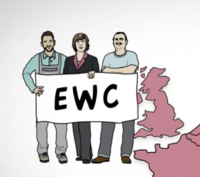
The Draft Report on Revision of the European Works Council
Directive presented on 12 May by
MEP Dennis Radtke (EPP), contains a number of proposed amendments to the
directive, which should allow EWCs to function properly, i.e. without being
obstructed by management as they attempt to exercise their basic right be
informed and consulted (see European Works Councils).
As Dennis Radtke pointed out, the aim here is not to create any new rights (see
IR Notes 183), but
rather to enforce compliance with the current directive. MEPs have until 21 June
to make amendments to this text, which achieves its stated aim in every way, and
proposes to: 1/ Strengthen sanctions: at the
present time, failure to honour the rights of European Works Councils is
punishable by financial penalties ranging “from 23 euros to 187,515 euros”.
Consequently, they are not effective, dissuasive and proportionate, in terms of
their effect on the multinational companies concerned. The report suggests
taking action on two fronts: a) based on the example of recent European
legislation, increasing the level of financial penalties, in this instance up to
10 million euros or 2% of the undertaking’s total annual worldwide turnover
(double that figure for a repeat offence); b) sanctioning undertakings by
excluding them from public procurement contracts and from European aid and
subsidies for a three-year period. Before the stage of imposing sanctions is
reached, Dennis Radtke is calling for decisions made by central management to be
suspended, on a temporary basis, when they are disputed on the grounds of a
breach of workers’ rights to be informed and consulted. 2/ Facilitate
access to justice: to
ensure that sanctions are effective, EWCs need to be able to take legal action
against their employer. The fact is that EWCs “do not have direct access to
justice in many Member States”, as in Ireland, whose legislation is so appealing
that multinational companies are transferring their European headquarters there.
In the rapporteur’s view, each State should draw up procedures allowing EWC
rights to be exercised “in a timely and effective manner”, and the central
management should bear any direct costs incurred in carrying out the procedures,
including the costs of legal representation and subsistence and travel expenses
for at least one workers’ representative. 3/ Restate
that information and consultation rights are to be exercised in advance
of any action taken: the latest ETUI survey,
published in 2019, revealed that just 20% of EWCs are informed and consulted
before management reaches its decision, whereas the directive requires advance
consultation to be the norm. The definition of consultation should point out
that the EWC must “express a prior opinion on the basis of the
information provided” by the employer, and no longer merely an
“opinion”, which is the wording under the current directive.
4/ Purge the
directive of any provisions that limit its
effectiveness. The report tackles several
provisions currently used by managements to restrict EWCs’ rights. For example,
the text proposes that the previous so-called “Article 13” agreements could
remain in force only if “the obligations arising from
this Directive have already been fully complied with”.
The confidentiality obligation that imposes a duty of silence on some councils,
would not apply to EWC members who pass on to national or local works councils,
information that may affect the employees’ situation. The definition of
transnationality incorporates recital 16 of Directive 2009/38 into the body of
the directive and relates to matters that “directly or indirectly” concern the
group as a whole or at least two entities in two different Member States.
|
1. European
Union
Legislation

Covid-19 to be recognised as an occupational
disease : On 18 May, Member States and social partners
sitting on the EU Advisory Committee on Safety and Health at Work (ACSH) reached an
agreement
on the need to recognise Covid-19 as an occupational disease in the health and
social care and the domiciliary assistance sectors, and – in a pandemic context – in
sectors where there is an outbreak in activities with proven risk of infection (see
press
release). EU Commissioner for Jobs and Social Rights, Nicolas Schmit, said:
“Based on this agreement, the Commission will update its Recommendation
of 19 September 2003 on occupational diseases to promote the recognition of
Covid-19 as an occupational disease by all Member States.” Such recognition will
allow employees in the sectors concerned, who have contracted this disease at their
workplace – and especially long Covid – to acquire specific rights based on national
rules, such as an entitlement to compensation on more favourable terms than those
applicable to diseases unrelated to work. Even if many countries have already taken
this step, this recommendation should lead to better harmonisation. The European
trade-union federation EPSU has welcomed this decision, for which its member unions
have been campaigning (see press
release).
|
Proposal

Protecting platform workers : On
19 May, MEP Elisabetta Gualmini (S&D) presented her report
on the proposal for a directive on improving working conditions in platform
work to members of the European Parliament’s Committee on Employment and
Social Affairs (see press
release). This report introduces significant changes to the proposal put
forward by the European Commission. The main proposed changes are: 1/ the provisions
relating to algorithmic management should apply not just to platform workers, but to
all workers who are subject to automated and semi-automated surveillance and
decision-making systems controlling their working conditions or the organisation of
their work. This would substantially increase the directive’s scope of application.
2/ The Commission’s proposal stipulates that if a worker’s working conditions meet
at least two of the five criteria whereby the employment relationship can be
classified as salaried employment, the worker shall be deemed to be a salaried
worker. The MEP opts for a presumption of salaried status for all workers, who would
be regarded as salaried workers, unless the platforms can demonstrate that they are
genuinely self-employed. This position is defended by Ludovic Voet, Confederal
Secretary (see ETUC press
release). He believes that responsibility for ensuring compliance with this
presumption of salaried status should not lie either with workers, via legal action,
or with the authorities.
|
Social
update
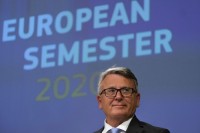
European Semester : On 23 May, the European Commission adopted a series of documents
giving Member States guidance on their economic, social and environmental
policies (see European Semester). As forecast, due to the war in
Ukraine among other things, the Commission is maintaining the escape clause of
the Stability Pact in 2023, so that States can free themselves from the EU’s
budget rules in order to support their healthcare systems and economy (see
press release). The various
documents published include a communication setting out the key economic policy orientations to be followed,
country-specific recommendations
for Member States and a proposal for a Council decision on guidelines for the
employment policies of the Member States (see press
release). According to the Commission, these guidelines
were updated this year “with a strong focus on the post-Covid 19 environment, on
making the green and digital transitions socially fair, as well as on reflecting
recent policy initiatives, including in response to Russia’s invasion of
Ukraine, such as measures to enable access to the labour market for people
fleeing the war in Ukraine”.
|
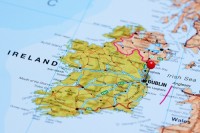
Ireland served with formal notice regarding EWC
legislation : On 19 May, the European Commission served an
infringement notice on the Irish government, to highlight defects in the way it has
transposed Directive 2009/38 on EWCs into domestic law. The Commission has
identified “a number of shortcomings in Irish legislation, which fails to guarantee
the right of workers’ representatives, the Special Negotiating Body or the European
Works Council to go to a national court over disputes related to breaches of the
rights and obligations under this Directive. This concerns for instance disputes
related to the right to request assistance and presence of an expert in negotiation
meetings or disputes related to confidentiality obligations” (see press
release, point 10). This initiative follows the complaint filed by
representatives of the Irish trade union SIPTU, according to its EWC expert, Denis
Sheridan (see SIPTU press
release). After witnessing an influx of multinational companies that decided
to move their European headquarters to Ireland in the wake of Brexit, because they
were attracted here by shortcomings in Irish legislation, which make it difficult
for EWCs to take any legal action, SIPTU alerted the government to the need to
review the country’s legislation. However, no action was taken, hence the complaint
submitted to the Commission. The Irish government now has two months to respond to
the Commission. If it fails to do so, or if its response is unconvincing, the
Commission will be able to issue a reasoned opinion, which is the final stage before
the case is referred to the Court of Justice for a ruling.
- Support for Greek employees in the
household electrical appliances industry: On 29 May, the
European Commission announced a proposal to release aid from the European
Globalisation Adjustment Fund (EGF), to support 206 workers dismissed by
companies in the household electrical appliances sector in Greece. (see press
release).
|
Case law

The law applicable to aircrew :
On 19 May, the Court of Justice delivered a ruling on the social
security legislation applicable to aircrew employed by an airline (CJEU,
19 May 2022, Case C-33/21, INAIL and INPS), which also gave it the
opportunity, for the first time, to set out the new applicability criterion
introduced in 2012 by Regulation 883/2004, namely the “home base” used to determine
the social security legislation applicable to aircrew. The case concerns 219 Ryanair
employees based at the Italian airport of Bergamo. The Italian social security
authorities took the view that these employees, who were recruited on an Irish
contract of employment and were subject to Irish social security legislation, should
pay their social security contributions in Italy. Ryanair “belatedly” submitted E101
certificates to the Italian court to prove that these employees were posted workers
and were covered by the Irish social security scheme. When an appeal was lodged, the
judges examined these E101 certificates closely: without referring to fraudulent
certificates, they note “that they were not numbered or arranged in an intelligible
or orderly manner, that there were 321 certificates, thus some were probably
duplicates, and that they did not cover all of the 219 Ryanair employees assigned
to” Bergamo airport. The judges decided that all employees who were not covered by a
valid E101 certificate were governed by Italian legislation. The Court of Justice
upheld this decision: this legislation is applicable to the employees in question,
even if they only work for 45 minutes per day in Ryanair premises intended to be
used by staff, known as the ‘crew room’, and who, “for the remaining working time
[are] are on board that airline’s aircraft”. Within the meaning of Regulation
1408/71, which is applicable to part of the period concerned, this ‘crew room’
constitutes “a branch or permanent representation” and the crew have a “significant
connection” “with the place from which” they “principally discharge their
obligations to their employer”. The Court reaches the same finding in respect of
periods that come under the new Regulation 883/2004, and also when it applies the
home base criterion, introduced in 2012: the activity of aircrew shall be “deemed to
be an activity pursued in the Member State where the home base […] is located”, i.e.
the location nominated by the operator where the crew normally starts and ends its
duty period (see press
release).
|
Trade
unionism
- Menstruation is a trade union issue :
On 27 May, the international trade-union federation IUF
published a statement
inviting its affiliates to take concrete initiatives in the workplace, in order
to address the problems faced by women during menstruation. This statement
provides full details of the federation’s follow-up to the resolution adopted on
this subject at its Congress in 2017.
|
2. Member
States
Germany

An obligation to be vaccinated :
Since 15 March this year, Article 20a of the law on protection
against infections (IfSG) has imposed an obligation to be vaccinated on employees of
healthcare establishments and of residential and care homes for the elderly, persons
with disabilities or dependent persons, i.e. places where employees may come into
contact with vulnerable people during the course of their duties. The employees
concerned have to provide their management either with proof of vaccination or
recovery, or with a medical certificate evidencing a permanent medical
contra-indication to vaccination. The Federal Constitutional Court has rejected
several constitutional appeals against this obligation (see press
release). Protecting so-called ‘vulnerable groups’ is deemed to be a more
important consideration than breaching the fundamental rights of healthcare
personnel and care staff. The obligation to be vaccinated is therefore deemed to be
a constitutional requirement.
|
Belgium
- A national LGBTQI+ plan :
The government has unveiled a
plan for a LGBTQI+ friendly
Belgium containing 133 separate
measures, some of which concern the field of employment. These measures
primarily involve communication and awareness-raising. In terms of
legislative changes, the plan proposes to include sex changes in the
provisions of the well-being law offering protection against reprisals (in
addition to the existing characteristics of gender identity and gender
expression) (see press release).
|
Spain

A trade-union study of the circular economy :
On 17 May, the Spanish trade-union
confederation UGT published a study devoted to the
circular economy, which advocates a just transition and recourse to collective
bargaining. The union recommends expanding the scope of collective bargaining to
include ecological transition-related matters, so that the impact of this
transition on employment and the quality of employment can be discussed.
Collective bargaining should address employees’ training requirements and
occupational health and safety issues, by anticipating future needs (see
press release). The
UGT also suggests introducing clauses into collective labour agreements that
will oblige companies to initiate actions that will be favourable to the
environment and to the circular economy, while guaranteeing that employees and
their representatives will be involved (see Circular economy). The UGT
is also calling for a requirement for businesses to appoint an environmental
delegate, who would be granted a time-credit to be specifically spent on solving
the company’s environmental problems in general, and to developing low-carbon
emissions and the circular economy in particular. A further suggestion is the
creation of bodies specifically devoted to environmental issues. This would
involve either setting up an Environmental Committee, made up of environmental
delegates plus an equal number of company representatives, or extending the
Occupational Health and Safety Committee’s remit to encompass environmental
matters.
|
France

Gender balance within management bodies :
The provisions aimed at achieving a balanced gender
representation among senior company executives, introduced by the law
of 24 December 2021 to speed up economic and professional equality (the
so-called ‘Rixain law’) entered into force on 1 March and are set out in a circular
issued by the Ministry of Employment. Now that this law has been passed, companies
with at least 1,000 employees are required to publish an annual statement showing
any differences in gender representation, both among senior executives and company
directors. They are also required to publish these differences on the Ministry of
Employment’s website. Moreover, from 1 March 2026 onwards, the proportion of men or
women making up each of these groups must not fall below the threshold of 30%.
|
Italy
- Integrating migrants into the construction
industry : The government and social partners in the
construction sector have concluded a partnership to promote the integration of
at least 3,000 people into working life, including: seekers and holders of
international or temporary protection, including Ukrainians; holders of special
protection; unaccompanied foreign minors transitioning to adult age; and former
unaccompanied foreign minors (see press
release).
|
Irlande

An initial evaluation of teleworking: :
The government has published an Evaluation
of the Impacts of Remote Working on the economy and society, part of which
is devoted to employment. For employees, the resulting increases in heating and
electricity costs for households, estimated at 79 euros and 30 euros per year
respectively, would appear to be offset by the savings from reduced commuting, which
are estimated at 413 euros per remote worker. Remote workers can also save an
average of 93 hours per year through reduced commuting which, according to the
report, represents an equivalent monetary benefit of 1103 euros. The reduction in
travel has the potential to “save 164,407 tonnes of CO2 a year, with an equivalent
monetary saving of €7.6m” (provided that remote workers do not take more frequent,
shorter trips from home during the day). The report, which emphasises that
teleworking facilitates participation in the labour market for persons with
disabilities or family responsibilities, suggests introducing targeted support with
‘start-up’ costs for people with disabilities or low incomes, including helping them
with equipment purchases, and emphasises that promoting teleworking does not exempt
companies from the requirement to continue adapting the workstations on their
premises. Also worthy of note is a growth in demand for housing in rural areas in
2021, which should also prompt the government to boost access to high-speed
broadband nationwide.
- Equal pay: The Gender Pay
Gap Information Act 2021 requires companies to issue an annual report on their
hourly gender pay gap, based on a set of parameters. A guide
announced on International Women’s Day (8 March) (see press
release), and published on 10 May, explains how to calculate the figures
required for the report, so that the law can be implemented for companies with
more than 250 employees in 2022. Thereafter, it will apply to companies with
more than 150 employees (2024), followed by those with more than 50 employees
(2025). Companies in the first wave will have until December to submit their
report.
|
Luxembourg
- Family leave : The
government Council of the 18 May passed two draft laws, one of which introduces
an entitlement to extraordinary leave where a child is born to anyone recognised
by the national legislation applicable, as an equivalent second parent. The
other law transposes Directive 2019/1158 of 20 June 2019 on work-life balance
for parents and carers, by laying down minimum requirements applicable to
paternity leave, parental leave and carer’s leave, and flexible work patterns
for workers who are parents or carers (see press
release).
|
3.
Companies
European
Works Council
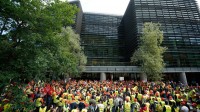
Restructuring : On 18 May, a major restructuring was announced by Vallourec management to the
group’s European Works Council. This will result in 2,950 job losses, primarily
in Germany (2,500 jobs), where two production sites will close by the end of
2023 (with production being transferred to Brazil), and France (320 jobs).
Following this announcement, at the initiative of trade union IG Metall, almost
1,000 German employees descended on the group’s head office near Paris. IG
Metall, which described the group’s attempts to find a buyer for its German
sites as “a farce”, is planning a trial of strength on a scale large enough to
negotiate favourable redundancy terms for these German employees (see press
release).
|
4. Studies
and reports

On 5 May, the ILO presented a major study on the role
played by collective bargaining (Social
Dialogue Report 2022: Collective bargaining for an inclusive, sustainable and
resilient recovery). The study, which is based on an examination of
collective agreements and practices in 80 countries at different levels of economic
development and the legal and regulatory frameworks in 125 countries, emphasises
that collective bargaining can effectively reduce wage inequality, whether in an
enterprise, sector or industry (see press
release and executive
summary). Collective bargaining also has a positive effect on the gender pay
gap. The study also highlights the added value of collective bargaining agreements
concluded for the purpose of tackling the Covid-19 pandemic and putting in place
decent hybrid and teleworking practices. Based on the lessons it has learned, the
ILO emphasises that collective bargaining will be “an essential tool to face the
fundamental changes that are shaking up the world of work”. This plea for the
development of collective bargaining, which also echoes a preoccupation of the
European Commission, endows the right to collective bargaining (which can have
positive effects worldwide) with a universal reach, and includes scarce comparative
data. In order to strengthen collective bargaining, the ILO is calling among other
things for employers’ and workers’ organisations to be revitalised, for the right of
all workers – regardless of their status – to engage in collective bargaining, to be
properly recognised, and for social dialogue to be strengthened, so that sustainable
development targets can be achieved. The lessons learned in the study will be
presented on 14 June (see agenda).
|
|
|











