 |
| |
IR Notes 188 – 15 June 2022
www.irshare.eu
|
|
|
| |
| |
A question for…
Susan Hayer, Lead researcher on industrial relations at the ILO

The EU wants to strengthen
collective bargaining by setting an ambitious target of 80%
collective bargaining coverage (see Lead Story). Several
organisations such the OECD and the ILO have highlighted the
advantages of collective bargaining in the area of setting
wages. Why does it need to be
promoted?
It
is encouraging to see these developments. As the recent ILO
Social Dialogue Report 2022 (*)
shows, collective bargaining can contribute to the inclusive and
effective governance of work – and that includes wage policies. The
report presents evidence of how agreements raise wage floors,
include workers on temporary contracts in their scope ensuring
parity in pay, close the gender pay gap and reduce wage inequality.
These effects were particularly significant during the Covid-19
crisis, where collective agreements frequently addressed the
disproportionate effects of the crisis on low-wage workers, women
and workers in temporary or marginal part-time
work.
Collective
bargaining allows the parties themselves to tailor wage policies to
a particular industry or enterprise. It is responsive, providing
mechanisms that enable parties to come back to the bargaining table
should circumstances change. In countries with sectoral bargaining
institutions, to prevent the erosion of wage floors set by
collective agreements, public authorities may decide to extend an
agreement to all employers within a sector, provided that the
agreement has been reached by sufficiently representative parties
and that non-parties have had an opportunity to submit their
observations – in accordance with ILO
recommendation no. 91, 1951.
If
collective bargaining is to play this
role, it requires firm foundations: strong and representative social
partners on the one hand, and the effective recognition of the right
to collective bargaining for all workers on the other. Building on
these foundations, policy makers have an important role to play in
ensuring that relevant information is available to the bargaining
parties and supporting their good-faith voluntary negotiations
through facilitation and mediation services.
(*) ILO
Social Dialogue Report 2022: Collective bargaining for an inclusive,
sustainable and resilient recovery.
|
|
|

|
|
|
|
|
| |
Who we are?
IR Notes
is a fortnightly newsletter produced
by IR Share and
its network of experts, and is available in several European languages
(English, French, German, Italian, Spanish). It offers Europe-wide
monitoring of employment law, labour relations and employment policy. It
is available by subscription for 18 euros per month .
The team This issue
was producaed by Pascale
Turlan and
Frédéric
Turlan.
Subscribe to IR Notes
Via the
IR
Share website or by calling us on:
+33 (0)6 81 41 53 95
or
E-mail: frederic.t@irshare.eu
Legal notice.
Publisher: IR Share SARL – 5, Les Compères – 89520 Fontenoy, France –
Tel.: +33 (0)6 81 41 53 95 – share capital 1,500 euros – commercial
register (RCS Auxerre): 512 567 959. Managing editor: Frédéric Turlan.
Hosting: Ideal prod – 14 rue Auguste Morel – 89100 Sens – France –
Tel.: + 33 (0)3 86 83 21 21. CPPAP no.: 0626 Z 93933.
|
|
|
|
|
| |
European Industrial Relations Dictionary
In case reading IR Notes inspires you to explore this subject further, we
are providing links to
the European
Industrial Relations Dictionary published by Eurofound. This is
updated at regular intervals by IR Share, which publishes IR Notes. The
term definitions are available in English and can easily be converted
into other languages using on-line translation tools.
|
|
|
|
|

|
|
|
Lead
story
What is the
purpose of the proposed directive on adequate minimum wages?

During the night 6-7 June, the Council and Parliament reached a compromise on the
proposed directive on “adequate minimum wages in the European Union”. The aim of
this directive is to guarantee a decent income for workers on a minimum wage. The
compromise remains in line with the proposal for a directive presented by the
European Commission in October 2020 (see IR Notes 151).
According to its many supporters, this text is an important milestone in the
construction of a social Europe. However, workers receive no effective right that
they can enforce to obtain a higher minimum wage. The directive does not require a
minimum wage set by law: the five Member States which currently leave the question
of minimum wages to social partners – namely Austria, Denmark, Finland, Italy and
Sweden – will be able to continue to do so. The directive obviously does not require
a minimum amount right across the EU or even a binding threshold that must be met,
for example 60% of the median wage, which would have guaranteed that all full-time
workers could reach at least the poverty threshold through the fruits of their
labours. So why all the fuss? As is often the case, a Social Europe is moving
forward through the creation of processes.
- The first process involves determining the minimum wage. According to the
proposed directive, Member States with statutory minimum wages will have to put
in place a framework for setting and updating minimum wages and will have to
provide data for comparison across Europe (see Council press
release). Although it has no bearing on the way the minimum wage is set,
the directive still requires guarantees. Progressively, Member States will have
to show that the way they set the minimum wage is designed to provide a decent
wage. So we will have to wait until the medium term to see an impact on the
level of the minimum wage, which will then enable workers throughout the Union
to earn decent pay.
- The second process, which will have the greatest impact, involves collective
bargaining (see Collective bargaining).
The Commission notes that “countries with a high collective bargaining coverage
tend to have a low share of low-wage workers, less pay inequality and higher
wages” (see press
release). The text is based on the premise of strengthening collective
bargaining with “the unions” to raise the level of minimum wages in Europe and,
more generally, of all wages, which is currently a topical issue given the high
level of inflation. The directive also requires Member States where fewer than
80% of workers are covered by a collective agreement (instead of the target of
70% originally stipulated by the Commission) to establish an “action plan” to
promote collective bargaining. This provision affects 20 Member States, as only
7 (Austria, Belgium, Denmark, Finland, France, Italy and Sweden) have a higher
rate. Considerable effort will be required: firstly, a dozen countries have not
yet reached half of the target figure (40%), and then the threshold can only be
reached if there is “multi-employer” collective bargaining which covers the
employees and employers in a sector. This level of dialogue does not exist in
seven countries (Estonia, Greece, Hungary, Latvia, Lithuania, Poland and the
Czech Republic). So the implementation and monitoring of these national “action
plans” should, in the medium term, fundamentally alter industrial relations
models. It is largely this effect of the directive that explains the tension on
the part of certain trade unions and Ceemet, the European employers’
organisation which represents the interests of the metal, engineering &
technology-based industries (see Social update), which is fully intent on
fighting to the bitter end against this 80% target.
|
1. European
Union
Proposal

Women on boards : On 7 June, the
European Council and Parliament reached an agreement to adopt the proposal
for a Directive on improving the gender balance among non-executive directors of
companies listed on stock exchanges and related measures (see Women
in the labour market) (see Council press
release and European Parliament press
release). This text aims to set a quantitative target for the proportion of
members of the under-represented sex on the boards of listed companies. The
companies concerned should aim to have at least 40% of their non-executive director
positions held by members of the under‑represented sex by 2026 (instead of 2027 in
the Council’s position, see IR Notes 182). If
Member States choose to apply the new rules to both executive and non-executive
directors, the target would be 33% of all director positions by 2026. If these
targets are not met, a company would have to apply clear, unambiguous and neutrally
formulated criteria when appointing or electing directors. The text grants
flexibility to countries which, before the directive comes into force, have either
achieved progress enabling them to move towards the objectives or have put in place
equally effective legislation. These countries can suspend the directive’s
requirements for the appointment or selection process. The text now has to be
formally adopted by the European Council and Parliament, prior to publication in the
OJEU.
|
Social
update
Directive on minimum wages (reactions) :
“While the EP rapporteurs claim that workers
are the big winners” following the adoption of the directive on adequate minimum
wages, Ceemet considers that “social partners and collective bargaining are
significantly losing”. For this European employers’ organisation which
represents the interests of the metal, engineering & technology-based
industries, the objective of 80% collective bargaining coverage “obliges Member
States to propose concrete measures if the coverage is below this threshold” and
“this will likely result in the end of well-functioning collective bargaining
systems”. In fact, in several Member States, the “only way to reach this
target”, adds Ceemet, “may be by making collective agreements universally
applicable”. This “will weaken social partners as it implies that the rules
apply to all, even to those that are not members of an employers’ organisation
or a trade union”. For Ceemet, “this interference goes against social partner
autonomy and will weaken what the Directive sets out to strengthen” (see
press release).
Business Europe has already expressed its opposition to the text (see
press release). The
unions had long been calling for the directive. Even though support for it is
not unanimous due to opposition from some Nordic trade unions, it is welcomed by
the European Trade Union Confederation (ETUC): “If adopted and properly
implemented, this directive will not only make statutory minimum wages fairer in
those countries which use them, but will also protect and promote collective
bargaining as the best solution for fair pay across Europe” (see press release).
|

Ban on products made by forced labour :
on 9 June, MEPs voted by an
overwhelming majority (503 for, 6 against, 4 abstentions) to adopt a resolution
calling on the European Commission to draft a new instrument to ban the import and
export of products made or transported by forced labour. More specifically, it would
involve banning “products from a particular site of production, a particular
importer or company, those from a particular region in the case of state-sponsored
forced labour and those from a particular transport vessel or fleet”. This new
instrument should also require “responsible companies to provide remediation to the
affected workers prior to import restrictions being lifted”. This text would
supplement the proposal for a directive on corporate sustainability due diligence
that seeks to foster sustainable and responsible corporate behaviour along global
value chains. “The Commission will have to define its methods by September” stated
MEP Raphaël Glucksmann, who also expressed his satisfaction at the vote held on the
same day for a resolution condemning the deportation of Uighurs as a crime against
humanity and a “serious risk of genocide” and calling for sanctions against the
Chinese officials responsible.
|
Trade
unionism
- First recommendations
on AI: on 25 May, the
IndustriAll Europe union federation, in its executive committee, adopted
recommendations for action on artificial
intelligence (AI) to
ensure that AI contributes to
quality employment and does not become a dystopian technology (see Artificial
intelligence). The recommendations include principles for a “responsible and human-centric introduction” of
AI in the workplace. The federation recommends that trade unions and worker representatives be
“provided with the means to be assisted by software engineers or data
scientists to support them in these discussions”. It adds that ad hoc
working groups (including European Works Councils) “could be set up to build
up a specific trade union analysis of the impact of the introduction of
cutting-edge technology (i.e. in the fields of human-machine interaction,
human-computer interaction and AI) on work and employment.
|
Sectoral
social dialogue
- Hospitals and health care :
on 31 May, the European social partners in the hospitals and
health care sector (Hospeem and EPSU) renewed their framework
of action on recruitment and retention which was adopted in 2010. This
new framework, which is designed to respond to a severe shortage of workers in
these sectors, includes aspects related to Covid-19; work-life balance; gender
equality and digitisation; psychosocial risks and stress; carcinogens, mutagens
and reprotoxic substances (hazardous drugs); musculoskeletal disorders; and
third party violence. (see press
release).
|
2. Member
States
Germany

Family leave : on 8 June, the
Federal cabinet adopted a bill which transposes directive 2019/1158 on work-life
balance for parents and carers into national law. The government believes that
domestic law is already in large part compliant with the directive. Its bill extends
the provisions which already apply to large companies to all companies, regardless
of size. For example, all employers will now need to justify refusal of a flexible
working request during the period of parental leave. Similarly, they will need to
respond to family leave requests within four weeks from the date when the request
was received and, if the request is refused, provide justification for their
decision. The beneficiaries of this leave will be protected against dismissal during
the leave period. Furthermore, the remit of the Federal Anti-Discrimination Agency
is extended with regard to questions relating to discrimination in the area of
work-life balance. For example, employees will be able to contact the agency if they
believe they have been disadvantaged due to taking family leave. Finally, ministers
confirmed the adoption of a draft law by the end of 2022 to introduce two weeks’
leave for the secondary parent after the birth of a child (see press
release).
|
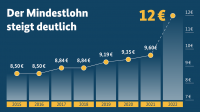
Minimum wage of 12 euros : as
provided for in the coalition government’s programme, the statutory minimum wage
will rise from 9.82 euros to 12 euros per hour from 1 October, following the vote in
favour in the German Bundesrat. It is already set to go up to 10.45 euros at the
beginning of July. The measure will apply to 6.2 million workers. The next
adjustment is due on 1 January 2024 (see press
release). Alongside this, the income limit which enables employers to use
“mini-jobs” will rise from 450 to 520 euros per month on 1 October. The Ver.di trade
union is unhappy about this measure which will “partly counteract the positive
effects of the minimum wage increase in terms of the risk of poverty in old age and
will primarily affect women, who more often have to work in mini-jobs” (see press
release). “For those who have spent almost all their working lives in
mini-jobs, this is a direct path to poverty in old age – and it’s mainly women who
are affected”, laments DGB executive board member Anja Piel (see press
release).
|
Spain

A guide on how to manage AI at work :
on 10 June, the Minister of
Labour, Yolanda Diaz, presented a guide on algorithmic information in the
workplace, which brings together in
a single document all rights and obligations pertaining to algorithmic
information in the workplace. It describes companies’ obligations in terms of
the information they must provide to workforce representatives and employees
(see press release). The
guide makes particular reference to the GDPR regulation and the recent Royal
decree-law 9/ 2021 (“Riders” law) which seeks to guarantee employment rights for
people working on digital platforms. This text enshrines the right of workers in
all companies “to be informed by their employers about the parameters, rules and
instructions which underpin any algorithms or artificial intelligence systems
used to reach decisions which may affect working conditions, access to and
retention of employment, including profiling”. The guide, hailed as a
world-first by the Minister of Labour, calls for the introduction into
legislation of a company’s obligation not only to provide information but also
to hold negotiations with employee representatives on the variables, parameters
and other characteristics of the algorithm or automated decision system.
|
Ireland

Investment in remote working hubs :
on 8 June, the government announced new initiatives to make
“remote working more accessible and attractive for thousands of people”. Recognising
the development of remote working as a powerful land-use planning tool, the
government is proposing a voucher scheme (Connected
Hubs Voucher Scheme) which will
give remote workers free use of one of 242 local digital hubs. As part of the Town
and Village Renewal Scheme, each Local Authority will receive €50,000 in funding to
enable them to promote the remote working opportunities available in their areas.
(see press
release).
|
3.
Companies
European
Works Councils

Creation of a Works Council :
The management of the Austrian company Palfinger (11,700 employees), the
world’s leading producer and supplier of innovative solutions in the field of cranes
and lifting systems, has reached an agreement with a special negotiating body (22
members representing 16 countries) to set up a European Works Council. The first
constitutive meeting will be held this summer. “Our goal is to inform all employees
in Europe even better than before about important developments and to represent
their shared interests efficiently,” explains Johannes Kücher, Chair of the
Palfinger AG Works Council. For the CEO, Andreas Klauser, “It was important to us
that all the countries in which Palfinger is represented in Europe receive one vote”
(see press
release).
|
- Purchasing power : Matters
relating to wages and purchasing power are rarely addressed in European Works
Councils. However, amid fast-rising inflation, this topic now features on
meeting agendas. So, on 22 June, Thierry Defresne (CGT), EWC secretary of the
French energy group TotalEnergies, will be
questioning management on the subject during the plenary meeting of the European
Works Council. The aim is to present a road map with three objectives, two of
which relate to the living conditions of Total employees: 1/ Obtain detailed
information from management on wages in countries and express them in terms of
purchasing power parity so as to facilitate comparison and provide information
for trade-union negotiators at local level; 2/ Create a European social
framework to extend certain rights which exist in France to all European
employees, starting with the issue of social protection (collective insurance
against major risks, coverage of healthcare costs, etc.).
|
|
|











