 |
| |
IR Notes 189 – 28 June 2022
www.irshare.eu
|
|
|
| |
| |
A question for…
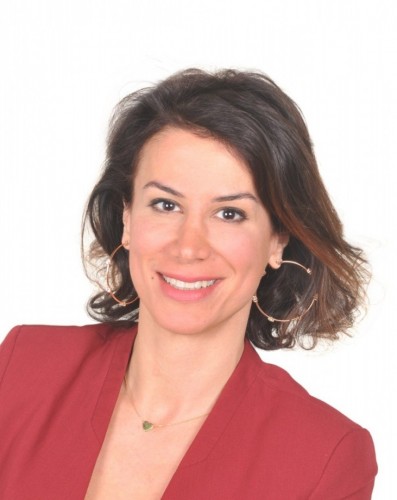
Manal Azzi, Team Lead on Occupational Safety and Health (OSH) at the
International Labour Organization (ILO)
In concrete terms, what’s the
significance of incorporating the right to a safe and healthy
working environment into the ILO’s fundamental rights (see Lead
story)?
This
decision clearly marks the beginning of a new era for occupational
health and safety. In 1998, to accompany the process of
globalisation, the ILO published a Declaration of the Fundamental
Principles and Rights at Work, which laid down four obligations
arising from ILO membership, namely: freedom of association and the
effective recognition of the right to collective bargaining; the
elimination of all forms of forced or compulsory labour; the
effective abolition of child labour; and the elimination of
discrimination in respect of employment and occupation. The ILO’s
187 member states are required to promote, respect and implement
these principles and rights, even if they haven’t ratified the ILO
conventions guaranteeing them. Given that you have to be in good
health to enjoy these four rights, in 2019, at the International
Labour Conference marking the ILO’s one hundredth anniversary, the
ILO Governing Body decided to commence discussions with a view to
adding a fifth principle governing labour law, and the ILO Centenary
Declaration for the Future of Work called for this fifth principle
to be safety and health at work. And so, after three years of
discussions with governments, employers’ representatives and
workers’ representatives from the ILO’s 187 member states, we
reached this decision to include the right to a safe and healthy
working environment in the ILO’s Fundamental Principles and Rights
at Work. This right has a broad scope of application: it seeks not
only to count the number of accidents at work and work-related
illnesses, but also to create a genuine prevention culture, not only
as regards physical integrity but also in terms of mental health and
combating bullying. This decision means that ILO conventions 155 and
187 have already been elevated to the rank of fundamental
Conventions.
As a result, governments will have to apply both
of these conventions, whether or not the governments concerned have
ratified them. Their content is binding on all countries, which will
be answerable for the progress made with their application.
Moreover, future international business agreements will have to
incorporate compliance with these five principles and fundamental
rights. In addition, the fundamental nature of these two ILO
conventions will have a ripple effect on the ILO’s other
occupational health and safety standards relating to specific
sectors and risks (there are nearly 40 of these standards). This is
because when countries come to “transpose” the two conventions, they
will have to take the content of these other standards into account.
Multinational companies will be affected too, in a number of
ways: they will be required to identify health and safety risks
linked to their due diligence obligations; tougher occupational
health and safety management systems will have to take account of
this development; and no country in which these companies operate
can escape the duty to bring its legislation into compliance with
these two ILO conventions which, I should emphasise, contain genuine
rights that can be mobilised by workers, such as that of stopping
work in the event of danger.
|
|
|

|
| |
Diary
11 July
On line
An
international webinar organised by the ILO, running from 14.30 to 16.00
and entitled “A safe and healthy working environment as a FPRW”, to take
stock of the decision to make the right to a safe and healthy working
environment one of the ILO’s Fundamental Principles and Rights at Work.
The presentation will be made in English via Zoom, with simultaneous
interpreting into French and Spanish. Registration on
line by 7 July 2022.
8 to 10
September
Barcelona
13th
ILERA European Congress, on the theme of “Industrial relations and the
Green transition”.
|
|
|
|
|
| |
Who we are?
IR Notes
is a fortnightly newsletter produced
by IR Share and
its network of experts, and is available in several European languages
(English, French, German, Italian, Spanish). It offers Europe-wide
monitoring of employment law, labour relations and employment policy. It
is available by subscription for 18 euros per month .
The team This issue
was producaed by Pascale
Turlan and
Frédéric
Turlan.
Subscribe to IR Notes
Via the
IR
Share website or by calling us on:
+33 (0)6 81 41 53 95
or
E-mail: frederic.t@irshare.eu
Legal notice.
Publisher: IR Share SARL – 5, Les Compères – 89520 Fontenoy, France –
Tel.: +33 (0)6 81 41 53 95 – share capital 1,500 euros – commercial
register (RCS Auxerre): 512 567 959. Managing editor: Frédéric Turlan.
Hosting: Ideal prod – 14 rue Auguste Morel – 89100 Sens – France –
Tel.: + 33 (0)3 86 83 21 21. CPPAP no.: 0626 Z 93933.
|
|
|
|
|
| |
European Industrial Relations Dictionary
In case reading IR Notes inspires you to explore this subject further, we
are providing links to
the European
Industrial Relations Dictionary published by Eurofound. This is
updated at regular intervals by IR Share, which publishes IR Notes. The
term definitions are available in English and can easily be converted
into other languages using on-line translation tools.
|
|
|
|
|

|
|
|
Lead
story
The right to
a safe and healthy working environment becomes a fundamental right
Elevating the right to a safe and healthy working environment to the rank of a
Fundamental Principle and Right at Work was the main outcome of the 110th
session of the International Labour Conference, held from 27 May to 11 June, in
Geneva. This conference, which is attended by trade unions, employers’
representatives and governments of the ILO’s 187 Member States, is the UN’s
parliament for workplace issues (see Health and Safety). The
principle of a safe and healthy working environment now forms part of the ILO’s
Fundamental Principles and Rights at Work, which were adopted in 1998, within the
framework of an ILO Declaration. The new principle joins the four existing
principles, which are: 1/ freedom of association and the effective recognition of
the right to collective bargaining; 2/) the elimination of all forms of forced or
compulsory labour; 3/ the effective abolition of child labour and 4/ the elimination
of discrimination in respect of employment and occupation. Under the 1998
declaration, ILO Member States, regardless of their level of economic development,
commit to respect and promote these principles and rights, whether or not they have
ratified the Conventions establishing them. The new fundamental Conventions, which
even non-signatory States are required to comply with, are the Occupational
Safety and Health Convention, 1981 (No. 155) and the Promotional
Framework for Occupational Safety and Health Convention, 2006 (No. 187) (see
ILO press
release). This step forward has been welcomed by the International Trade
Union Confederation (ITUC), which plans to continue campaigning. It is calling for
all workers to be granted the following rights: 1/ consultation over risk
assessments; 2/ “eradication of toxic chemicals” and “toxic work organisation”,
including long hours; 3/ free protective equipment and training; and 4/ the “right
to refuse dangerous work”. Another objective is “to extend access to occupational
health services beyond the 20% of workers worldwide who currently have it, as well
as universal sick pay from day one”. Within companies, the ITUC is calling for more
powers for union workplace safety reps and for more joint safety committees (see press
release). What impact will this change have in Europe? The European Trade
Union Confederation (ETUC) emphasises that although this decision was widely
supported by EU Member States, the fact remains that “a dozen European countries
have themselves still not ratified ILO convention 155 on occupational health and
safety (…). And they include some of the countries with the highest workplace injury
rates in the world, according to the ILO. Their data puts France, Austria,
Switzerland and Germany among the 20 countries with the highest number of injuries”
(see press
release). ETUC Deputy General Secretary Claes-Mikael Stahl calls on the 12
European countries concerned to sign this convention, as “it would be the worst kind
of hypocrisy and European exceptionalism to vote to make workplace safety a right in
other parts of the world without applying the same standards in your own country”
(see press
release). It should be noted that the Spanish trade-union confederation UGT
is especially pleased with this decision, in the context of the rising number of
accidents at work and work-related illnesses, and also in light of the focus on
mental health and on combating violence and harassment in the workplace. (see press
release).
|
1. European
Union
Projects

Towards adoption of the Non-Financial Reporting
Directive : On 21 June, the Council and the European
Parliament reached a provisional political agreement concerning revision of the
Corporate Sustainability Reporting Directive (CSRD) (see IR Notes 182) (see
Due dilligence). This text,
which will apply to companies with 250 or more employees, now has to be formally
adopted by the Council and the Parliament before it is published in the OJEU. Member
States will then have 18 months to transpose it into their domestic law (see press
releases issued by the Council
and the Parliament,
and also the General
approach adopted by the Council, with the proposal for a directive
appended). The European Commission presented this directive
on 21 April 2021 (see IR
Notes 163). The directive will apply with effect from: 1 January 2024 to
companies that are already subject to the Non-Financial Reporting Directive; from 1
January 2025 to large undertakings (within the meaning of Article
3 of Directive
2013/34/EU (the “Accounting Directive”), which are not currently
subject to it, and from 1 January 2026 to any other companies, among others listed
SME. The sustainable development report will enable workforce representatives to
understand their company’s impact on the environment and on society, and its
sustainability strategy. It will have to include information on social issues such
as gender equality, equal pay for equal work or work of equal value, training,
skills development, working conditions, pay, social dialogue, collective bargaining
and worker participation, work-life balance, and a healthy, safe and well-adapted
working environment.
|
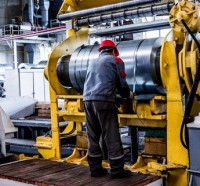
Towards adoption of a regulation for safer
machinery : On 24 June, the Council adopted a mandate for
negotiations with the European Parliament, with a view to adopting the proposal
for a regulation on machinery products (see Council press
release and the Commission’s executive
summary of the impact assessment report). This text amends the 2006 “Machinery
Directive” and transforms it into a regulation, i.e. an EU law that is
immediately effective and will not have to be transposed into Member States’
domestic legislation. Twin objectives are being pursued here: firstly, promoting the
free movement of machinery within the single market, and secondly, ensuring a high
level of protection for EU workers and citizens. The regulation keeps open the
option for manufacturers to self-assess their conformity and re-establishes the
intervention of conformity assessment bodies in respect of a list of products posing
risks, which was abolished by the 2006 directive. The European Trade Union
Confederation believes that scrapping the requirement for third-party safety checks
is behind the growing number of workers being injured by machinery. This figure rose
from 75,000 in 2014 to more than 80,000 in 2019 (see press
release and ETUC’s position
paper on the proposal for a regulation).
|
European
social dialogue
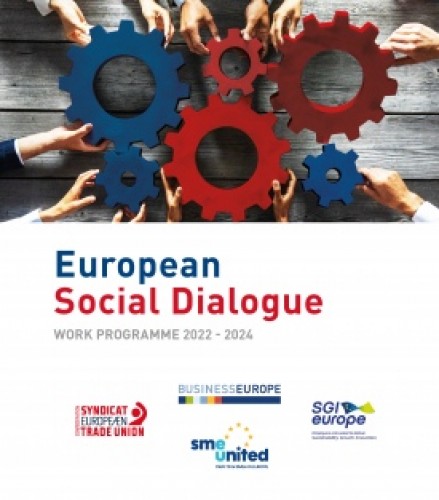
New work programme : On 28 June,
the European social partners (ETUC, BusinessEurope, SGI Europe and SMEunited)
adopted their new 2022-2024
work programme, which includes a commitment to negotiate a legally binding
agreement on “telework and right to disconnect” (see European social partners)..
The 2022-24 work programme is comprised of 6 joint actions: 1/ revising the 2002
autonomous agreement on telework, with a view to proposing it for adoption as a
legally binding agreement to be implemented via a directive, which would be a first
since 2010; 2/ adopting a “framework of actions for ensuring a just transition”; 3/
preparing a joint declaration on youth employment, with a view to exploring best
practices, challenges and tools to facilitate the employment of young people; 4/
organising a seminar that might result in the creation of guidelines covering
workplace control and surveillance technologies; 5/ organising a seminar, followed
by a joint research project, on effective access to training, involving the social
partners in skills intelligence, and dealing with skills mismatch and skills
shortages; 6/ launching a joint project to examine the effectiveness of
capacity-building actions and identifying obstacles to implementation of the social
partners’ autonomous framework agreements (s. common
press release).
|
Case law
Family benefits cannot vary according to
children’s country of residence : Austria will have to
review its family benefits legislation. In his opinion,
the Advocate General of the Court of Justice pointed out that EU law on the
coordination of social security systems “is based on the general idea that, if a
migrant worker pays social contributions and taxes in a Member State, he or she must
be able to benefit from the same allowances as nationals of that State”. In its
judgment, the Court of Justice takes the view that the “adjustment mechanism, which
is based on the criterion of the children’s residence abroad for determining the
amount of the family benefits and social and tax advantages, affects migrant workers
more” and “therefore constitutes indirect discrimination on grounds of nationality,
which is permissible only if it is objectively justified”. Which it is not. This
“difference in treatment (…) is neither appropriate nor necessary for the purposes
of ensuring the supportive function and the fairness of the social system”. (see CJEU,
16 June 2022, Case 328/20, Commission v. Austria and press
release). The self-employed workers’ trade union Vidaflex emphasises that
this decision, which it had fervently hoped for, primarily concerns workers who
spend 24hrs/day looking after one of the 35,000 people in Austria who require home
care. It calls on the government to review its legislation as soon as possible, and
to compensate the workers concerned (see article
on APA OTS). The Austrian trade union confederation ÖGB “has warned that
index-linking is illegal under EU law and condemned the dangers of making
unrealistic calculations”, which were intended to produce annual savings of 114
million euros from the State’s budget. A reply to a parliamentary question submitted
in May 2022 indicated that Susanne Raab (ÖVP), who is Austria’s Minister for the
Family, had already earmarked 220 million euros to cover subsequent payments (see press
release).
|
2. Member
States
Spain

Trade-union cooperation in combatting LGBTI
phobia : On 27 June, the two trade-union confederations CCOO
and UGT signed an agreement
to combat the inequality and harassment faced by LGTBI+ persons who are
victimised in the workplace. Both organisations believe that it is
“important to provide for measures that eradicate and prevent harassment based on
sexual orientation, gender identity and gender pressure, via the use of collective
bargaining, and to strengthen the commitment of employers to guarantee the
conditions of access to employment and to enhance the employability of LGBTI+
persons” (see press release). For
its part, on 16 June, CCOO published a guide on
how to guarantee equality and diversity in collective labour agreements, one
aspect of which is the removal of any clauses that might give rise to discrimination
against LGBTI+ persons.
|
Italy
Anti-corruption : On 16 June,
Italy’s anti-corruption authority (ANAC) and the three trade-union confederations
CGIL, CISL and UIL, signed a cooperation
protocol to improve the collaboration between this authority and the trade
unions, including via the creation of a permanent observatory to monitor public
procurement contracts. For example, the trade unions will be able to feed
information back to the authority on the proper application of collective labour
agreements, and efforts to combat social dumping and undeclared work. This
initiative seeks to ensure that funds released under the national recovery and
resilience plan are used properly, and that the simplification measures adopted in
the legislation governing public procurement contracts are “implemented in
accordance with collective labour agreements and with rights protecting workers”.
|
Ireland
Artificial intelligence : The
government has unveiled the report
on the skills needed for the deployment of artificial intelligence, which
was submitted on 23 June, by a group of experts. This document emphasises the need
for everyone, regardless of whether they work in the technology sector, to acquire a
sufficient level of knowledge and understanding of AI. The study focused on four
groups, identifying the skills needed not just for AI developers and experts, but
also for public sector employees, teachers and educators, as well as for the general
public. The report emphasises the need for organisations and individuals to identify
the impact of AI on their job or sector and to prepare for this by seeking the
necessary training. One of its proposals is to make AI-related micro-credentials –
at Higher Education (HE) and Further Education and Training (FET) levels – available
broadly to both learners and workers across the economy (see press
release). The experts’ view is that “whether jobs are transformed rather
than replaced will depend, to a great extent, on how well the strengths of AI and
the strengths of human beings can complement each other within each job”.
|
3.
Companies
European
works council
Restructuring : The secretary of
the Unilever European Works
Council, Hermann Soggeberg, has announced that management has informed it that the
company will stop production at its Röszke plant in Hungary in 2023. As a result,
80% of the 190 workers and their families “are at risk of losing their livelihoods”,
says Hermann Soggeberg, who expects management “to take responsibility for its
workers in Röszke and offer them a perspective”. The EWC is relying on the
consultation procedure, which has just commenced, to provide assistance for the
Hungarian employees.
|
European
company
Conversion : The Korian group, which manages care
homes serving the elderly and vulnerable, has signed an agreement establishing its
SE works council, with a special negotiating body supported by EPSU, following the
group’s conversion into a European company. The new agreement broadly adopts the
content of the Agreement
on the establishment of a European Works Council, which was created in 2019
(see IR Notes 119).
The new agreement, which we will publish on line once management have given us the
green light, strengthens the role of the select committee, which will meet four
times a year (instead of two) and can be consulted on subjects “not requiring the
involvement of the full Council”, as stated in the press
release. The text also introduces “consultation thresholds depending on the
importance and impact of the subjects submitted” and “clarifies the list of subjects
open to information and consultation”. The agreement confirms the presence of
“observers” such as workers from cooperatives in Italy (already represented under
the previous agreement) and in the United Kingdom. The Council’s 20 members will be
entitled to receive at least 2 days of training per year.
|
4. Studies
and reports
Minimum wages in 2022 : On 15
June, the European Foundation for the Improvement of Living and Working Conditions
(Eurofound) published its annual
review of minimum wages, which has now established itself as a benchmark.
This year, its report is of particular importance, given that the Twenty-Seven are
in the process of finalising the minimum wage directive, and inflation is returning
with a vengeance. The study emphasises that while minimum wages increased
substantially between 1 January 2021 and 1 January 2022 in nominal terms, the
real-life impact does not signify a boost to living standards when rising inflation
is taken into account. Minimum wage workers in 15 out of the 21 Member States with a
statutory minimum wage actually saw a decline in their wages in real terms. As a
result, Eurofound warns that if present inflation trends continue, minimum wages
will barely grow in real terms in any country in 2022, and significant losses in the
purchasing capacity of minimum wage earners will become a dominant theme.
|
|
|











