 |
| |
IR Notes 223 – 7 February 2024
www.irshare.eu
|
|
|
| |
| |
Sad news
Pascale Turlan-Milovanovich

It is with deep regret that we
report the death, on the last morning of January, of the deputy
editor of IR Notes: Pascale Turlan who, for the past three
years, had been
working hard to enhance the quality of our newsletter, monitoring
the progress of social Europe in Member States via multiple websites
and looking out for “weak signals” – news stories that may not
initially sound very important, but are indicative of future trends
or topics related to social dialogue. Pascale used to proofread all
of the articles published in IR Notes, to make sure they were
concise and could be understood by everyone.
We had planned to revamp the IR Share
website later this year and to rethink the distribution methods used
for IR Notes, and with this in mind, she had recently prepared a
short biography for the forthcoming website. It is reproduced below,
and will appear on the future website: “Pascale studied law, and
worked for a number of years as a legal adviser at a major Paris law
firm, specialising in labour law. She then took time out to be with
her two children and help them with their education, when they were
experiencing serious problems at school. Pascale home-schooled them
for 10 years, with Frédéric’s support, while at the same time
assisting with the development of IR Share. This was a deeply
fulfilling and extremely busy time. Iris and Hugo went on to pass
their bac and to complete their higher education with
flying colours! Since 2021, Pascale has been a journalist and a
formal member of IR Share. She is involved in the editing of IR
Notes, in performing studies on behalf of Eurofound and in IR
Share’s development projects”. Pascale thus played her own small
part in the construction of a social Europe, firmly believing that
there can be no lasting peace without social justice. She
highlighted issues that can help to make the workplace a more
“women-friendly” environment, and applied her rigorous legal mind to
everything she did. We will honour her memory by continuing to meet
her high expectations, as she looks down on us, carefully
scrutinising our work, as always. And on a more personal note, I
would like to express my infinite sadness that I shall be unable to
share with her the future developments – and, I hope, successes – of
IR Notes and IR Share, which represent the fruit of our joint
endeavours.
Frédéric Turlan, Managing Director
of IR Share
>
Anyone who knew Pascale, and
would like to assist causes that were close to her heart, is invited
to contribute to a fund
opened in her memory.
|
|
|

|
|
|
|
|
| |
Who we are?
IR Notes is a
fortnightly newsletter produced by IR
Share and its
network of experts, and is available in several European languages
(English, French, German, Italian, Spanish). It offers Europe-wide
monitoring of employment law, labour relations and employment policy. It
is available by subscription for 273 euros per year .
The team This issue
was producaed by Pascale Turlan
and
Frédéric
Turlan.
Find out more about the IR Share
team on our website.
Subscribe to IR Notes
Via the
IR
Share website or by calliang us on:
+33 (0)6 81 41 53 95
or
E-mail: frederic.t@irshare.eu
Legal notice.
Publisher: IR Share SARL – 5, Les Compères – 89520 Fontenoy, France –
Tel.: +33 (0)6 81 41 53 95 – share capital 1,500 euros – commercial
register (RCS Auxerre): 512 567 959. Managing editor: Frédéric Turlan.
Hosting: ALTEO by Damien Cornillet – Château – 89500
Villeneuve-sur-Yonne. CPPAP no.: 0626 Z 93933.
|
|
|
|
|
| |
Follow us on LinkedIn!

Why not connect to the IR Notes LinkedIn page, so that you can keep up with
developments in the issues we’re covering, between two editions?
You’re welcome to follow us! There are already 588 of you following
us!
|
|
|
|
|
| |
European Industrial Relations Dictionary

In case reading IR Notes inspires you to
explore this subject further, we are providing links to the European
Industrial Relations Dictionary published by Eurofound. This is updated at
regular intervals by IR Share, which publishes IR Notes. The term
definitions are available in English and can easily be converted
into other languages using on-line translation tools.
|
|
|
|
|

|
|
|
Lead
story
A top-level
get-together, designed to revive European social dialogue

Despite the breakdown, in December of last year, of the European negotiation on
telework and the right to disconnect, which should have led to the adoption of a
directive applicable in all Member States (see IR Notes 219),
the European Commission, the Belgian presidency of the EU and the European social
partners managed to restore some optimism regarding the prospects for European
social dialogue, at a summit held on 31 January at the château of Val Duchesse, near
Brussels (see Val Duchesse). There, they
signed a Tripartite
Declaration for a Thriving European Social Dialogue, prefaced by a quotation
from the late Jacques Delors: “If the European Union is to work, it will need
competition to boost it, solidarity to unify it and cooperation to strengthen it”
(see European Social Dialogue).
This declaration represents “a renewed commitment to strengthen social dialogue at
EU level” and sets out several other commitments. One of them relates to the
economic challenges facing the EU, and seeks to address labour and skills shortages
by drawing up an “Action Plan” by spring 2024. The aim is to “bring more people to
the labour market, improve working conditions, facilitate the recognition of
qualifications and integrate workers coming from abroad, through social dialogue and
collective bargaining”. The other commitments attempt to defuse the crisis
surrounding the EPSU case (see IR Notes 129), when
the Commission refused to submit a European sectoral agreement to the Council for
approval, with a view to converting it into a directive (see EPSU case). This review of the
appropriateness of European agreements, exercised in the name of the Commission’s
right of initiative, as recognised by the Treaty, was upheld by the EU Court of
Justice, thereby increasing tensions between the Commission and the social partners.
The declaration points out that “the role that the Treaty awards to social partners
differentiates social dialogue from other forms of consultation, such as the
dialogue with civil society”. In more concrete terms, the Commission has decided to
appoint “a dedicated European Social Dialogue Envoy” to “support and coordinate the
implementation of the Commission Communication on strengthening social dialogue in
the EU” (see IR Notes
201), building on “the Commission’s network of social dialogue
coordinators”, as recommended by the Nahles report (see IR Notes 157). A
mechanism will be put in place in cases “where social partners jointly identify that
social dialogue is not being respected and appropriately promoted at EU level”.
Similarly, if social partners “jointly identify concerns at national level, the
Envoy will channel these joint concerns to the EU institutions”. The Envoy will
contribute to the implementation of the commitments taken to support and promote
social dialogue, including in the quadripartite statement “A
New Start for Social Dialogue“ (see IR Notes 58).
Lastly, the signatories will initiate a process leading to the signing of a “Pact
for European Social Dialogue” by the beginning of 2025. This process will take the
form of a series of tripartite and bipartite meetings, designed to “identify new
proposals to reinforce European Social Dialogue”. These will cover financial
aspects, which have been an area of tension ever since the Commission expressed a
desire to end direct funding of European social partners, by inviting them to draw
up project funding applications, as part of EU funding arrangements. These meetings
will also have to produce an “agreed bipartite approach on the negotiation processes
and the implementation and promotion of European autonomous agreements and
agreements implemented via European Directive/Council decision”, so that everyone
can put the EPSU case behind them. It remains to be seen whether the stakeholders
concerned will finally decide to make use of the powers, granted to them under the
Treaty, to be co-legislators on employment-related matters, by coming up with
standards, even without the threat of a legislative intervention by the Commission.
>
Social partners’ reaction: The European Trade Union
Confederation has expressed its delight at this declaration, which contains
“measures designed to end the gridlock in European social dialogue”, resulting from
the failure of telework negotiations (see press
release). BusinessEurope warns that “autonomous bilateral social dialogue
can only thrive if employers and workers have the necessary space to engage with
each other.” (see press
release), in other words without the threat of a legislative intervention by
the Commission. Ceemet, which represents the employers of the metal, engineering and
technology-based industries, says it is “highly satisfied with the outcomes of the
Val Duchesse Summit” (see press
release).
>
Further information: Note from Notre Europe – Jacques
Delors Institute – Social
Europe: social dialogue at the heart of the debate, January 2024
|
1. European
Union
Legislation

Working conditions in the passenger transport
sector : On 29 January, the Council presidency and the
European Parliament’s negotiators reached a provisional agreement on the proposal
for a revision of Regulation (EC) No. 561/2006 on driving times and rest periods in
the occasional passenger transport sector. This law aims to introduce derogations
covering breaks and rest periods taken by drivers engaged in occasional road
passenger transport, for example those driving tourist buses (see Council press
release). The necessary technical work is continuing, so that the law can be
definitively passed by the Council and Parliament.
- Due diligence: Following
the agreement reached by the trilogue, negotiators from the European Parliament
and Council have finalised the proposal for a Directive on Corporate
Sustainability Due Diligence. The document
should enable a consolidated text to be presented, on 13 February, at
Parliament’s Legal Affairs Committee, with a view to being passed at the plenary
session in April. Once it has been passed by the Council, the new directive can
be published.
|
Social
update

Revision of the European Works Council directive
: Reactions to publication, on 24 January, of the proposal
for a revision of the European Works Council directive (see IR Notes 222),
have been extremely positive on the trade union side. IndustriAll Europe says that
it wants to keep battling to improve the text as it progresses through Parliament,
in a number of ways: by introducing the possibility of a court injunction suspending
the employer’s decision if the EWC has not been properly consulted; by providing
“simple and rapid access to justice for EWCs in each Member State”; via recourse to
a trade union expert, not only at the special negotiating body stage but also to
support EWCs once they are operating; and by broadening the EWC’s powers to include
“projects planned in one country that affect another” (see press release), which
is explicitly provided for by the directive on worker participation in the European
company. The European Trade Union Confederation (ETUC) is calling for “penalties
strong enough to stop companies violating these rights [to be informed and
consulted]”, and for the directive to be “extended to franchises to ensure that
companies like McDonalds have to be covered by an EWC, and [that] at least one EWC
advisor is a trade union representative” (see ETUC
and EPSU
press releases). The employers, for their part, are not inclined to give in, and
BusinessEurope will continue to insist on various points: 1/ it does not accept that
the future directive should apply to agreements signed before 1996 or between 2009
and 2011. Its view is that there is a risk this “will damage many well-functioning
European Works Councils” and it calls for “the renewal procedures in these
agreements, allowing for mutually beneficial adaptations” to be respected; 2/ it
rejects the proposed extension of the definition of transnationality to include
cases that only involve one Member State; 3/ in terms of deciding what is
confidential information, it is against the proposal to allow Member States to
impose prior administrative or judicial authorisation of non-disclosure by
companies, as this “would harm business competitiveness and delay companies’
decision-making” (see press
release). The chemical industry employers’ organisation (ECEG) is also
demanding that the revision should “at least safeguard the existing status of
established European bodies, and allow employers to rely on their continuance, as
originally intended in the Directive” (see press
release). Some national employers’ associations too, are expressing alarm,
such as the BDA in Germany, which believes that “the revision that has just been
proposed is superfluous, shows insufficient respect for the existing bodies, and
will merely create disruption within companies”. It explains that transforming the
European Works Council “into a co-decision-making body based on the German model
does not reflect the realities of multinational companies and would not be accepted
throughout Europe” (see press
release).
> See also: European
Parliament, Briefing, Revision
of Directive 2009/38/EC on European works councils
|
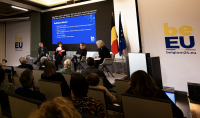
Psychosocial risks : At the
recent high-level conference on mental health in relation to work, organised by the
Belgian presidency of the EU on 30 and 31 January, the speakers addressed the role
of regulation and particularly the role that a future European directive specific to
psychosocial risks could play. The discussions revealed that specific pieces of
legislation incorporating organisational measures designed to combat work-related
stress have a greater impact in terms of protecting workers’ mental health. The
European Commission has announced that it will soon be launching a peer review of
existing national legislation in this area, with a view to drawing up “a
strengthened European legislative framework guaranteeing a level playing field
throughout the European Union”. The Belgian presidency will be inviting the various
EU Member States to Brussels in order to start work on this initiative (see
conference Conclusions).
|

Asbestos : In a letter
dated 25 January, the European Trade Union Confederation and the European
trade-union federations IndustriAll Europe, EFBWW, EPSU and CSEE-ETUCE, call on the
European Commission to keep its promise to put forward a proposal for a directive on
the screening, registration and monitoring of asbestos in the construction industry,
with a view to improving workers’ safety, especially in light of the forthcoming and
much-needed energy-saving Renovation Wave initiative. The text was on the Commission
College’s agenda in June 2023, but has since disappeared from the Commission’s
agenda (see ETUC press
release).
|
- Encadrement des stages : le
29 janvier, la Confédération européenne des syndicats a adressé un courrier,
à la Commission européenne, s’inquiétant du retard pris dans la présentation
d’une initiative visant à encadrer les stages et notamment de faire en sorte
qu’ils soient rémunérés. La Commission a effectué une déclaration à ce sujet, le
6 février, devant le Parlement européen.
|
Case law

Permanent disability : The Court
of Justice has issued a ruling on a Spanish case concerning a household refuse
collection vehicle driver who suffered an accident at work (CJEU,
18 January 2024, Ca Na Negreta SA, not available in English). As he was
unable to carry on doing this job, his employer redeployed him to a driving job in
the mobile collection point sector. This work was less physically demanding,
involved less driving time and was compatible with his physical limitations. At the
same time, the national social security institute refused to recognise that the
employee in question was now permanently unable to work. However, after he lodged an
appeal, his permanent disabled status was finally acknowledged. The employer had
exercised its right under Spanish law to terminate the driver’s contract of
employment, because once it has been determined that an employee is permanently and
totally unable to carry on their normal occupation, the employer is automatically
entitled to terminate their contract of employment, without having to comply with
any formalities and without such termination being conditional on any prior
obligations linked to “reasonable accommodation”, in contrast to the provisions
contained in EU Directive 2000/78. The CJEU therefore held that Spanish law did not
comply with EU law, and that prior to any termination, the employer must either
“first make or maintain reasonable accommodation allowing this worker to hold on to
their job,” or “demonstrate, if applicable, that such accommodation would give rise
to a disproportionate burden”.
|
2. Member
States
Germany
A common front against the far right :
Faced with the rise of the far-right AFD party, the social
partners have issued a joint message, reminding all Germans that they “have made a
decisive contribution to the reconstruction” of Germany “after the horrors of the
National Socialist (Nazi) regime, and to the development of a social and economic
model that maintains a fair balance in society”. They “have never drawn any
distinctions regarding workers’ origins or nationality. This has helped to guarantee
our country’s democracy and prosperity over a period of many decades. The German
economy, Germany’s trade unions and its works councils are all aware of the enormous
importance that social peace represents for Germany”. Denouncing “right-wing
extremists’ current plans to repatriate immigrants to their country of origin”, the
social partners emphasise that “our companies are a reflection of society. The
people who work in our country, and with us, are our colleagues, neighbours and
friends” (see joint
declaration issued by DGB-BDA).
|
Belgium
- Holiday pay : Since 1
January, a worker who falls ill while on annual leave has been entitled to hold
on to their holiday entitlement and take the days in question at a later date.
(see press releases issued by CSC
and FGTB). In this case,
they must immediately inform their employer of the address they are staying at,
submit a medical certificate by the normal workplace deadline applicable and
tell their employer that they wish to postpone their remaining days of leave and
take them after their current period of absence comes to an end (see Ministry of
Employment press
release).
|
Spain
- Delivery workers’ employment status :
For the second time, Amazon has lost a court case brought by
the country’s social security authority, and as a result, 3,688 delivery workers
who were previously regarded by the multinational as self-employed workers will
now be reclassified as employees. The group has decided to appeal (see UGT press
release and article
in El Periódico).
|
3.
Companies
European
Works Council
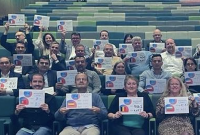
Inflation : Even though European
Works Councils have no powers in the area of wage policy, the impact of inflation on
European employees is prompting them to address this issue. At its plenary session
in December 2023, the BNP Paribas
European Works Council (“CEG”) observed a minute’s silence to
highlight workers’ lost purchasing power, while each member held up a placard
indicating the rate of inflation in their respective countries (see photo). The
press release issued by the BNP Paribas CEG select committee emphasises that
“although some efforts have been made in some countries and business lines, the CEG
regrets the lack of collective and significant measures taken”.
|
Syndicalisme

International social dialogue :
During Saint-Gobain’s global union network
meeting on 19 and 20 December 2023, which was attended by 20 union representatives
from 9 countries, union delegates had the chance to engage in a debate with Régis
Blugeon, social affairs director at Saint-Gobain. Among other things, they discussed
possibilities for expanding social dialogue with the group internationally (see
IndustriAll press
release).
|
|
|











