 |
| |
IR Notes 236 – 18 September 2024
www.irshare.eu
|
|
|
| |
| |
A question for…
Tom Deleu, Secretary General of the European Federation of Building and
Woodworkers (EFBWW)

On 17
September, in conjunction with other European trade union
federations, you organised a demonstration outside the
European Parliament in Strasbourg, calling for better
supervision of subcontracting. So, what are your demands?
A new legislature, together with a new
European Commission and a new European Parliament, is now coming
into being, and from the outset, we wanted to remind the European
institutions to put the battle against social dumping on the agenda,
with a view to finding solutions. We absolutely must have
legislation designed to limit subcontracting chains. The current
legislative framework doesn’t allow us to combat social dumping
effectively. We’re seeing an increase in abusive situations, which –
in an increasing number of cases – are involving third-country
nationals, whose circumstances are particularly precarious. They’re
vulnerable to various forms of human trafficking and forced labour.
These abuses are in addition to the more traditional phenomena of
unpaid wages and workers being housed in unsanitary accommodation.
There’s no technical reason why long subcontracting chains should be
allowed. The only reasons why they exist are to hide these
phenomena, to evade social legislation and to make it harder to
conduct inspections, especially when these take place in a
crossborder context. So what we need to do is: firstly, force
companies to reduce subcontracting chains; secondly, make the main
contractor jointly and severally liable for what goes on; and
thirdly, regulate the role played by intermediaries such as
temporary work agencies and other placement services.
|
|
|

|
| |
Diary
19 and 20
September
Bordeaux
Annual international conference of the International Research Chair in
Comparative Studies on Occupational Health (CIECST) entitled “Ageing of
the working population: occupational health, return to work, and
retirement policy issues” (see registration).
24 September
Strasbourg
Lecture on
“Les
implications de la directive transparence salariale en France et
en Allemagne” [‘Implications of the pay
transparency directive in France and Germany’], with Judith
Brockmann (Kassel University) and Nicolas Moizard (Strasbourg
University). Contact: fru6703-contact@unistra.fr
26 and 27
September
Brussels
ETUC’s annual European Works Council Conference (programme).
4 October
Paris
Conference organised by the Réalité du Dialogue Social
association, entitled « Nouveau parlement
européen : quelles perspectives pour l’Europe sociale ?
» [“A new European Parliament:
what are the prospects for social Europe?”]. Participants
include Maxime Cerutti (BusinessEurope), Isabelle Schömann (ETUC), Rémi
Boyer (Clariane), Livia Hentschel (DGB) and Jean-Michel Pottier (CPME).
7 to 10
October
Strasbourg
Plenary session of the European Parliament
9 to 10
October
Budapest
Informal
meeting of Employment and Social Policy Ministers
17 and 18
October
Brussels
European
Council
4 November
Strasbourg
Lecture
on “L’égalité
dans les relations de travail, comparaison
France-Allemagne“ [‘Equality in workplace
relationships: comparing France and Germany’], with Gerhard Binkert
(Landesarbeitsgericht Berlin-Brandenburg [Regional Labour
Court]) and Yves Struillou (Conseil d’État [Council of State]).
Contact: fru6703-contact@unistra.fr
14
November
Paris
International
conference organised by the INRS, anticipating the transformations
taking place in the world of work and preventing occupational hazards
(programme).
2 to 3 December
Brussels
Meeting of the
Council of Employment and Social Policy
|
|
|
|
|
| |
Who we are?
IR Notes is a
fortnightly newsletter produced by IR
Share and its
network of experts, and is available in several European languages
(English, French, German, Italian, Spanish). It offers Europe-wide
monitoring of employment law, labour relations and employment policy. It
is available by subscription for 273 euros per year .
The team This issue
was producaed by Iris
Turlan and
Frédéric
Turlan .
Find out more
about the IR
Share team on our website.
Subscribe to IR Notes
Via the
IR
Share website or by calliang us on:
+33 (0)6 81 41 53 95
or
E-mail: frederic.t@irshare.eu
Legal notice.
Publisher: IR Share SARL – 5, Les Compères – 89520 Fontenoy, France –
Tel.: +33 (0)6 81 41 53 95 – share capital 1,500 euros – commercial
register (RCS Auxerre): 512 567 959. Managing editor: Frédéric Turlan.
Hosting: ALTEO by Damien Cornillet – Château – 89500
Villeneuve-sur-Yonne. CPPAP no.: 0626 Z 93933.
|
|
|
|
|
| |
Follow us on LinkedIn!

Why not connect to the IR Notes LinkedIn page, so that you can keep up with
developments in the issues we’re covering, between two editions?
You’re welcome to follow us! There are already 635 of you following
us!
|
|
|
|
|
| |
European Industrial Relations Dictionary
In case reading IR Notes inspires you to
explore this subject further, we are providing links to the European
Industrial Relations Dictionary published by Eurofound. This is updated at
regular intervals by IR Share, which publishes IR Notes. The term
definitions are available in English and can easily be converted
into other languages using on-line translation tools.
|
|
|
|
|

|
|
|
Lead
story
Super
Mario’s ideas on how to prevent the European Union’s “slow agony”
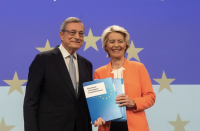
On 9 September, Mario Draghi (the previous President of the European Central Bank,
whose role in saving the euro during the 2010 debt crisis earned him the nickname
“Super Mario”) submitted his report on the future of European competitiveness, which
was commissioned one year ago by the President of the European Commission, Ursula
von der Leyen. His findings are unequivocal: the European economy is losing ground
against the US economy, and is suffering a serious onslaught from China. The GDP per
capita gap between the EU and the US rose from 15% in 2002 to 30% in 2023. According
to the report, “Around 70% of the gap in per capita GDP with US at PPP is explained
by lower productivity in the EU. Slower productivity growth has in turn been
associated with slower income growth and weaker domestic demand in Europe: on a per
capita basis, real disposable income has grown almost twice as much in the US as in
the EU since 2000”. The solution lies in boosting EU productivity, and with this in
mind, Mario Draghi calls on its Member States to make an annual additional
investment of EUR 750 to 800 billion, i.e. 5% of EU GDP, otherwise the EU will slide
into a slow agony. Part
A of the report sets out this finding and makes recommendations, whereas Part
B, which is over 300 pages long, analyses the weaknesses of the European
economy in ten key sectors (including energy, artificial intelligence,
semi-conductors, defence and transport), putting forward recommendations for each
one, while at the same time developing five horizontal policies to be pursued with a
view to restoring competitiveness.
Insofar as it emphasises that
competitiveness should not be boosted at the expense of dismantling the European
social model, the report is reassuring (see European social model). A
European approach must ensure “that productivity growth and social inclusion go
hand-in-hand.” “The European welfare state will therefore be critical to provide
strong public services, social protection, housing, transport and childcare during
this transition”. The EU should also review its approach to skills, and ensure “that
all workers have a right to education and retraining, allowing them to move into new
roles as their companies adopt technology, or into good jobs in new sectors.” Mario
Draghi also emphasises that: “More effective and proactive citizens’ involvement and
social dialogue, combining trade unions, employers and civil society actors, will be
central in building the consensus needed to drive the changes. Transformation can
best lead to prosperity for all when accompanied by a strong social contract”. The
report has the merit of painting a realistic picture of the situation and ruling out
the usual neo-liberal solutions of recourse to austerity and dismantling labour law,
in favour of promoting an investment policy.
The social partners have given the
report a cautious welcome (see Social update, below). Will it be enough to prompt an
appropriate reaction from EU leaders, who will have to discuss this report in the
coming months? Nothing could be less certain, as the report invites those in charge
to use public borrowing to supplement private investment, a policy likely to deter
many Member States.
|
1. European
Union
Social
update
Reactions to the Draghi report :
The European Trade Union Confederation (ETUC) is pleased that
Draghi has identified the need to tackle the “chronic under-investment in industry
and public services”, even though the report highlights the risks associated with
deregulation. The ETUC calls on the Commission to convene “a social partner working
group to discuss the report and the way forward” (see ETUC press
release). IndustriAll Europe applauds the recommendation to relaunch an
industrial policy, but is disappointed that the report overlooks “important features
of the European model, such as social dialogue and collective bargaining”. It also
overlooks “the role that low wages played in the weakening of demand, boiling
everything down to weaker productivity” and it “misses the issue of fair
distribution of the wealth created between profits, wages and investments” (see press release). Speaking
for the employers, BusinessEurope expresses satisfaction with the report, and calls
for “measures like incentivising productive investments in Europe, lowering energy
costs or reducing regulatory burdens on companies”. However, it believes that
“market forces should be at the core of such a strategy, rather than excessive
public intervention” (see press
release). SMEunited President Petri Salminen adds: “The most important
aspects for SMEs in this context are the reduction of regulatory and administrative
burdens, a level playing field with big business, a better functioning single market
and more reciprocity and fairness when it comes to relations with third countries.”
(see press
release).
|
2. Member
States
Spain
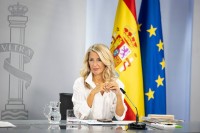
Domestic workers : On 10
September, the government passed a royal
decree relating to health and safety protection in the area of family services
provided in the home. This law “places Spain at the forefront of legislation
on preventing workplace risks faced by domestic workers”, explains the Minister of
Employment, Yolanda* Díaz (photo). It grants workers the right to stop work
immediately if they encounter a serious and imminent risk, without suffering any
prejudicial consequences (see press
release).
|
Finland
Labour market reforms : On 5
September, as part of the country’s labour market reforms, the government submitted
a draft law to Parliament, which is designed to facilitate the process of concluding
company agreements, in ways that include allowing companies to depart from the
provisions of the law. The aim is to develop local agreements that will enhance
companies’ performance and productivity. (see press
release). The trade union confederation SAK argues, however, that this
proposal will “destroy the Nordic labour market model” (see press
release). The government also set up two tripartite working parties on 9
September, tasked with drafting legislative proposals to make it easier to dismiss
employees on personal grounds and to allow a fixed-term contract of employment to be
concluded for a one-year period without any special reasons (see press
release).
|
France

Gynaecological health leave :
Since early September, Strasbourg Eurométropole has been
experimenting with “gynaecological health leave”. This allows female employees who
are suffering from menstrual pains, endometriosis or menopause-related symptoms, to
take 13 days of exceptional leave per year (no more than three days in a row per
month), on presentation of a medical certificate issued by a gynaecologist or a
midwife, and which is valid for two years. For female workers, “taking this leave
will be a step of last resort”: they will also benefit from adaptations to their
workstation, and to their work premises more generally, as well as more flexible
telework arrangements and for those working outdoors, easier access to toilets. In
taking these measures, the local authority is demonstrating that it intends to allow
women to carry on working normally, as far as possible (see press
release).
|
Malta

Health and safety at work : On
15 July, Parliament passed a law on
occupational health and safety, establishing that it shall be an employer’s
duty to ensure “the physical and psychological well-being of his workers at all
times”. The law introduces heavy penalties for breaches of safety rules, with fines
ranging from 1500 to 50,000 euros, and in serious cases, up to two years’
imprisonment, or four years for a repeat offence. It also introduces a
round-the-clock telephone helpline. The new law creates a dedicated court to deal
with occupational health and safety matters, and requires an employer to appoint a
Health and Safety Reporting Officer to supervise and oversee compliance with
occupational health and safety rules.
|
3.
Companies
European
Works Councils
Legal dispute in Irland : An
Irish court has ruled for the first time on a case involving a European Works
Council – that of the US group Verizon, which set up an EWC
under the subsidiary requirements of Irish legislation, after failing to reach an
agreement with its employee representatives (IR Notes 156
and IR Notes
153). In November 2021, a number of EWC members acting in a personal
capacity, including its secretary, took their case to the WRC, which is the
competent commission for resolving collective labour disputes in Ireland (editor’s
note: under Irish law, an EWC has no legal personality of its own, and therefore
cannot take matters to court). They applied for the company’s management to be made
to pay the costs incurred by four EWC members who had taken part in a training
course for EWC members, and also certain consultancy fees incurred by the EWC. In
respect of refunding these training costs, the WRC had ruled that the EWC had
already benefitted from a training day organised by management, so the latter was
not obliged to reimburse the costs incurred by the four members in attending a
further seminar. Management had also informed these members in advance that the
company would not fund the cost of attending this course. As regards the consultancy
fees, the WRC had ruled that management should pay 50% of these costs and decided
which subjects, in its view, qualified for reimbursement, and which ones did not (IR Notes
207). On appeal, on 27 August, the Labour Court handed down two decisions
(one concerning training costs, the other relating to consultancy fees), completely
dismissing the workforce representatives’ entire application. The Court ruled that
“the Complainant’s decision to attend the conference was a unilateral one made in
the full knowledge that his attendance would not be supported by his employer”.
Consequently, “the company’s refusal to fund his attendance at that event was not
unreasonable”, as the company is not required “to furnish its EWC with a blank
cheque” (Decision
TID242). As far as the consultancy fees were concerned, the Court overturned
the WRC’s previous judgment of Solomon, ruling that the employees’ representative
did not have an interest in bringing an action (Decision
TID241). The employee representatives have now decided to take the case to
the High Court, and lodge a final appeal. Over and above the material facts of these
cases, the underlying issue is that of an EWC’s inability to take a matter to court:
any litigation has to be pursued by individuals, at their own expense. This
situation creates a practical obstacle to contesting any decisions made by company
managements (see also IR Notes
204).
>
Recently published on line on IR Doc:
Agreement
on the Involvement of Employees at Nintendo SE.
|
Transnational agreement
Strengthening employment rights :
On 16 July, the Italian energy group Enel officially signed the
updated version of its Global Framework
Agreement. The renegotiation of this agreement, which was first signed in
2013, was completed in October 2023. The new
agreement was signed by representatives of management and of the Italian
trade unions FILCTEM CGIL, FLAEI CISL and UILTEC UIL, as well as the international
trade union federations PSI and IndustriAll Global Union. The new text adopts the
standard elements contained in global framework agreements – including various ILO
conventions and OECD principles, such as those on harassment and violence at work,
fair pay, freedom of association, and health and safety guarantees – together with a
number of enhancements. The issue of work-life balance features prominently in the
agreement: in terms of working time, it enshrines the principle of employees
disconnecting outside working hours and places particular emphasis on parental
protection. In this regard, the agreement adopts measures aimed at protecting
workers’ rights, as set out in the Statuto della Persona (“Person’s
Charter”), an agreement signed at Italian level in 2022 (see IR Notes 185).
The dual (digital and environmental) transition also lies at the heart of this
agreement: this transition is to be the subject of a “social dialogue with the trade
unions and employee representatives, with a view to finding a social consensus on
the energy transition”. The agreement also includes undertakings to train employees
and boost their skills. This means leaving nobody behind, as established by the
“just transition” principle. Lastly, the agreement establishes a Global Council,
which is set up to provide information and monitor the agreement. It has powers to
set up working parties, in conjunction with management. It will bring together
representatives of the group’s trade unions and of the international trade union
federations that are signatories. Enel’s social relations department emphasises that
its main objective is to promote an ever-more virtuous environment, in order to
protect and maximise value for its workforce. This framework agreement is one of the
most comprehensive to date, and sets a new standard for companies.
|

Supply chain : On 28 August, the
UK apparel brand New Look
(10,000 employees) concluded an agreement with the International Transport Workers’
Federation, which is intended “to improve the safety, resilience and sustainability
of transport supply chains”. One of its objectives is to “advance freedom of
association for its supply chain transport workers by, among other elements,
ensuring the ITF’s affiliate trade unions have the right to organise and enter the
premises of supply chain logistics providers”. Sue Fairley, New Look’s Senior Head
of ESG, Quality and Sourcing, explains that the agreement will facilitate compliance
with due diligence requirements (see Due diligence), as provided
for by the recent European directive, by enabling the group to “make sure there is
no modern slavery or human trafficking in any part of our operations, which includes
transport and logistics” (see press
release).
|
Trade
unionism
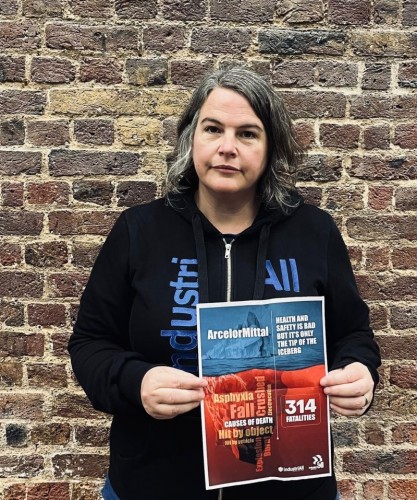
Health and Safety :
The IndustriAll Global Union and IndustriAll
Europe federations have organised a global day of action to draw attention to the
health and safety situation at the steelmaking group ArcelorMittal. In light of the
mounting death toll at the company’s sites (more than 300 fatal accidents since
2012), they call on management to convene the joint global health and safety
committee, which has not met since the Covid-19 pandemic (see IndustriAll Europe press
release).
|
4. Studies
and reports
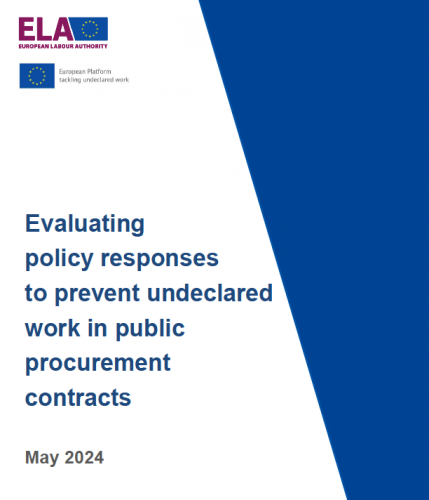
Undeclared work in public procurement contracts
: The European Labour Authority has published a study
entitled Evaluating
policy responses to prevent undeclared work in public procurement contracts.
This study offers an interesting contribution, given the prospect of a forthcoming
revision of European market regulations. The document analyses the various national
legislations and puts forward recommendations on how to take immediate steps to
tackle undeclared work in EU public procurement, in ways that include abandoning the
focus on seeking the lowest price (see press
release).
|
“Platform workers” directive :
The European directive on platform workers is due to be formally
adopted, first by Parliament and then the Council, in the coming days (see Platform work). To mark with
this development, the European Trade Union Institute (ETUI) has published a policy
brief examining the main innovations introduced by the directive, assessing
its contribution to the EU acquis and identifying the main weaknesses and
potential threats to its effectiveness.
|
|
|











