 |
| |
IR Notes 243 – 8 January 2025
www.irshare.eu
|
|
|
| |
| |
Éditorial
New website, new ambitions

Have you visited the IR Share website yet? With the help
of the Wisefrog team, we’ve reinvented it last year and
converted it into a dedicated platform for industrial relations in
Europe. Here, our readers can access almost 2,000 documents that
we’ve published on line, ranging from EU directives to Court of
Justice rulings, via EWC agreements and instruments adopted within
the framework of sectoral social dialogue. In addition, these
on-line documents are gradually being supplemented with articles
previously published in IR Notes. The site is currently available in
English only, but it will soon be accessible in French. It’s a
vehicle for showcasing IR Notes, by making the newsletter more
visible and thus increasing the chances of gaining more subscribers,
who are the guarantors of our independence. On this website, readers
will also find the latest studies and research
projects, including those
performed on behalf of Eurofound, plus our latest training
activities, especially those aimed
at EWCs. Lastly, the new site’s launch coincides with the creation –
alongside the French-language Club CE européen – of the
“EWC Club“, aimed at English speakers. It will meet
six times per year, and provide a forum for EWC secretaries and
managers responsible for EWCs. We are currently recruiting its
members and preparing its work programme for 2025. This website
“renovation” is one of the projects we were working on with my wife
and IR Notes deputy editor, Pascale Milovanovich, who died almost
one year ago. Another project was an overhaul for IR Notes, with the
aim of redesigning it and making its content available via a
paywall, in order to make information more easily accessible, grow
our readership and develop an archiving module, making it easier to
find previous articles. This is one of the projects we’ll be working
on in 2025. If you have any suggestions, or if you’d like to take
part in this rethink, please feel free to contact me
here.
The whole IR Share team sends you its very
best wishes for 2025!
We hope you enjoy reading IR Notes.
Frédéric Turlan
Editor and director, IR Share
|
|
|

|
|
|
|
|
| |
Who we are?
IR Notes is a
fortnightly newsletter produced by IR
Share and its
network of experts, and is available in several European languages
(English, French, German, Italian, Spanish). It offers Europe-wide
monitoring of employment law, labour relations and employment policy. It
is available by subscription for 273 euros per year .
The team This issue
was producaed by Ambre Grenier-Boley,
Victoria Fonseca,
Iris Turlan and Frédéric
Turlan.
Find out more
about the IR
Share team on our website.
Subscribe to IR Notes
Via the
IR
Share website or by calliang us on:
+33 (0)6 81 41 53 95
or
E-mail: frederic.t@irshare.eu
Legal notice.
Publisher: IR Share SARL – 5, Les Compères – 89520 Fontenoy, France –
Tel.: +33 (0)6 81 41 53 95 – share capital 1,500 euros – commercial
register (RCS Auxerre): 512 567 959. Managing editor: Frédéric Turlan.
Hosting: ALTEO by Damien Cornillet – Château – 89500
Villeneuve-sur-Yonne. CPPAP no.: 0626 Z 93933.
|
|
|
|
|
| |
Follow us on LinkedIn!

Why not connect to the IR Notes LinkedIn page, so that you can keep up with
developments in the issues we’re covering, between two editions?
You’re welcome to follow us! There are already 668 of you following
us!
|
|
|
|
|
| |
European Industrial Relations Dictionary

In case reading IR Notes inspires you to
explore this subject further, we are providing links to the European
Industrial Relations Dictionary published by Eurofound. This is updated at
regular intervals by IR Share, which publishes IR Notes. The term
definitions are available in English and can easily be converted
into other languages using on-line translation tools.
|
|
|
|
|

|
|
|
Lead
story
Negotiations
commence on revision of European Works Council directive

Following the highly favourable vote by the European Parliament’s Committee on
Employment and Social Affairs on 3 December last year, MEPs, at their plenary
meeting on 19 December, approved Parliament’s negotiating position based on the
report submitted by MEP Dennis Radtke (EPP) (see IR Notes
242). However, unlike the Committee’s vote, when only the far-right was
opposed to revision of the directive, the plenary vote
reveals a Parliament that is much divided on the subject, given that almost 100
Conservative MEPs from the EPP – the grouping that Dennis Radtke himself belongs to
– voted against this revision, as did 22 Renew MEPs. In total, 300 MEPs supported
Dennis Radtke’s text, 254 voted against it and 21 abstained. The vote will
undoubtedly weaken the position of Parliament’s negotiators, who will find it very
hard to maintain certain proposals, such as that of fixing the financial penalties
applicable to breaches of the EWC’s right to be informed and consulted, at the same
level as those provided for by the GDPR regulation, i.e. a fine of up to 10 million
euros or 2% of the company’s worldwide turnover (the higher amount being applicable)
or double that figure for a repeat offence. Parliament’s proposal to characterise as
‘transnational’ a plan put forward by a company’s management and which might affect
employees in a different Member State from the one where the management team behind
the plan has its head office, also seems to be under fire. Nevertheless, once a few
problematic provisions such as this one have been set aside, there is a strong
likelihood that a common position will be reached. This outcome is all the more
likely, given that the two institutions – Council and Parliament – are already in
agreement on a number of significant measures condemned by the employers, such as
the obligation to renegotiate the so-called opt-out agreements, i.e. those concluded
during the two-year period after the 1994 and 2009 directives entered into force
(see European works
councils).
Even though the division within the EPP indicates
that Member States governed by leaders from the parties making up the EPP are likely
to adopt a firm stance, the positions adopted by the Council and Parliament on this
proposed revision are fairly similar, as can be seen from the document
published by the Council on 20 December, which, article by article, compares the
Commission’s proposal with the Council’s position and that of Parliament. This
document will be used as the basis for work on the trilogue, which is due to
commence on 6 February. The chances of the directive’s revision being adopted in
2025 remain high.
|
1. European
Union
Legislation
|
Social
update

EU Polish presidency sets out its social
ambitions : In its work
programme, the Polish presidency of the EU, which began on 1 January, sets
outs the issues on which it plans to make progress during the first half of 2025. In
the field of working time, it cites “legislative initiatives relating to the use of
AI in the workplace and those relating to teleworking and the right to disconnect”,
without specifying an objective. The programme devotes a paragraph to social
dialogue, making reference to the Val
Duchesse Declaration (2024) (see IR Notes 223) and
the Recommendation
on Strengthening Social Dialogue in the EU (2023) (see IR Notes 201). The
Presidency “will take steps to develop social dialogue and emphasise its role,
including by continuing work on the revision of the European Works Councils
Directive and starting work on a New Pact for European Social Dialogue”. It will
also pursue work on the “Traineeship package”, which includes proposals for a directive
and a recommendation
(see IR Notes
227). The Presidency will also “engage in the 2025 review of the
implementation of the European Pillar of Social Rights Action Plan (see European Pillar of Social
Rights),, with its three main objectives of increasing
employment, strengthening skills and qualifications and reducing poverty among
Europeans set for 2030” (see Polish presidency website).
|

Due diligence : On 10 December
2024, the European Trade Union Confederation and European trade union federations
issued a joint
statement defending the recent directives on due diligence (CS3D), Corporate
Sustainability Reporting (CSRD) and products made using forced labour. The
signatories therefore find themselves pitted against the employers’ organisations,
which have urged the European institutions to ease the application of these
directives (see IR
Notes 240). In Germany, after receiving support from four ministers,
including the Minister of Labour, Hubertus Heil (SPD), the employers’ position has
now been further bolstered by Chancellor Scholz himself, who submitted a long letter
to the President of the European Commission on 2 January, requesting among other
things that the application of reporting obligations imposed by the CSRD directive
be postponed, on the grounds of cutting bureaucracy and easing these obligations.
The trade unions are calling on the business community “to stop destabilising
democratically adopted legislation and to stop bashing EU law for the so-called sake
of simplification, whereas the CS3D brings more legal certainty and predictability,
allowing for a level playing field”.
|
Case law

Working time of domestic staff :
On 19 December 2024, the Court of Justice delivered a ruling
indicating that domestic employers will have to establish a system for measuring the
length of time worked by every domestic employee on a daily basis (CJEU,
19 December 2024, Case C-531/23, Loredas). In a previous judgment, the Court
of Justice ruled that Spain had failed to put in place a system for measuring,
objectively and reliably, the number of hours worked by employees (CJEU,
14 May 2019, Case C-55/18, CCOO, see IR Notes no.
120). Spain then amended its legislation to comply with this ruling, but the
courts and administrative practice have interpreted the new law on the basis that it
did not apply to domestic workers. In this new case, the Court emphasises that “the
judicial interpretation of a provision of national law or an administrative practice
(…) under which employers are exempt from their obligation to establish a system
enabling the duration of the daily working time of each domestic worker to be
measured”, and which therefore deprive these workers of “the possibility of
determining objectively and reliably the number of hours worked and their
distribution over time, clearly does not comply with” EU law. The Court states that,
given that they are in a position of weakness, the worker “may be dissuaded from
explicitly claiming his or her rights vis-à-vis his or her employer where, in
particular, doing so may expose him or her to measures taken by the employer likely
to affect the employment relationship in a manner detrimental to that worker”.
Consequently, “in the absence of a system for objectively and reliably measuring
both the number of hours worked by the worker and their distribution over time as
well as the number of hours worked in excess of normal working time as overtime, it
appears to be excessively difficult, if not impossible in practice, for workers to
ensure compliance with the rights conferred on them by Article 31(2) of the Charter
and by Directive 2003/88, with a view to actually benefiting from the limitation on
weekly working time and minimum daily and weekly rest periods provided for by that
directive” (see press
release).
|
Sectoral
social dialogue

Temporary work : On 16 December
2024, social partners in the temporary agency work industry adopted their Joint
Work Programme 2025-2027, in which they promise, among other things, to
adopt at least two sets of joint recommendations linked to the EU’s social and
employment policies, in the areas of participation in the labour market, skills or
social protection.
|
2. Member
States
Germany

Short-time working : The Federal
cabinet has extended to 31 December 2025, the scheme whereby short-time working
benefit is payable for a longer period (24 months instead of the previous 12), thus
enabling companies experiencing difficulties to retain their skilled employees (see
press
release). This decision enjoys the support of the trade unions. However,
Yasmin Fahimi, the President of the DGB trade union confederation, has emphasised
the importance of ensuring that the Federal Employment Agency has the resources
needed to manage the anticipated increase in the number of beneficiaries (see press
release). Alexander Bercht, a member of the executive committee of the
chemical industry trade-union federation IGBCE, has also called for further urgent
measures to speed up the transformation of Germany’s industrial sector and
emphasised the need to reinstate easy access to short-time working benefit. He
points out how effective this measure was when it was introduced during the Covid 19
pandemic. “The obstacles preventing the payment of short-time working benefit should
be minimised”, he argues (s. press
release). The president of Germany’s metalworking industry employers’
organisation Gesamtmetall, Dr. Stefan Wolf, has emphasised the need for structural
reforms, including simpler administrative procedures, lowering the tax burden and
capping social security contributions (see press
release).
|
- New occupational diseases recognised :
On 11 December 2024, the Federal cabinet issued a government
order recognising a further three medical conditions as occupational diseases,
subject to approval by the country’s federal states (see press
release). Rotator cuff injuries, gonarthrosis and chronic obstructive
pulmonary disease (COPD) are now recognised as such for certain occupations or
under certain specific conditions.
|
Austria

Amazon introduces a works council :
A works council has been elected for the first time at national
level within the Amazon group (see press
release). The vida trade union has welcomed this development and
congratulated its new president, Jorge Plaut, who has promised to promote decent and
respectful employment within the company.
|
Belgium

Company transfers : On 17
December 2024, the social partners concluded Collective
Labour Agreement (convention collective de travail or CCT) no. 32/8
on the National Labour Council (CNT). This CCT adds a new chapter to CCT 32 bis on
maintaining employees’ rights in the event of a company transfer. The new agreement
enters into force on 1 February 2025. It stipulates that when ownership of a company
is transferred, employees or their representatives who are affected by the transfer
will be entitled to demand that the transferor (the former employer) provides
certain information to the identified transferee (the new employer). They can also
invite the transferee to introduce themselves in person before the transfer takes
place. The CNT emphasises that the aim “is to achieve a high-quality and effective
information and consultation process.” (see press
release).
|
Spain
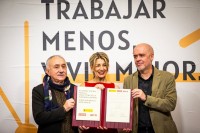
Shorter working hours : On 20
December 2024, the government and the two trade-union confederations CCOO and UGT
signed an agreement
aimed at reducing the length of the working week from the current figure of 40 hours
to 37.5 hours, with no cut in wages. This agreement supports the bill “on reducing
the maximum length of the ordinary working day, recording working time and the right
to disconnect from work”, which the government plans to submit to Parliament. The
government justifies this measure by the increased productivity achieved in recent
years and the goal of granting employees “freedom spaces where they can enjoy
themselves and flourish”. The plan also introduces a right to disconnect and sets
out details of the legislation on the breakdown of working time (see government,
CCOO
and UGT)
press releases. The employers are fiercely opposed to this measure and
believe that using the law to change matters normally dealt with by collective
bargaining “represents interference in the autonomy of collective bargaining” (see
CEOE press
release).
|
- Short-time working : On 23
December 2024, the government activated the short-time working scheme (RED) for
the car industry, which employs 200,000 people (10% of Spanish GDP). The RED
scheme requires companies taking advantage of it to promise to maintain the jobs
in question for a two-year period. Applicant companies must submit a retraining
plan for their employees, which is designed to enhance their skills and
employability in light of ongoing changes in the industry’s production system
(new technologies, manufacture of hybrid and electric vehicles) (see press
release).
|
Sweden

Racism and hate crime in the workplace :
The government has adopted a new plan to combat
racism, placing the emphasis on four areas, including working life (see press
release). This plan, which has been put forward by Paulina Brandberg, the
Minister for Gender Equality and Working Life (photo, Kristian Pohl), includes
measures to provide employers and other labour market actors with tools and
information for enhancing procedures for combatting racism and discrimination in the
workplace.
|
3.
Companies
European
works councils

Agreement renewed : On 2 October
2024, the management of the Mobivia group (22,000 employees)
and its European Works Council renewed their European
Works Council agreement of 16 July 2020 (see IR Notes 150),
while keeping in place most of the resources provided under the previous agreement.
However, the new
agreement transforms one of the four annual meetings provided for under the
previous agreement into a select committee meeting (comprising 5 members). EWC
members are granted 7 days per year to discharge their duties. Select committee
members have 15 days. Select committee members are also granted a further 12 days
per year to undertake site visits. The main countries covered are Germany (9,126
employees), France (8,298 employees) and Spain (2,286 employees).
|

Agreement revised : On 30
October 2024, the management of the Finnish group Nokia concluded an agreement on
the functioning of its EWC, which had previously operated on the basis of the
directive’s subsidiary requirements. The CFE-CGC trade union reports “significant
progress in several areas”. The agreement confirms the practice of holding two
annual meetings, and granting access to experts and to the trade union coordinator,
although Nokia will not cover their travel expenses. The CFE-CGC has expressed
satisfaction, commenting that: “The agreement stipulates that if a new European
directive is passed and transposed into Finnish law, it will automatically be
incorporated into the agreement without the need for renegotiation” (see press
release).
|

Virtual meeting : On 23 December
2024, the Central Arbitration Committee (CAC), which is the UK authority responsible
for resolving disputes involving EWCs, handed down a decision
on a case brought by the British
Council’s EWC against the management of this government
institution, which is responsible for promoting the English language around the
world. The case in question involved the EWC established under UK law prior to
Brexit, which continues to function alongside the EWC set up in Ireland, after
Brexit. The two bodies continue to function in parallel. The EWC’s view was that in
principle, an exceptional EWC meeting taking place under the subsidiary requirements
should be held in person, not on line, unless otherwise agreed between the central
management and the EWC. The CAC points out that UK law (TICER) is “silent as to the
format of that meeting and as to whether that format needs to be agreed between the
parties”. The CAC’s opinion is that “it can be open to an employer to unilaterally
impose an online meeting upon an EWC”, but it would be “good practice for an
employer and EWC to seek to agree the format of the meeting”.
|
Transnational negotiation

Harassment and violence against women :
The Spanish textile group Inditex (161,200 employees
worldwide, including 125,800 in Europe) and its EWC have issued a joint
statement against violence against women and harassment in the workplace,
which includes undertakings by the group to put in place actions linked to providing
information, training, internal communication (among other things to make the
International Day for the Elimination of Violence against Women), mechanisms for
reporting harassment and providing victim support. The EWC’s Equality working party
is responsible for monitoring the statement’s application (see press
release).
|

Sexual harassment : On 6
September 2024, the Lipton Teas and
Infusions group (17,000 employees) and the IUF international
trade union federation signed a Joint
Commitment on Preventing Sexual Harassment. The text is particularly aimed
at “women workers, particularly contingent, temporary and/or migrant workers, such
as those in agricultural supply chains”, who may be more vulnerable than other
female workers, especially “in a situation where exposure to harassment is perceived
as a condition of employment”. The text states that the group must “ensure that
sexual harassment does not occur in its supply chain”. The signatories are putting
in place a procedure to stop sexual harassment in the workplace which, among other
things, makes it clear that “in cases of sexual harassment, it is the perpetrator
and not the person making the complaint who will be redeployed”. All units will have
to establish a “clear and precise local policy on sexual harassment, complaints
procedures and mechanisms for dispute resolution/grievance handling based on
international standards and national legal and collective bargaining law and
practice.”
|
4. Studies
and reports

National social dialogu : On 18
December, the ILO published the second edition of its Social
Dialogue Report, entitled “Peak-level social dialogue for
economic development and social progress”. It focuses on social dialogue established
at the highest level within countries, and sets out global and regional trends in
this area. The report shows that Europe is characterised by having a high proportion
(92%) of permanent national social dialogue institutions (NSDIs). These
organisations, which are usually made up of tripartite representatives – employers,
workers and governments – sometimes include civil society organisations. They are
run by a secretariat, which is often managed by the Ministry of Labour, and are
frequently chaired by ministers or heads of government. The report emphasises that
young people are under-represented on these bodies. Social dialogue that includes
young people has declined since the pandemic. On the other hand, the report
demonstrates that social dialogue has helped to mitigate the effects of inflation.
It also indicates that only a quarter of social dialogue processes conducted at peak
level between 2022 and 2023 touched upon themes relevant to the twin (environmental
and digital) transition.
|
|
|











