 |
| |
IR Notes 249 – 2 April 2025
www.irshare.eu
|
|
|
| |
| |
A question for…
Paola Panzeri, Deputy General Secretary of the European Public Service
Union

What
can you tell us about the European framework agreement on
diversity and inclusion that you’ve signed with the Veolia
group (see 3. Companies)?
Firstly, I’d like to emphasise that it’s an
exhaustive agreement that covers all aspects of diversity, without
limiting itself to a few discrimination factors, in particular by
encouraging a more inclusive and intersectional approach to various
areas of discrimination: gender, LGBTQ+, disability and the
interface between an employee’s working life and personal life. For
example, it allows employees – and especially female employees who
are caring for someone with disabilities or a close family member –
to adapt their working conditions to meet their needs. The agreement
also seeks to promote and encourage diversity of social and cultural
origins at all stages of an employee’s career with the company…
so, not just at recruitment level, but also in terms of access to
training and career development.
Secondly, this agreement establishes rights
for employees in 17 Member States. So, if a female employee is known
to have experienced violence in the workplace – including where it
is inflicted by a third party visiting the workplace (a form of
violence that is increasingly common) – or domestic violence, she
will be able to take all the necessary steps without suffering any
loss of earnings. In the context of domestic violence, the aim is to
ensure that the workplace is a safe place: a female employee who is
a victim of this will be able to go to work, away from the control
of the person perpetrating the violence, and will then be free to
take the necessary steps to contact the authorities or victims’
associations, in a secure environment and without loss of
earnings.
The third
important point – and admittedly, this one is less striking – is
that the agreement establishes an oversight committee staffed by
those who negotiated it. The committee will monitor application of
the agreement, in conjunction with the country Dialogue Spaces
provided for in the European Works Council agreement, with a view to
promoting good practice and issuing recommendations.
|
|
|

|
|
|
|
|
| |
Who we are?
IR Notes is a
fortnightly newsletter produced by IR
Share and its
network of experts, and is available in several European languages
(English, French, German, Italian, Spanish). It offers Europe-wide
monitoring of employment law, labour relations and employment policy. It
is available by subscription for 273 euros per year .
The team This issue
was producaed by Ambre Grenier-Boley,
Victoria Fonseca,
Iris Turlan and Frédéric
Turlan.
Find out more
about the IR Share team on our
website.
Subscribe to IR Notes
Via the
IR
Share website or by calliang us on:
+33 (0)6 81 41 53 95
or
E-mail: frederic.t@irshare.eu
Legal notice.
Publisher: IR Share SARL – 5, Les Compères – 89520 Fontenoy, France –
Tel.: +33 (0)6 81 41 53 95 – share capital 1,500 euros – commercial
register (RCS Auxerre): 512 567 959. Managing editor: Frédéric Turlan.
Hosting: ALTEO by Damien Cornillet – Château – 89500
Villeneuve-sur-Yonne. CPPAP no.: 0626 Z 93933.
|
|
|
|
|
| |
Follow us on LinkedIn!
Why not connect to the IR Notes LinkedIn page, so that you can keep up with
developments in the issues we’re covering, between two editions?
You’re welcome to follow us! There are already 692 of you following
us!
|
|
|
|
|
| |
European Industrial Relations Dictionary
In case reading IR Notes inspires you to
explore this subject further, we are providing links to the European
Industrial Relations Dictionary published by Eurofound. This is updated at
regular intervals by IR Share, which publishes IR Notes. The term
definitions are available in English and can easily be converted
into other languages using on-line translation tools.
|
|
|
|
|

|
|
|
Lead
story
The
Commission wants to make it easier to access European funding to offset the effects
of restructuring

As mentioned in recent communications on the Clean Industrial Deal, its
sector-specific implementations (carmaking, steel, etc.) and on the Union of Skills
(see IR Notes
248), on 1 April, the European Commission put forward a proposal to amend Regulation
(EU) 2021/691 on the European Globalisation Adjustment Fund for Displaced
Workers (EGF). This proposal
for a regulation seeks to extend the scope of EGF aid, so that it no longer
applies solely to workers who have already been made redundant, but also to “workers
at risk of imminent job displacement”, so that they can acquire the skills needed to
help them to redeploy to other industries or change jobs (see press
release). It would apply to workers “whose employment contract or
relationship is expected to be ended by redundancy as of the date on which the
employer notifies the competent public authority in writing of the projected
collective redundancies”, regardless of the type or duration of their employment
relationship. For a State to be eligible to seek assistance from the Fund, at least
200 workers must face an imminent risk of losing their job. As is already the case,
to receive EGF aid, companies will have to apply for it via the Member State
concerned. The Commission also wants to speed up the processing of funding
applications by imposing processing deadlines on businesses, States and on itself.
This means that the employee representatives of the companies concerned, and the
trade unions supporting them, will have to familiarise themselves with these new
rules. Furthermore, whereas the Parliament and Council currently have to examine and
approve each application for aid individually, under the new arrangements, they
would approve the EGF’s budget once a year, and the Commission would allocate this
funding to States in accordance with their requirements. Since 2007, the EGF has
intervened in 182 cases, and spent 700 million euros on helping more than 170,000
workers in 20 States. The EGF’s annual budget for the period 2021-2027 is 35 million
euros but this is currently under-utilised (see European Globalisation Adjustment
Fund, the page
dedicated to the EGF on the Commission’s website and the list
of amounts awarded).
The Commission has also put forward a proposal amending
the regulation establishing the European Social Fund + (ESF+) (see European Social Fund), which
is the EU’s main instrument for investing in people. The new rules will enable
States to invest more easily in the skills required for strategic sectors, such as
defence, the ecological transition and the car industry, and for regions affected by
Russia’s unjustified invasion of Ukraine.
|
1. European
Union
Projects

Sustainability and due diligence :
On 26 March, the Council adopted its negotiating position for
embarking on a trilogue with the European Parliament, for the purpose of revising
the Sustainability Reporting (CSRD) and Due Diligence directives. The Polish
presidency has given this proposal absolute priority. The Member States have
supported the Commission’s proposal for:
1/ a two-year deferral of the entry into force of the
obligations laid down by the CSRD directive in respect of large undertakings that
have not yet started to implement them, and of listed SME; 2/ a one-year deferral of the
transposition deadline and the first phase of application (covering the largest
undertakings) of the Due Diligence directive. The aim is to reach a “swift agreement
between the co-legislators”, which will leave them time to agree on substantive
changes to both directives (see press
release) Two days earlier, the European Trade Union Confederation (ETUC) and
five of its federations (EFBWW, EFFAT, IndustriAll Europe, ETF and EPSU) had
published a joint press release urging MEPs to leave the CSRD and Due Diligence
directives as they are. They call on MEPs to “reject this disastrous package and
ensure that the core objectives” of these directives and “the protections provided
therein are safeguarded from this deregulation agenda” (see press
release).
|

Oversight of traineeships : On
18 March, MEP Alicia Homs Ginel (S&D) presented her draft
report on the proposal for a directive on improving the working conditions of
trainees to Parliament’s Committee on Employment and Social Affairs. Her
text, which will be debated once all of the amendments have been filed, defines a
traineeship as a “period of entry-level work”, which is “limited in time” and aimed
at providing “practical and professional skills through significant training to
facilitate the transition from education to stable employment, or accessing a
profession, based on a written contract between the trainee and the traineeship
provider, which is paid in accordance with the Directive (EU) 2022/2041” (on
adequate minimum wages). Member States’ representatives, for their part, will
discuss this proposal for a directive on 3 April, based on a new compromise proposal
submitted on 28 March by the Polish presidency of the Council of the EU.
|
Social
update
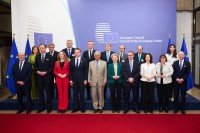
Tripartite Social Summit : On 19
March, European social partners met with representatives of the Council and the
European Commission, on the eve of the European Council, within the framework of the
Tripartite Social Summit, which is a twice-yearly forum for dialogue at the highest
level, held on the day before the Council meeting. The partners delivered their key
messages: BusinessEurope called for a burden reduction programme and lower energy
prices, while the European Trade Union Confederation wanted to boost domestic demand
through higher wages and investments, in order to “provide immediate protection
against job losses”. The social partners issued a joint statement on the
geopolitical context, which was ignored in the Pact for Social Dialogue signed on 5
March (see IR
Notes 248), calling on the European institutions and Member States “to keep
social partners at both European and national level fully involved in all relevant
deliberations following the geopolitical uncertainties and transformation
processes.” (see press
release).
- Restructuring: On 26
March, the Commission proposed mobilising 8 million euros from the European
Globalisation Adjustment Fund (EGF) to support 2,400 workers who were dismissed
following the bankruptcy of Belgian coach manufacturer Van Hool (see press
release).
|
2. Member
States
Germany
Due diligence : On 20 March, the
Uni Global Union federation, in association with IndustriALL Global Union, the DGB
trade union federation and the Friedrich Ebert Fondation, announced the creation of
a Competence Centre for Human Rights Due Diligence, in the form of a foundation
based in the Netherlands (see DGB
and UNI
Global Union press releases). This centre will pursue three key objectives:
strengthening trade unions’ capacities, supporting strategic interventions and
advocating for implementation of due diligence legislation – in particular, the EU
Due Diligence Directive (see IR Notes 226)
and the German act on corporate due diligence obligations in supply chains. The
centre is due to be operational by the end of 2025.
|
Spain

Reconciling work and retirement :
This year, 1 April marks the entry into force of the final phase
of the pension reforms (decree-law 11/2024
of 23 December 2024) concluded via an agreement between the government,
employers and trade unions. These reforms introduce new measures concerning access
to retirement pension, including a dual subsidised rate for people who concurrently
draw a gradual and a deferred retirement pension, and changes in access to drawing a
partial retirement pension. 1/
Gradual retirement pension: previously, workers needed to have paid at least
36 years and 6 months’ worth of contributions in order to qualify for this. However,
this option has now been expanded to include people with shorter
careers. 2/ Deferred
retirement pension: the rate of increase has been raised to 2% every six months,
i.e. 4% per year (compared to the previous rate of 2%). These increases can now also
apply concurrently with a gradual retirement pension, thereby offering a dual
remuneration, whereas previously, the two schemes were incompatible. 3/ Partial retirement pension:
as of today, it will be possible to retire three years before the statutory
retirement age (compared to two years, previously). In addition, the employee taking
the retired person’s place (who would usually be on a temporary contract) will now
have to be on a permanent, full-time contract of employment.
|
Luxembourg

Representation of women on management bodies :
On 28 March, the government passed a draft law setting a
quantified gender balance target for directors of listed companies, for the purposes
of transposing Directive 2022/2381 of 23 November 2022. From now on, listed
companies with their registered office in Luxembourg will have to ensure that by 30
June 2026 at the latest, members of the under-represented sex hold at least 33% of
all of their directorships, whether executive or non-executive (see press
release). On 31 March, the government also adopted a National
action plan for gender equality, which includes a number of initiatives
relating to the world of work (see press
release).
|
3.
Companies
European
works councils

New agreement signed : On 30
October 2024, the management of Nokia and a special negotiating
body signed a European
Works Council agreement replacing the EWC that had previously operated on
the basis of the directive’s subsidiary requirements. The agreement provides for the
creation of a select committee made up of 5 members, but no secretary. The
negotiators wanted to prevent any special relationship developing between management
and one of their number. Two annual meetings are provided for, together with other
meetings in exceptional circumstances. To qualify for this description, a plan must
have a “significant” impact, resulting either from collective redundancies or from
substantial changes affecting at least 100 employees in at least two Member States.
In terms of resources, the EWC is entitled to use the services of experts paid for
by management, and of a trade union coordinator, though management will not pay for
the latter. In view of the automatic translation and generative AI tools now
available, the agreement stipulates that management will pay translation costs only
in exceptional circumstances. The text also regulates the disclosure of confidential
information. “There are still some gaps in the agreement”, explains Linas
Maknavicius, an EWC member who belongs to France’s CFE-CGC trade union, “but our
social dialogue is quite good, and we’ve been able to set up a working group on
sustainability reporting (ESG), even though this is not provided for in the
agreement. This working group has been able to provide feedback on the
sustainability element of Nokia’s 2024 annual report.”
|
Transnational agreements
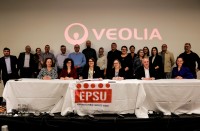
Diversity and inclusion : On 26
March the Veolia group and the
European Public Service Union (EPSU) signed a European
Diversity and Inclusion Framework Agreement. This text contains a number of
binding commitments on equal treatment, anti-discrimination policies and support for
workers facing domestic or workplace violence. It follows on from the “letter of
commitment” signed on 16 June 2021 by the group’s HRD and the EWC on “changes in the
business lines and the diversity and inclusion policy” of the group. In the event of
workplace or domestic violence, the agreement grants “leave of absence with full pay
to enable employees who are victims of violence and harassment at work, and who so
request it, to take the necessary steps, especially administrative formalities such
as filing a complaint”. The signatories grant an employee the right “to refuse a
move to a country where their rights would be further restricted or threatened
because of their sexual and emotional orientation and/or their membership of the
LGBTIQ+ community”. Paola Panzeri, Deputy General Secretary of the European Public
Service Union (EPSU) comments as follows (see A question for…): “Even though some of
the rights granted by the agreement apply to only one person or just a few people
within the group, such as the employee’s right to take paid leave in connection with
domestic violence, to reject a move to a country that is hostile to the LGBQI+
community or the right for an employee to have their chosen name or adopted family
name used in the company’s internal communications, this will already be a very
positive change, as these are genuine rights, and they can make a big difference to
these people”. An oversight committee is being set up and will have access to a set
of key performance indicators (KPI) (see EPSU press
release).
|
Dispute settled : On 28 March,
the Uni Global Union federation issued a press release concerning the settlement of
a dispute between the management of BNP
Paribas Taiwan and one its employees, who had sent a number
of emails to his colleagues with a view to forming a trade union. The Taiwan
Federation of Financial Unions (TFFU), which is a trade union affiliated to UNI,
provided its support to the employee throughout the process and requested UNI Global
Union’s intervention through the global agreement. UNI Global Union is pleased that
the dispute has been resolved, thanks to the global agreement (see press release).
|
4. Studies
and reports

Platform workers’ health :
Following a formal request from the CGT trade union
confederation to conduct a risk assessment, the French National Agency for Food,
Environmental and Occupational Health & Safety (ANSES) examined the working
conditions of the 71,000 self-employed delivery riders and drivers working for
platforms in France, most of whom spend their time delivering food, and published an
opinion
on 26 March (see also report).
The document analyses the short, medium and long-term effects of the algorithmic
management system used by platforms. In addition to the short-term risks posed by
traffic accidents and musculoskeletal disorders, the study also identifies harm
caused to these workers’ mental health (stress, fatigue, burn-out), linked to the
constant pressure of notifications, isolation and the lack of stable working
relationships. In the longer term, ANSES notes that they are likely to suffer from
sleep disorders and from metabolic, respiratory or cardio-vascular diseases linked
to their non-standard working hours and their working environment (urban pollution,
noise, etc.). Among other things, ANSES recommends that these self-employed workers
should be subject to the Employment Code, as it would guarantee levels of health and
safety protection equivalent to those enjoyed by employees.
|

Telework and mental health : On
27 March, the study and research department of France’s Ministry of Labour published
a study
based on a review of literature focusing on the risks associated with telework. This
practice, which applied to 26% of employees in 2023, identifies three main
categories of risk: a distancing of social relationships, an intensification of work
and difficulties in managing the separation of employees’ work and personal lives.
|
Keeping older workers in the labour force :
On 31 March, the European Foundation for the Improvement of
Living and Working Conditions (Eurofound) published a study entitled Keeping
older workers in the labour force. The report, which analyses national
policies designed to keep these older workers in employment, and the responses given
by social partners, notes that caring facilities and social support are vital for
older workers, and especially women, many of whom exit the labour market prematurely
in order to look after family members.
|
|
|











