 |
| |
IR Notes 261 – 05 November 2025
www.irshare.eu
|
|
|
| |
| |
A question for…
Séverine Picard, Chief Executive Director of Progressive Policies

You recently published a report on
occupational safety and health as the forgotten dimension of EU
trade (see 4. Studies and reports). What lessons do you think
can be learned, and do you see a role for European Works
Councils to play here?
Our report shows that the EU is exporting
its toxic waste, especially to Global South countries, and Africa in
particular, to have it recycled. This means we’re exporting our
health and safety risks, which are then being managed outside EU
borders. What’s more, countries that have concluded trade agreements
with the EU, especially those in Africa and South America, are
seeing a major boost to their trading opportunities as a result of
these special partnerships, but without benefitting from higher
worker protection standards. This means that, in statistical terms,
these workers are facing increased health and safety risks through
trade with the EU.
In our
recommendations, we make clear our view that it is absolutely
necessary to review these agreements, which are no longer suited to
the growth in trade, bearing in mind that this low level of
protection is what these countries actually want, rather than having
health and safety standards imposed on them. Should we penalise
them, at the risk of creating economic problems for them, or can we
find other ways to reduce the risk exposure faced by workers in the
countries concerned? It’s a complex question, but it leads to our
recommendation to leverage due diligence, especially in the sectors
that are most exposed, such as extractive industries, agriculture
and chemical waste management. EWCs could play a more influential
role in this area, as they exert influence on companies’ central
management. As yet, they’re not exploiting this possibility as much
as they should be, but admittedly, in many cases they’re already
struggling to assert their rights to be informed and consulted.
Nevertheless, they could monitor what is going on and use their
influence on central management when complaints are fed back to them
by local trade unions, via international trade-union federations,
though this assumes the existence of permanent links between these
various actors. A EWC could also set up a permanent working group
dedicated to due diligence or alternatively appoint a member who
would be specifically responsible for checking compliance,
especially within groups with long subcontracting chains.
|
|
|

|
| |
Agenda
10 and 11
November
Luxembourg
Conference
of the University of Luxembourg on the theme “Regulating Minimum
Wages: Between the EU and the Member States.” (Registration).
11 November
Luxembourg
The Court of Justice will deliver its judgment in the case of Denmark v.
the European Commission, concerning the Minimum Wage Directive.
13
November
Brussels
A
conference jointly organised by the European Commission and the European
Economic and Social Committee (EESC), entitled: “Building
the workforce of tomorrow: inclusive participation and quality jobs
for a competitive Europe”.
19 and 20
November
Bordeaux
The
European Trade Union Institute (ETUI) is organising a training
seminar on the support that trade unions can provide to European
Works Council in the context of transnational restructuring.
20 November
Dublin (and on
line)
Eurofound Forum 2025: Europe’s
social model – the key to competitive growth, with Roxana Mînzatu,
Micheál Martin, Li Andersson, Brigid Laffan, Daniel Susskind and Ivailo
Kalfin.
1
December
Brussels
Employment
and Social Policy Council meeting
4 December
Lisbon (and on
line)
A conference organised by the
European Trade Union Institute, Práxis and the Centro de Investigação e
Estudos de Sociologia (CIES-Iscte), entitled “Reviving
worker participation in Portugal and Europe: towards a progressive
agenda to democratise the economy”.
|
|
|
|
|
| |
Who we are?
IR Notes is a
fortnightly newsletter produced by IR
Share and its
network of experts, and is available in several European languages
(English, French, German, Italian, Spanish, Polish). It offers
Europe-wide monitoring of employment law, labour relations and
employment policy. It is available by subscription for 273 euros per
year .
The team: This
issue was producaed by Inès
Bollet, Victoria
Fonseca, Ambre
Grenier-Boley, Laura Renucci, Iris Turlan
and Frédéric
Turlan. Find out more about the IR Share team on our website.
Subscribe to IR Notes
Via the IR
Share website or by calling us on: +33 (0)6 81 41 53 95
or
E-mail: frederic.t@irshare.eu
Legal notice.
Publisher: IR Share SARL – 5, Les Compères – 89520 Fontenoy,
France – Tel.: +33 (0)6 81 41 53 95 – share capital 1,500 euros –
commercial register (RCS Auxerre): 512 567 959. Managing editor:
Frédéric Turlan. Hosting: ALTEO by Damien Cornillet – Château – 89500
Villeneuve-sur-Yonne. CPPAP no.: 0626 Z 93933.
|
|
|
|
|
| |
Follow us on LinkedIn!

Why not connect to the IR Notes LinkedIn page, so that you can keep up with
developments in the issues we’re covering, between two editions?
You’re welcome to follow us! There are already 751 of you following
us!
|
|
|
|
|

|
|
|
Lead
story
The
Commission’s work programme for 2026
On 21 October, the European Commission published its work
programme 2026, supplemented by an annex
setting out the timetable, the texts under discussion and the texts to be evaluated
or repealed (see press
release). As far as social Europe is concerned, the programme merely
restates a number of announcements that have already been repeated many times. 1/ The quality jobs “package” is
duly scheduled, though with no clues whatsoever regarding its content
(4th quarter). The text merely indicates that this “Quality Jobs Act”
must “ensure that modern employment keeps pace with the modern economy”. 2/ The other “package” on “fair
labour mobility” (3rd quarter) will include legislative proposals
relating to: a European social security pass; strengthening the European Labour
Authority; and skills portability. 3/ As for the current
legislative process, one awaited text is absent from the programme: the proposal for
a directive on telework and the right to disconnect. This should mean that it will
be put forward by the end of 2025. As for the proposal for a directive on quality
traineeships, it looks set to continue working its way through the legislative
process, as do the proposals for a regulation on the declaration of posting of
workers, on the revision of the European Globalisation Adjustment Fund and the
creation of an EU talent pool. On the other hand, the proposed revision of the
directive on the protection of workers from risks related to exposure to
carcinogens, mutagens and reprotoxic substances at work may be abandoned. 4/ Several strategies and
initiatives are announced to boost citizens’ purchasing power and combat poverty, an
area where the EU is lagging behind. The following are announced: an initiative to
tackle “issues related to short-term rentals” (2nd quarter); a “European
Affordable Housing Plan” (4th quarter) and an “EU anti-poverty strategy”
to “address structural causes of exclusion and strengthen support services”
(2nd quarter). This will include “a strengthened Child Guarantee that
will include investments and reforms to tackle child poverty”. There are also two
strategies covering “gender equality” (1st quarter) and “the rights of
persons with disabilities” (2nd quarter). 5/ Work on the goal of
simplification will continue, so as to cut the administrative burdens faced by
companies, with a number of new “omnibus” packages on various topics. However these
do not affect social legislation – directly, at least. 6/ A number of significant texts
that may affect employment relationships are announced: the presentation of a
28th regime for innovative companies (1st quarter) that might
include a simplification of the social legislation applicable to start-ups; a
revision of public procurement rules (2nd quarter) that might allow a
strengthening of the obligation to adhere to social clauses, such as restricting
public contracts to companies that apply a collective agreement, an evaluation of
the legislation covering market surveillance and compliance of products, and an
evaluation of the whistleblower protection directive (4th quarter).
|
1. European
Union
Legislation
European Works Council : On 27
October, following on from the Parliament (see IR Notes
260), it was the turn of the Council of the EU to definitively adopt the revision
of the European Works Council Directive (see press
release). The directive will enter into force as soon as it has been
published in the OJEU. After the directive has entered into force, Member
States will have to transpose it into their domestic law within two years and apply
it within three years.
|
Social
update

Domestic violence : On 17
October, the Employment and Social Affairs Council approved Conclusions
on Violence against women and domestic violence. Ministers state that
“preventing and combating violence against women and domestic violence is a societal
responsibility, as violence undermines gender equality and women and girls’ right to
equality in all areas of life and hinders their equal participation in society and
the labour market, and can lead to serious health or safety consequences and even
fatalities”. As far as employment relationships are concerned, these conclusions
invite Member States to take initiatives to promote training for “workers in
relevant fields” that can accommodate women who are victims of violence; and take
actions leading to “awareness-raising and education among the population as a whole,
including bystanders (…)”. States are also urged to “support the development of
tools and training for healthcare workers, care workers and social workers in order
to help them detect cases of violence against pregnant women and new parents,
bearing in mind that violence may escalate around the time of pregnancy and birth”.
|

Restructuring : On 30 October,
the European Commission proposed releasing aid worth 8.5 million euros via the
European Globalisation Adjustment Fund (EGF), to support 5,800 of the 6,500
employees dismissed following the bankruptcy of electric battery manufacturer
Northvolt in Sweden. The Swedish government applied for EGF support in June 2025.
Aid accounts for 60% of the budget under the scheme, with the remainder being funded
by the Swedish Public Employment Service (see press
release).
|
Case law

Social dumping in the transport industry :
On 16 October, the Court of Justice handed down a judgment
upholding a 2019 Danish regulation that restricts the cabotage operations of
non-Danish transport companies to “seven consecutive days in one calendar month”
(Editor’s note: cabotage is the transport of goods – including loading and unloading
– between two points within national territory, undertaken by a non-resident
company). The European Commission’s view is that this regulation restricts transport
companies’ freedom to operate within Member States, but Denmark argued that this
regulation precisely defined the notion of “occasional services”, as provided for by
EU law in the area of cabotage, and was part of the margin of discretion left to
Member State when implementing texts. The Court of Justice confirms that the
“waiting period” imposed by Denmark “does not go beyond what is necessary to attain
the objective pursued by that practice, which is to ensure that cabotage operations
by coach and bus are not carried out in such a way as to create a permanent or
continuous activity in the same host Member State.” The European Transport Workers’
Federation (ETF) stresses that this represents “a major victory in the ongoing
battle against social dumping in the transport sector.” Flemming Overgaard, chairman
of the Danish trade union 3F Transport, comments that “the ruling also means that
Sweden and other countries are free to copy the Danish rules and put effective
brakes on the undermining of wages and working conditions for foreign drivers
throughout the Nordic region” (see press
release).
|
2. Member
States
Germany

Presumed discrimination : The
Bundesarbeitsgericht (BAG – Federal Labour Court) has delivered a ruling
pointing out that a difference in pay between men and women for work of equal value
creates a presumption of discrimination, which must be corrected by the employer
(see press
release). In this particular case, a female employee had denounced a pay gap
with one of her male colleagues (without taking account of a comparable group of
male employees), on the basis of a dashboard released by the employer, in accordance
with German pay transparency law. The regional labour court had initially rejected
the claim on the grounds that comparing her salary with a group of comparable male
employees and a group of comparable female employees did not reveal any unjustified
pay gaps. However, the BAG partially quashed this decision, aligning itself with EU
Court of Justice case law and validating the comparison made only with the male
employee cited by the complainant. The DGB trade-union confederation has expressed
its satisfaction with this decision (see press
release) and calls on Germany to rapidly transpose the pay transparency
directive.
|

Occupational health : The
Ministry of Labour and Social Affairs wants to reduce the amount of bureaucracy
faced by companies in the area of occupational health and safety, thereby cutting
administrative burdens by around 200 million euros per year (see press
release). Among other changes being made, companies with fewer than 50
employees will no longer be required to appoint a safety manager. Three packages of
measures will gradually be implemented during the current government’s term of
office. The first one is due to enter into force in November.
|
Austria

Caring, an arduous occupation :
The work of nurses, carers and care assistants will be
recognised as an arduous occupation in 2026 (see GPA
and ÖGB
press releases). The measure, which is supported by the trade unions, is intended to
enhance working conditions in a sector dominated by female employees and
experiencing a labour shortage. Part-time workers who work at least half-time will
also benefit. As of next year, nurses will only have to perform 12 physically
demanding supervisions per month, rather than the current figure of 15. This reform
means that almost two thirds of professionals should be retiring by the age of 65
(see press
release).
|
Belgium

End of career : At the National
Labour Council [Conseil National du Travail – CNT] meeting on 21 October,
the social partners signed several collective labour agreements concerning
end-of-career jobs, making these jobs more accessible for women and workers who are
covered by specific schemes (strenuous occupations, construction, night-time work,
etc.). A number of other collective labour agreements, such as those providing for
an employee’s right to receive an allowance paid during a career break
[allocation d’interruption] or a supplementary early retirement allowance
paid by their former employer [complément d’entreprise], were also renewed,
extending their validity to June 2029 (see press
release). The Confederation of Christian Trade Unions (CSC) expressed its
delight at the decisions taken, and plans to conclude further agreements moving in
this direction in 2026 (see press
release).
|
Netherlands

Free childcare : The government
has launched a public consultation on a draft law allowing working parents to enjoy
(almost) free childcare from 2029 onwards (see press
release). The State will pay childcare benefits directly to host
organisations, thereby bringing the current deferred reimbursement system to an end.
Benefits will also gradually be raised, especially for sectors experiencing labour
shortages. As a result, an extra day’s work will no longer lead to a benefit cut,
which will make work more remunerative.
|
3.
Companies
European
company works council
Employee share ownership : The
management of the Clariane
group has introduced a share allocation plan for its 69,315 employees, who
are spread across six EU countries. The plan has been approved by the European
company’s works council, which represents the group’s European employees. On
2 October, every employee who had been working for the company for at least three
years, regardless of their country, occupation or status, was awarded 50 Clariane
shares free of charge. Employees will acquire permanent ownership of these shares if
the company meets its performance target, i.e. if the customer satisfaction level in
2027 and/or the average customer satisfaction level in 2025, 2026 and 2027 meets or
exceeds the group’s target (see press
release).
|
Transnational agreement
Basic rights : On 17 October,
the management of retail group Carrefour
and the Uni Global
Union federation renewed the global
agreement first signed in 2001. The new
text was signed on the final day of the annual meeting of Carrefour’s EWC
(known as the ‘CICE’), which, says UNI Global Union, “has played a crucial role in
strengthening the GFA through supporting documents addressing gender equality,
violence against women and other key issues” (see press
release). The federation is delighted that “despite recent changes to its
global footprint, the company has maintained its commitment to the agreement’s due
diligence obligations, including throughout its franchise network”.
|
4. Studies
and reports
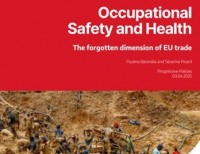
Exporting workplace accidents :
Progressive Policies has published a report
commissioned by the European Trade Union Confederation, which wants to have a better
understanding of the impact on workers’ health and safety resulting from free-trade
agreements concluded between the EU and third countries. Séverine Picard, Director
of Progressive Policies, points out that “virtually no research has been conducted
on this subject to date” (see ‘A question for’… opposite). However, two types of
work are now under way: 1/
Legal work, involving the mapping of all current EU free-trade agreements, to
examine their health and safety provisions (see the report’s Annex).
Among other things, this work shows that the weakest trade agreements, in terms of
protecting workers’ health and safety, are the agreements concluded with countries
that export the largest quantities of hazardous products to the EU. 2/ Research of a more
qualitative nature, examining whether or not the increase in trade flows has any
influence on workers’ health and safety. The report reaches its conclusion at a
fairly early stage, and the answer is that it does, firstly due to waste being
exporting to third countries, and secondly because Global South countries are seeing
a major boost to their trading opportunities. The mathematical consequence of this
situation is more accidents and more deaths at work, in response to our needs for
agricultural products and rare minerals.
|

Algorithmic management and AI in the workplace :
On 21 October, the European Commission published a survey
of 70,000 workers in the 27 EU Member States, performed between late 2024 and early
2025, showing that artificial intelligence (AI) tools are being extensively used in
the workplace (see press
release). 30% of the workers surveyed had used AI-based tools at least once
during the previous 12 months. The uptake of AI varies widely within the EU, ranging
from 45% in Denmark to 13% in Greece. The AI tool used most heavily by workers in
the EU is clearly ChatGPT (21%), which is well ahead of Copilot and Gemini. The
survey also reveals that digital monitoring is quite common: Digital monitoring is
used to track the working hours of 37% of EU workers, and the workplace entries and
exits of 36% of EU workers. The survey also measures the use of algorithmic
management, emphasising that 24% of EU workers have their work schedules allocated
automatically.
|
|
|











