 |
| |
IR Notes 227 – 3 April 2024
www.irshare.eu
|
|
|
| |
| |
A question for…
Brigitte Ollier, Senior Advisor on Social Affairs at UITP

Why
do you and the European trade union federation ETF want to
establish a European sectoral social dialogue committee for
urban public
transport?
The European Commission never really paid
much attention to our sector, which is primarily the responsibility
of local and regional authorities, until it realised that urban
mobility is an important factor in tackling the challenges
associated with climate change. Historically, we were attached to
the EU Social Dialogue Committee for Road Transport, in the form of
a working group. However, attaching us to this group is no longer
appropriate. Our sector is multimodal (bus, tram, train, metro,
etc.), and it doesn’t make sense for us to be associated with a
single mode of transport, such as road. We already have an ongoing
social dialogue within the framework of the working group, and we
have already adopted a number of joint recommendations, such as
those on employment of women and on safety. However, this social
dialogue needs to be strengthened, as a growing number of
cross-cutting European policies will have a significant impact on
both urban transport operators (in the private and public sectors)
and authorities, for reasons including bus fleet electrification,
metro line automation, the introduction of self-driving vehicles,
etc. All of these challenges involve issues of adapting human
resources, delivering training and implementing changes in the
nature of jobs. European social dialogue has full legitimacy to
issue recommendations to companies, authorities and trade unions for
accompanying these changes.
For all of these reasons, around a year ago,
European social partners submitted an official request to the
Commission, seeking the creation of a European sectoral social
dialogue committee specific to the urban public transport sector. No
decision will be made before the next Commission is in place, but we
expect it to agree to the creation of this specific committee, on
the basis of the representativeness study currently being finalised
by Eurofound for the urban transport sector.
|
|
|

|
| |
Diary
3 April
Brussels
The
European Parliament’s Committee on Employment and Social Affairs votes
on adoption of the Radtke report concerning the proposal for a revision
of the European Works Council directive (see press
release).
11 April
Brussels
Discussion on the Council on the compromise text put forward by the
Belgian presidency of the EU on the proposal for a revision of the
European Works Council directive.
15 and 16
April
La
Hulpe
High-level Conference organised by the Belgian presidency of the EU to
debate the implementation of the European
Pillar of Social Rights and adopt the La Hulpe Declaration on
the Future of Social Europe, to prepare the future social agenda of the
2024-2029 period.
|
|
|
|
|
| |
Who we are?
IR Notes is a
fortnightly newsletter produced by IR
Share and its
network of experts, and is available in several European languages
(English, French, German, Italian, Spanish). It offers Europe-wide
monitoring of employment law, labour relations and employment policy. It
is available by subscription for 273 euros per year .
The team This issue
was producaed by Iris
Turlan
and
Frédéric
Turlan.
Find out more about the IR Share
team on our website.
Subscribe to IR Notes
Via the
IR
Share website or by calliang us on:
+33 (0)6 81 41 53 95
or
E-mail: frederic.t@irshare.eu
Legal notice.
Publisher: IR Share SARL – 5, Les Compères – 89520 Fontenoy, France –
Tel.: +33 (0)6 81 41 53 95 – share capital 1,500 euros – commercial
register (RCS Auxerre): 512 567 959. Managing editor: Frédéric Turlan.
Hosting: ALTEO by Damien Cornillet – Château – 89500
Villeneuve-sur-Yonne. CPPAP no.: 0626 Z 93933.
|
|
|
|
|
| |
Follow us on LinkedIn!

Why not connect to the IR Notes LinkedIn page, so that you can keep up with
developments in the issues we’re covering, between two editions?
You’re welcome to follow us! There are already 603 of you following
us!
|
|
|
|
|
| |
European Industrial Relations Dictionary

In case reading IR Notes inspires you to
explore this subject further, we are providing links to the European
Industrial Relations Dictionary published by Eurofound. This is updated at
regular intervals by IR Share, which publishes IR Notes. The term
definitions are available in English and can easily be converted
into other languages using on-line translation tools.
|
|
|
|
|

|
|
|
Lead
story
A
last-minute proposal for a directive regulating the use of trainees

On 20 March, the European Commission put forward a proposal
for a directive and a proposal
for a recommendation to Member States, which is aimed at improving the
working conditions of trainees in the EU and preventing the misuse of traineeships
(see Traineeship). MEPs (see IR Notes 211) and
youth organisations (see IR
Notes 212) have
long been calling for this proposal for a directive, which aims to supplement the
revision of the current Council
recommendation of 10 March 2014 on a reinforced Quality Framework for
Traineeships (see IR
Notes 26). The
main aspects of the proposal for a directive apply only to trainees who have an
employment relationship and not to all trainees – for example, those whose
traineeship is part of a training course are not covered. The proposal seeks to:
1/ Affirm the principle of
non-discrimination, which has already been applied to employees who are on a
fixed-term contract, so that trainees are treated on an equal footing with regular
employees, in terms of their working conditions, including pay. However, objective
reasons, such as having different tasks to undertake, lower levels of
responsibility, less work intensity or the amount of time taken up by the
traineeship’s learning and training component, can provide justification for
treating these trainees differently. 2/
Ensure, by means of controls and inspections based on analysing
six criteria, such as the “excessive duration of the purported traineeship” or “the
requirement for previous work experience”, that traineeships are not used to
disguise regular employment relationships. To this end, the law will require
employers to provide information to the authorities, on request, on the number and
duration of traineeships, and the working conditions associated with them. Member
States will also have to set “a time limit indicating excessive duration of a
traineeship and of repeated, including consecutive, traineeships with the same
employer”. In addition, employers will have to provide trainees with “information on
the expected tasks, working conditions, including pay, social protection, learning
and training elements” in advertisements for traineeships. 3/ Protect trainees against
retaliatory measures if they seek to assert their rights. The law will enable
workers’ representatives to bring judicial or administrative proceedings, on behalf
or in support of one or more trainees, in order to enforce their rights. Moreover,
given the vulnerability of trainees, Member States will have to establish “channels”
allowing trainees “to report malpractice and poor working conditions”.
For its
part, the proposal for a revision of the 2014 recommendation, which applies to all
trainees, provides for: 1/
fair pay for trainees; 2/
access to social protection for trainees; 3/
designation of a mentor to provide the trainee with targeted
coaching and support; 4/ equal
access to traineeship options, including for persons in vulnerable situations and
ensuring that workplaces are accessible to trainees with disabilities; 5/ authorisation for hybrid and
remote working, ensuring that trainees are given the necessary equipment;
6/ increasing their
employability by providing additional vocational coaching and measures encouraging
traineeship providers to offer trainees regular employment once they have completed
their traineeship.
>
Reactions: The European Youth Forum
believes that the Commission’s initiative takes one step forward and two steps back.
It’s a way “to tackle an increasing problem: the replacement of entry-level jobs by
(unpaid) internships”. However, this means the directive is “only looking at workers
disguised as interns, instead of well… all interns in the labour market”. It “leaves
too many responsibilities for the labour inspectors, who are already underfunded and
overworked”. “All interns in the labour market deserve a fair pay”, says the NGO
(see press
release). “Unpaid traineeships mean bright young people from working class
backgrounds are locked out of many careers because they can’t afford to work for
free”, adds Tea Jarc, Confederal Secretary of the European Trade Union
Confederation. “The directive proposed today does little to address this scandal,
giving yet another job to under-resourced labour authorities when the obligation
should be on employers to deliver quality traineeships” (see press
release).
|
1. European
Union
Legislation

Health and Safety : Directive
2024/869 of 13 March 2024 amending Directive 2004/37/EC and Directive 98/24/EC
as regards the limit values for lead and its inorganic compounds and for
diisocyanates (other
languages) was published in the OJEU on 15 March. The new
provisions will have to be transposed into domestic law by 9 April 2026.
|

New Zealand : The Free
Trade Agreement between the European Union and New Zealand (other
languages) was published in the OJEU on 25 March. It includes articles on
multilateral labour standards and agreements (Art. 19.3), gender equality (Art.
19.4) and responsible business conduct and supply chain management (Art. 19.12).
Each Party undertakes to promote “social dialogue on labour matters between social
partners and relevant government authorities” (see Fair trade agreement).
|

Violence and harassment : On 25
March, the Council of the EU adopted a decision
inviting Member States to ratify ILO
Violence and Harassment Convention (No. 190) (see press
release). The EU is unable to ratify this convention because only States can
be parties to it. So far, the convention has entered into force in Spain, Greece,
Ireland and Italy, and it will enter into force in the coming months in four other
Member States (Germany, Belgium, France, Portugal) (see ratification
page).
|
Social
update

Labour shortages : On 20 March,
the European Commission published a communication
entitled “Labour and skills shortages in the EU: an action plan”, with the
aim of remedying these shortages, which “are a serious bottleneck for the EU’s
sustainable and inclusive growth, competitiveness, green and digital transitions”.
The Commission points out that the shrinking working-age population, the job growth
expected from the green and digital transitions, and poor working conditions, “such
as above-average job strain and low wages, are key factor[s] behind persistent
labour shortages in some occupations and sectors”. It plans to provide funding to
social partners, so that they can expand their work in combatting this trend, and
invites them “to submit operational projects” (see press
release).
|
Sectoral
social dialogue

Violence perpetrated by third parties :
On 19 March, European social partners from several business
sectors embarked on negotiations aimed at revising the 2010
guidelines to tackle third-party violence and harassment (see Harassment and violence at
work). According to the European Public Service Union (EPSU), the
main points addressed concern gender-based violence, including domestic violence;
digitalisation and cyberviolence; health and safety risk assessments, including
staffing levels and workload; support, sanctions, compensation and redress.
Moreover, “the multifaceted nature of violence which often occurs at the
intersection of precarity, racism, sexism and homophobia, will be a cross-cutting
issue” (see EPSU press
release).
|
2. Member
States
Austria

Occupational disease : On 28
March, Parliament passed a
law updating the table of occupational diseases, which now covers 73
diseases, including four new ones (see press
release). The ÖGB trade union confederation is pleased that “white skin”
cancer has been included in the list, but disappointed at the lack of ambition
demonstrated in this update. It wants to see an ongoing update procedure established
(see press
release).
|
Belgium

Dismissal for medical reasons :
From 1 April 2024 onwards, employers who invoke “medical force
majeure” as grounds for terminating a contract of employment will have to pay a
contribution of 1,800 euros into the “Back to Work Fund”, managed by the social
security authority. The employees concerned will receive a voucher for career
guidance or personalised coaching, to help them move into a new job. From 1 April
2025 onwards, employees and unemployed persons who have been recognised as unfit for
work for more than a year, will also be eligible to use this fund (see press
release).
- Platform workers:The
Council of Ministers has approved a draft royal decree fixing minimum terms and
conditions for the insurance contracts that digital platforms are required to
take out to cover their self-employed workers. The protection offered by these
contracts must be at least equivalent to the law governing accidents at work
(see press
release).
|
Denmark

Longer leave for employees with twins :
From 1 May, the parents of twins will enjoy 26 weeks of parental
leave, split between the two parents, i.e. 13 weeks each, to be taken before the
children’s first birthday (see press
release and text
of law).
|
Ireland

Flexible and remote working : On
7 March, the government gave its approval for the right to request remote and
flexible working arrangements, as provided for by the Work-Life Balance Act of 4
April 2023 (see IR
Notes 206). With this in mind, the Workplace Relations Commission (WRC) has
published a Code
of Practice for Employers and Employees. All employees are now entitled to
apply to work remotely. Parents and employees looking after children or family
members who need to be cared for, are also entitled to request flexible working. The
reasons mentioned by the guide for requesting a switch to remote working include:
reducing the carbon footprint, neurodiversity and particular medical needs requiring
a calm working environment. Being in breach of the code is not an offence, but this
can be invoked where a complaint is lodged with the WRC, alleging a breach of these
new rights (see press
release). The ICTU trade union confederation has welcomed this code (see press
release).
- Retirement at age 66: The
government has passed a draft law enabling employees whose retirement age
(frequently 65) is fixed at below 66 in their contract of employment – when the
State retirement pension becomes payable – to carry on working until they obtain
the State pension. Contractual clauses stipulating a lower retirement age will
therefore no longer be enforceable against employees (see press
release). The ICTU trade union confederation has welcomed the
introduction of this law (press
release).
|
Slovakia

Returning to work : On 26 March,
the government put forward two draft laws designed to combat labour shortages.
Employers who recruit someone who has been registered as unemployed for at least two
months, to a position that will be their first job, and for a period of either at
least 12 months or an indefinite period of time, will receive a subsidy. This
subsidy is intended to make it easier to recruit young graduates and people who have
been working abroad but would like to return to Slovakia, where they have not yet
worked for the first time. The State will pay employers a monthly subsidy of 1318.50
euros for six months. In addition, at the time they are recruited, people who have
been registered as unemployed for at least two months will receive a bonus of 150
euros per month for the first 3 months, then 75 euros per month for the next 3
months, to encourage them to stay in their job (see press
release).
|

Minimum wage : In preparation
for transposing the directive on adequate minimum wages, the Minister of Employment
has drawn up an amendment designed to fix the minimum wage, from 1 January 2026
onwards, at 60% of the average monthly wage over the past two years. The Minister
says the minimum wage might rise to 920 euros and pass the threshold of 1,000 euros
in 2027. He is also planning to review the law on extending collective labour
agreements, in order to simplify the process of requiring all employers in a given
sector to implement these agreements; the aim here is to meet the target of having
80% of employees covered by a collective agreement (see press
release).
|
3.
Companies
European
Works Councils

Renegotiation : The TechnipFMC group has
renegotiated its European Works Council agreement, which was concluded for a fixed
term, and replaced it by a new
agreement lasting indefinitely, which was signed on 19 December 2023. The
agreement covers the EU, the EEA and the United Kingdom. The council will meet twice
a year, and in principle these ordinary meetings will be held in person. In
addition, it will be consulted in exceptional circumstances only, where at least 15%
of the workforce in each of the countries concerned are affected, via extraordinary
meeting(s) held on line. Members are entitled to one day’s training per year,
delivered on line. The EWC is entitled to use the services of an expert in
exceptional circumstances only, and only if such services are “absolutely
necessary”. The Council Secretary will be assigned 40 hours per annum to carry out
their work, while the other members will each have 24 hours. The text states that
once the relevant technologies are deemed to have reached maturity, the parties
intend to use automatic interpreting facilities at meetings held only in English.
> See also: Geopost European
Works Council agreement signed on 5 March 2024.
|
Corporate
Social Responsibility
A minimum level of social protection :
On 21 March, the TotalEnergies group unveiled a
programme benefitting all of its employees worldwide, based on four pillars: 1/
Social protection: all employees are covered by “an adequate and reliable health
insurance plan” and a “death benefit plan that is equal to at least two years of the
gross reference salary”; 2/ Health: every employee is entitled to a health check-up
once every two years and will benefit from a psychosocial risks prevention
programme; 3/ Family benefits: at least 14 weeks’ childcare leave on full pay is
granted to the primary parent and two weeks to the secondary parent. A pay rise
during periods of parental leave is guaranteed; 4/ Working environment and
conditions: flexible working hours are adopted as standard, together with “Green
Fridays”, thus freeing up employees from any collective meetings scheduled by
management, every other Friday (see press
release).
|
4. Studies
and reports
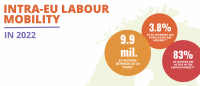
Mobility in the EU : On 12
March, the European Commission published its 2023
Annual report on intra-EU labour mobility (see also Executive
summary). This shows both a remarkable degree of stability, with almost 10
million working-age people (a figure that represents 3.8% of the EU working-age
population) having been movers in 2022, and a return to the posting levels seen
before the Covid-19 crisis, with 3.1 million posted (full-time equivalent)
employees, compared to 2.6 million in 2021 (up 19%). These movers are often people
with a high level of education (32% in 2022, compared to 28% in 2016) (see press
release).
|
|
|











