
After decades of activism and increased efforts by organisations to improve the inclusiveness of unions, women now represent close to half of Europe’s trade union membership. However, women hold over a quarter of union leadership positions.
The numbers
The primary pan-European study of gender equality within trade unions is the ETUC’s Annual Gender Equality Survey. This is an indicative survey, as response rates can vary from year to year. The latest edition, from 2019, studied 41 confederations in 26 countries. These represent 38 million workers and 80% of the ETUC membership.
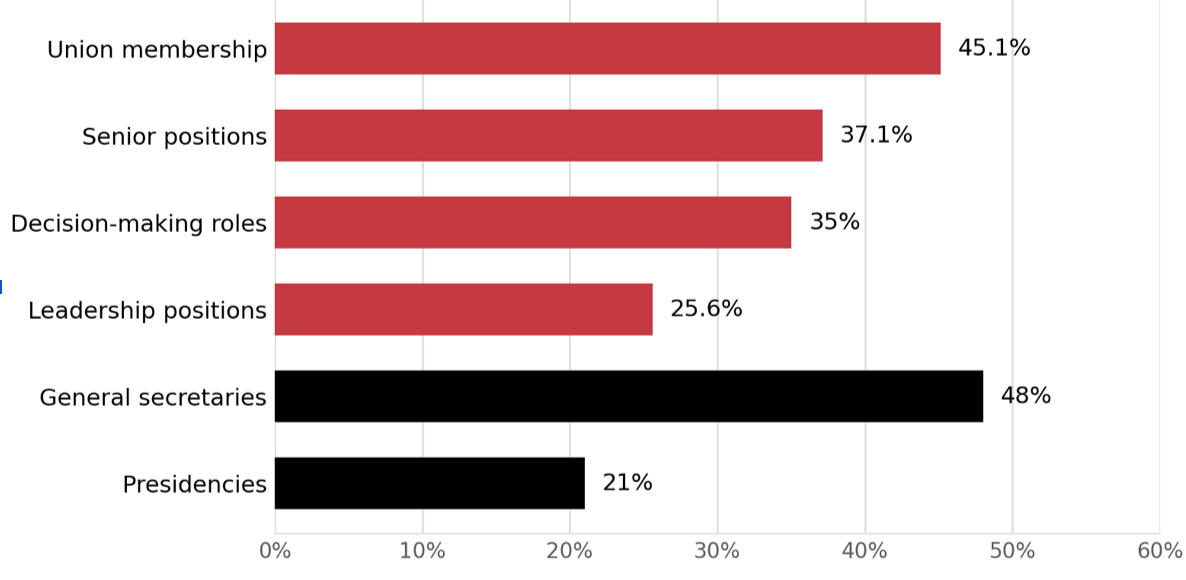
According to the survey, 45.1% of union members were women. This proportion varies between unions and countries, ranging from 77.4% at STTK in Finland, to 29.7% at SGB in Switzerland. In the labour force overall, meanwhile, the proportion of women is generally lower, being highest in Lithuania and lowest in Turkey.
However, women remain underrepresented in powerful positions. On average, women hold 37.1% of senior positions, 35% of key decision-making roles, and 25.6% of leadership positions. Indeed, women represent 48% of general secretaries (12 out of 25), and 21% of presidencies (7 out of 33 presidencies).
Beyond unions, data on workplace representation show varying signs of gender equality. In Germany, for instance, women accounted for 39% of works council members in 2015 (WSI, 2015). When women are underrepresented in the workforce, they are more likely to be present in works councils. Conversely, they are less likely to be present when they represent a large proportion of the workforce. This can be explained by the legislative requirements demanding that the minority gender hold at least proportionate representation to their share of the workforce. Most importantly, women hold only 25% of leadership positions.
The reasons for exclusion
Several barriers prevent women from joining trade unions or accessing leadership positions. A lack of gender policy may reinforce these barriers. Within unions, hegemonic masculinity cultures are strongly embedded. Women are often expected to adopt adversarial and confrontational attitudes to be credible. The unequal division of care responsibilities between men and women can also be a barrier for women.
Additionally, the ETUC studies show that women are more likely to be in part-time, fixed-term, and platform employment, which limits women's ability to become union representatives. With weaker contracts, trade unionism becomes riskier. Labour market segregation is an important barrier to leadership. Lastly, recruitment into trade unions often relies on informal networks, which can reproduce existing gendered patterns.
Paths to improvement
The ETUC established a Charter on Gender Mainstreaming in Trade Unions in 2007, and made recommendations in its ETUC Action Programme on Gender Equality adopted in 2012. The equality plan requires affiliates to keep sex-disaggregated statistics on the number of women negotiations and membership and leadership.
Mandatory proportional representation is also key. The ÖGB (Austrian Trade Union Federation), CFDT (French Trade Union Federation), DGB (German Trade Union Confederation), USO (Spanish Trade Union), and SSSH (Croatian Trade Union) have all implemented either targets or quotas to improve representation. Yet, this does not negate the need for awareness, mentoring, and training. Gender mainstreaming in collective bargaining and social dialogue, as well as women-only courses, can have significant impacts on union confidence and identity.
Further reading:
- Ledwith S. 2012. Gender politics in trade unions. The representation of women between exclusion and inclusion. https://journals.sagepub.com/doi/10.1177/1024258912439145
- Gill Kirton & Anne-Marie Greene. 2010. The dynamics of managing diversity. https://www.sciencedirect.com/book/edited-volume/9781856178129/the-dynamics-of-managing-diversity
- Kirton Gill and Healy Geraldine. 2012. ‘Lift as you rise’: Union women’s leadership talk. https://www.researchgate.net/publication/258139698_'Lift_as_you_rise'_Union_women's_leadership_talk
- Etuc Gender Equality Plan https://www.etuc.org/en/gender-equality-plan-0


