
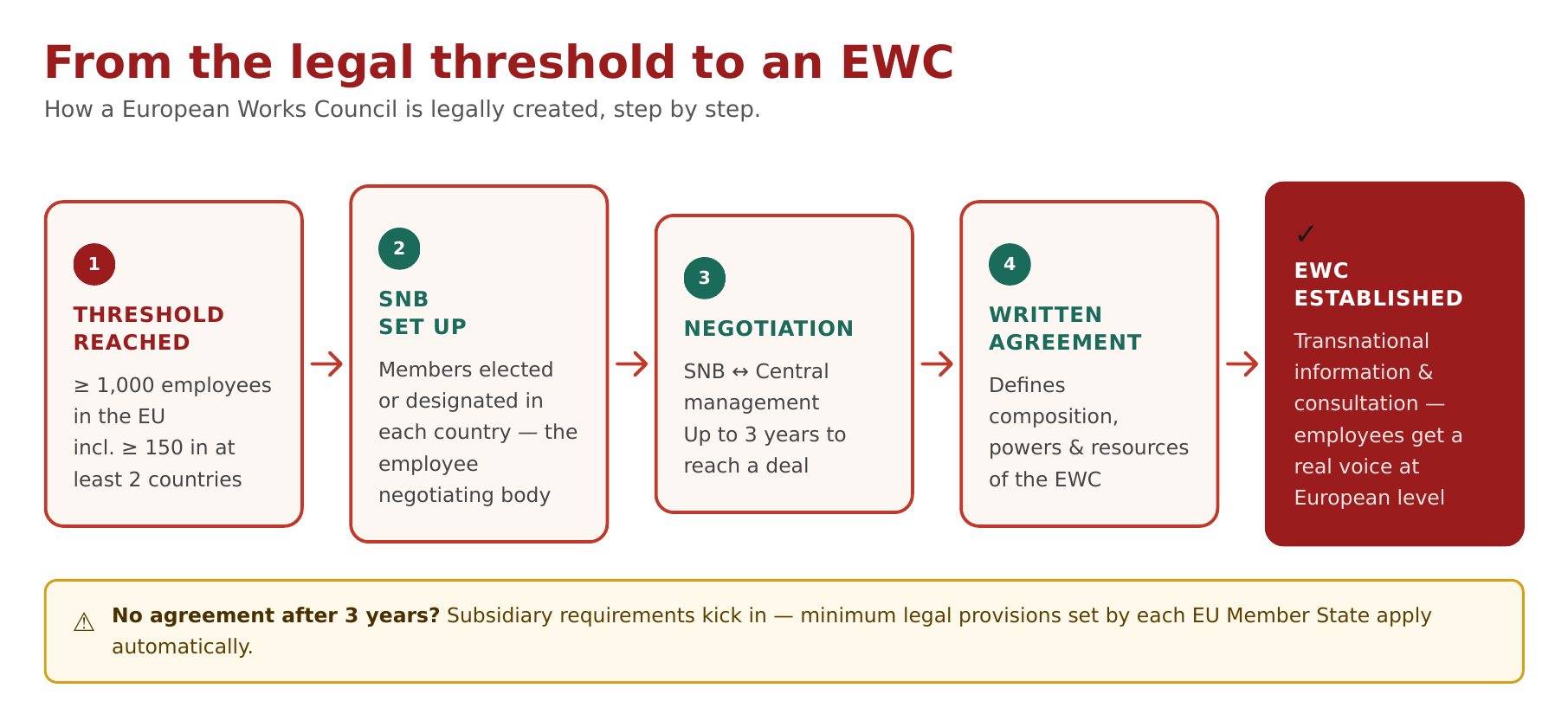
In a nutshell: the Special Negotiating Body (SNB) is a temporary body representing employees, tasked with negotiating with management to set up a European Works Council (EWC).
This term first appeared in European law with Directive 94/45/EC of 22 September 1994 on European Works Councils. This legislation, which has been transposed into the national law of all Member States, stipulates that a European Works Council should, ideally, be established by agreement between the employer's management and a SNB whose members represent employees across Europe.
1. Who are the members?
The Directive refers to national legislation, as the method of appointment varies according to each country’s industrial relations culture:
- In some Member States, members are appointed by the majority trade unions;
- In others, they are elected by the works council;
- Where there are neither trade unions nor employee representatives, they are appointed or elected directly by all employees.
2. How many are there?
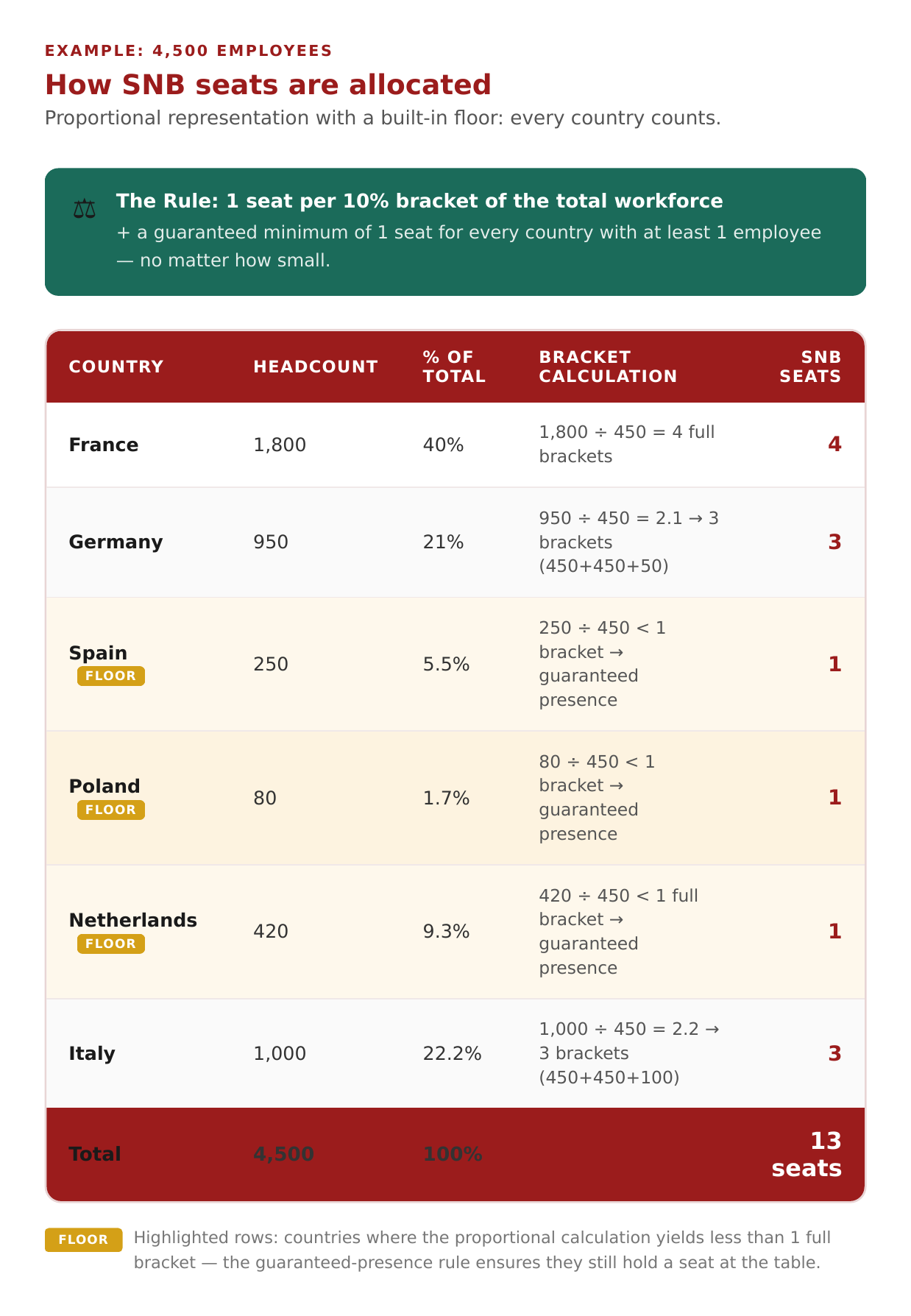
The Directive lays down a clear rule: the number of seats is proportional to the workforce in each country, with a minimum number of seats guaranteed for any country represented within the company, even if there is only one employee.
In practice, a reference band equal to 10 per cent of the total workforce is calculated, and each country is allocated one seat for each band reached.
Beware of a common misconception: some interpret the rule as granting a representative only once the workforce exceeds 10 per cent.
This is incorrect — all countries must be represented, including the smallest ones.
3. What is its role?
The GSN’s task is to determine, in consultation with management and by written agreement:
- the scope of the EWC's activities;
- its composition;
- its powers and the duration of terms of office.
In the absence of a EWC, the GSN may also agree on the arrangements for a procedure for informing and consulting employees.
In accordance with the principle of party autonomy, the members of the GSN enjoy considerable freedom. For example, regarding the composition of the EWC, the GSN may adopt the same structure as its own, but it may also agree on other rules: excluding countries with fewer than 150 employees, grouping several small countries under a single seat, or even allowing representatives from non-EU countries to sit on the EWC (the United Kingdom, Serbia, Ukraine, or India).
In summary: the GSN is temporary. It ceases to exist once the agreement is signed. It is succeeded by the EWC, which then permanently ensures the information and consultation of employees at European level.
4. Not to be confused with SNBs in European collective agreements
The term ‘special negotiating body’ is also used in a different context: some companies negotiate European collective agreements directly with European trade union federations.
In this case, the SNB consists solely of employee representatives who are members of a trade union organisation affiliated to the federation in question. Even if they work for the company or are members of the EWC, they negotiate in accordance with their trade union mandate.
The number of negotiators is determined by agreement between management and the trade union federation, which then makes the appointments.


