Lead story

As the planet burns, a French court issues a ruling inviting companies to take their due diligence plans seriously.
On 25 June, as France and much of Europe sweltered in a heatwave, the Paris Ordinary Court [Tribunal Judiciaire] issued a landmark ruling in the case brought by a coalition of associations and the City of Paris against TotalEnergies.
The court’s 34th Chamber, which is specialised at national level in due diligence cases, was called on to answer two questions in particular:
- Do due diligence requirements include climate issues? On this first point, the court notes that the term “environment”, within the meaning of the due diligence law of 27 March 2017, “must be interpreted in its broadest sense, which includes climate change caused by the discharge of greenhouse gas emissions into the atmosphere, which is a key component of the environment, something that is part of the negative environmental effects recognised in the international and European undertakings to which France is party”. The court adds that because they are “a serious, present and future threat to the enjoyment of human rights […], climate-related risks must be taken into account by companies in their due diligence plan, wherever identifying these risks forms part of the process of preventing serious breaches of human rights”. It also extends its reasoning to take in Directive (EU) 2024/1760 of 13 June 2024 on corporate sustainability due diligence (the CS3D directive). “The inclusion of climate in the environment is supported by” this directive, the Annex of which (Part I, Section 1, Point 15) prohibits causing “air pollution” and “harmful emissions” [that] “substantially impair the natural bases for the preservation and production of food” [or] “harm a person’s health [or] safety”. The court emphasises that “It is therefore undeniable that the said harmful emissions include greenhouse gas emissions generated by human activities”, specifying that the new “Omnibus directive” has “no impact on the due diligence obligations regime”. Clara Alibert, advocacy officer of CCFD-Terre Solidaire’s Acteurs économiques branch, is delighted: “In spite of deregulation at European level, climate-related due diligence is alive and well”, she observes.
- Do (Scope 3) indirect emissions come within its perimeter? In other words, is the group also accountable for the greenhouse gas emissions of drivers who use its fuels? The court emphasises that the group’s goal of carbon neutrality by 2050, which TotalEnergies sets itself in its due diligence plan, “is based on including scope 1 and 2 greenhouse gas emissions only”. The group claims that Scope 3 greenhouse gas emissions generated by its subsidiaries’ customers are outside its control and do not come within the scope of application of the due diligence law. In a detailed and clearly explained ruling, the court “deems that greenhouse gas emissions resulting from its activities form part of the climate-related risks included in the scope of application of due diligence” and orders TotalEnergies to include Scope 3 emissions in its risk-mapping, and in the prevention and mitigation actions contained in its due diligence plan, within a period of six months. A hearing will be held on 21 January 2027, to check that the ruling has been implemented.
This ruling – which is the first to apply due diligence to the field of climate change – is the culmination of a legal battle lasting more than six years. Clara Alibert emphasises that the ruling obliges companies to position themselves seriously on Scope 3, and “is a reminder that no multinational company can evade its responsibility when it comes to climate deregulation”. One aspect of this case still remains a blind spot, though: the extreme discretion shown by employee representatives with regard to this question, despite the European trade union movement proclaiming as early as 2014 that “there are no jobs on a dead planet” – a slogan largely forgotten now, in the name of immediate protection for employment. Nevertheless, the prospect of including Scope 3 in risk-mapping partially explains several asset disposals that have taken place in recent years, such as the removal of retail activities (service stations) from the TotalEnergies group’s scope, in 2023. These were sold to the Canadian group Couche-Tard in Germany and the Netherlands, and transferred to a joint venture with Couche-Tard (60%) in Belgium and Luxembourg, together with several thousand jobs.

 Legislation
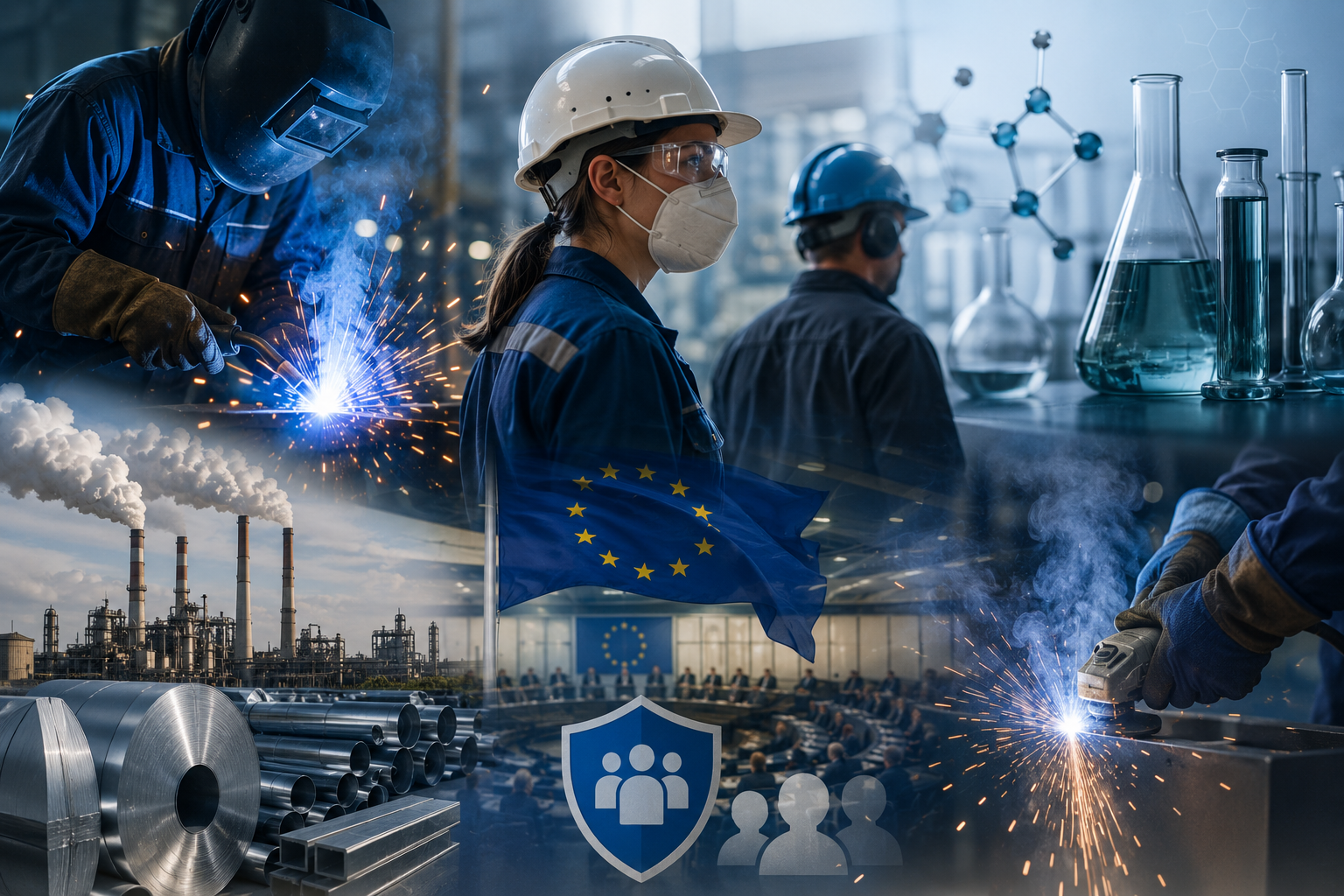
Agreement on the sixth revision of the carcinogens, mutagens and reprotoxic substances directive: On 23 June, the Council and the European Parliament reached a provisional agreement on the sixth revision of the CMR directive, which obliges Member States to set binding occupational exposure limit values (OELs) (see press release). It was unveiled on 18 July 2025, and covers four substances and a work process. Cobalt and its inorganic compounds – used in the manufacture of batteries and magnets – are the subject of separate OELs for their inhalable and respirable fractions, with a six-year transition period. Polycyclic aromatic hydrocarbons (PAH), which are present in steel and aluminium production, and in welding fumes, now have a general OEL. This value is twice as high during the seven-year transition period, and is extended to take in all carbon and graphite manufacturers, because the co-legislators have expanded its scope compared to the initial proposal. 1,4-dioxane (chemical and textile industries) and isoprene (rubber industry) have also been added to the co-legislators’ initiative, supplementing the legislation. The inclusion of welding fumes in Annex I of the directive – which lists processes and substances established as carcinogenic in nature – symbolises the progress made by this revision, which also updates the definitions contained in the text, and includes reprotoxic effects, which is a first. In addition to the initial proposal, the co-legislators have secured the introduction of an obligation to provide regular breaks for workers wearing personal protective equipment (PPE), a clarification of the rules regarding the use of this equipment, and a commitment to develop practical guidelines on welding fumes. A recital also points out that setting OELs does not completely eliminate the residual risks, and a clause provides for revision five years after implementation. The provisional agreement has yet to be formally adopted by both institutions.
Agreement on digital declaration for posted workers: On 23 June, the Council and the European Parliament reached a provisional agreement on the “eDeclaration” regulation, which establishes a multilingual public interface, managed by the Commission, enabling posting declarations to be submitted on line in a standardised format. These declarations include data on pay and work periods, as requested by the trade unions, to make it easier to perform checks. The regulation offers a high degree of flexibility: Member States are free to adhere to the system but if they do so, they are not permitted to demand any further information in addition to that specified by the form, though they can opt to gather only part of this information. The agreement also provides for documents to be submitted directly via the interface, in place of national procedures, and allows posted workers to access their own declarations (see Council press release). The text is widely supported by employers’ organisations, and on 17 June they issued a joint statement calling for the information required to remain limited to that strictly necessary for the notification process. In this sense, “the eDeclaration is positive news for businesses across Europe”, says Markus J. Beyrer, BusinessEurope Director General (see press release). For her part, Isabelle Schömann, ETUC Deputy General Secretary, pays tribute to Parliament’s negotiators, who “have effectively neutralised a dangerous push for deregulation” (see press release). The provisional agreement has yet to be formally approved by both institutions before it enters into force.
Across Europe


 Spain
Spain
A new action plan to prevent workers being exposed to excessive summertime heat: This plan, which was adopted on 9 June at the Council of Ministers, strengthens the monitoring of activities where workers are most exposed to high temperatures. The document sets out measures designed to protect workers, particularly in the agricultural and construction sectors (see press release). The National Institute of Occupational Health and Safety (INSST) and the Labour Inspectorate are planning to run information and prevention campaigns, and to give greater priority to handling complaints made by workers suffering from heat stress (see press release). Decree 8/2024 continues to be applicable: it provides for four days’ leave in cases where it is impossible for workers to access their workplace or where protection protocols have to be applied due to high temperatures. At a conference held on 15 June, Employment Minister Yolanda Díaz indicated that during the summer of 2025 (June-September), the Labour Inspectorate took “more than 10,000 actions relating to unfavourable environmental conditions, which identified almost 300 offences and led to the imposition of penalties amounting to almost 1,600,000 euros”.
 Netherlands
Switching the burden of proof for checks on compliance with paying the minimum wage: A bill seeks to ensure that companies pay the minimum wage, thanks to a legal presumption. The employer would be required to prove that all of its employees are being paid at least the statutory minimum wage (see press release). If the employer fails to do so, the Labour Inspectorate can demand that they provide documentary evidence. If no evidence is produced or if the employer is found not to have been paying the minimum wage, the authorities will be entitled to calculate the amount owed, and if applicable, impose penalties. This bill seeks to protect the most vulnerable employees, especially migrant workers.
Spain
A decree to strengthen digital monitoring of working time: On 2 June, the Secretary of State for Labour announced that the government plans to pass a royal decree before the summer, with the aim of updating Decree-law 8/2019 which, in 2019, made it a requirement for all companies to log their employees’ working time. Under this plan, companies will have to use dedicated monitoring software to keep an exact record of the number of hours actually worked (see IR Notes 271).
 Belgium
Reform introducing widespread recourse to flexi-jobs enters into force: The law introducing miscellaneous provisions concerning flexi-jobs – which escape the usual rules applicable to social security contributions and taxation – was approved by the Chamber of Representatives on 18 June. On 1 July, the option of flexi-jobs is being extended to a majority of sectors, subject to compliance with eligibility conditions on taking them. These vary according to circumstances (full-time workers, pensioners, temporary agency workers, etc.). An assessment will be made one year after the reform has entered into force, to analyse its effects on the labour market and on workers’ health, plus its budgetary repercussions, among other things. The FGTB trade union confederation is sceptical and critical of a reform that will cost the State and the social security system “more than half a billion euros” (see press release). The Belgium Employers’ Federation, on the other hand, sees flexi-jobs as “a catalyst providing opportunities for workers, pensioners and businesses” (see press release).
 Luxembourg
Stricter checks on compliance with the right to disconnect: The right to disconnect, which is provided for by the law of 28 June 2023, will now be imposed more strictly on employers. Since 4 July 2023, they have been liable to pay an administrative fine of between 251 and 25,000 euros if they fail to comply. The penalty is decided by the Labour and Mines Inspectorate, based on the seriousness of the offence committed. Previously, employers were under an an obligation to establish a regime ensuring compliance with this right for employees using digital tools for work purposes, though they did not face any risk of administrative sanctions. Parliament had in fact provided for a three-year transition period, to allow companies to adapt.
 France
Limiting the length of sick leave: Decree no. 2026-498, published on 12 June 2026, limiting the length of sick leave qualifying for payment of daily allowances will enter into force on 1 September 2026 and impose caps on the length of sick leave that did not previously exist. From now on, an initial period of sick leave can last no longer than 31 days, or 62 days if an extension is granted. This is one of the implementing decrees of the social security financing law for 2026; Decree no. 2026-501, dated the same day, states that the daily allowance payable for sick leave linked to an accident at work or to an occupational disease, can be paid for a maximum period of four years. A new four-year period will commence after the employee has returned to work for at least one year.
 Germany
Workforce representatives at Deutsche Post and Ver.di call for better protection against the heat: Deutsche Post works councils, supported by the Ver.di trade union federation, are calling for the introduction of working conditions adapted to extreme temperatures, to protect employees’ health and safety (see press release). Their wish list includes: paid breaks; the right to stop work when temperatures reach excessive levels; plans to protect workers against heat and cold; and free drinks, sun cream and suitable equipment.
 Ireland
Strengthening protection for employees whose employer ceases trading: On 8 June, the government implemented a “Deemed Insolvent Process”, as provided for by the 2026 Act protecting employees whose employers cease trading, in order to remedy situations where a company ceases trading without following a formal procedure. From now on, when they are owed wages and their employer fails to respond within eight weeks, employees can use this mechanism to have their employer “deemed insolvent” and to access the Insolvency Payments Scheme, financed by the Social Insurance Fund. The purpose of this reform is to provide effective protection for workers, under EU law (see press release).
Company updates

 European works councils
A commitment to protect jobs at Stellantis: The EWC of car-manufacturing group Stellantis met from 16 to 18 June at Mulhouse (France), on a site that is not only an assembly plant but also an industrial hub equipped with forges, foundries and machining centres. “This location wasn’t selected by chance”, says EWC secretary Philippe Gilleron: “we wanted to draw the attention of both management and political decision-makers to the importance of protecting the car industry as a whole, and not just its assembly sites.” While workforce representatives support the European Commission’s desire to promote the “Made in Europe” label, they are keeping an eye on forthcoming decisions. Although Made in Europe means that 70% of a vehicle’s value has been produced in the EU, there remains a real risk of business being lost: “given that the battery represents a substantial share of this value, the mere fact of manufacturing it in the EU would mean that a great many parts produced outside the EU could be imported”, warns Philippe Gilleron. The meeting was primarily devoted to FaSTLAne 2030, a strategic plan unveiled on 21 May 2026, at an investors’ day (see press release). Although this plan aims to cut European production by 800,000 units, Stellantis has announced that “no site closures are foreseen in the “Fast Lane 2030” Plan, which is a positive reassurance for the 124k employees working for [the group] in Europe”, says the IndustriAll Europe trade union federation (see press release). As far as social dialogue is concerned, Philippe Gilleron is pleased with the “trust built up” at meetings where “the agenda – drawn up in conjunction with management – dealt with real issues put forward by decision-makers”.
Data and reports

 One employee in five can always be contacted, and is never left in peace
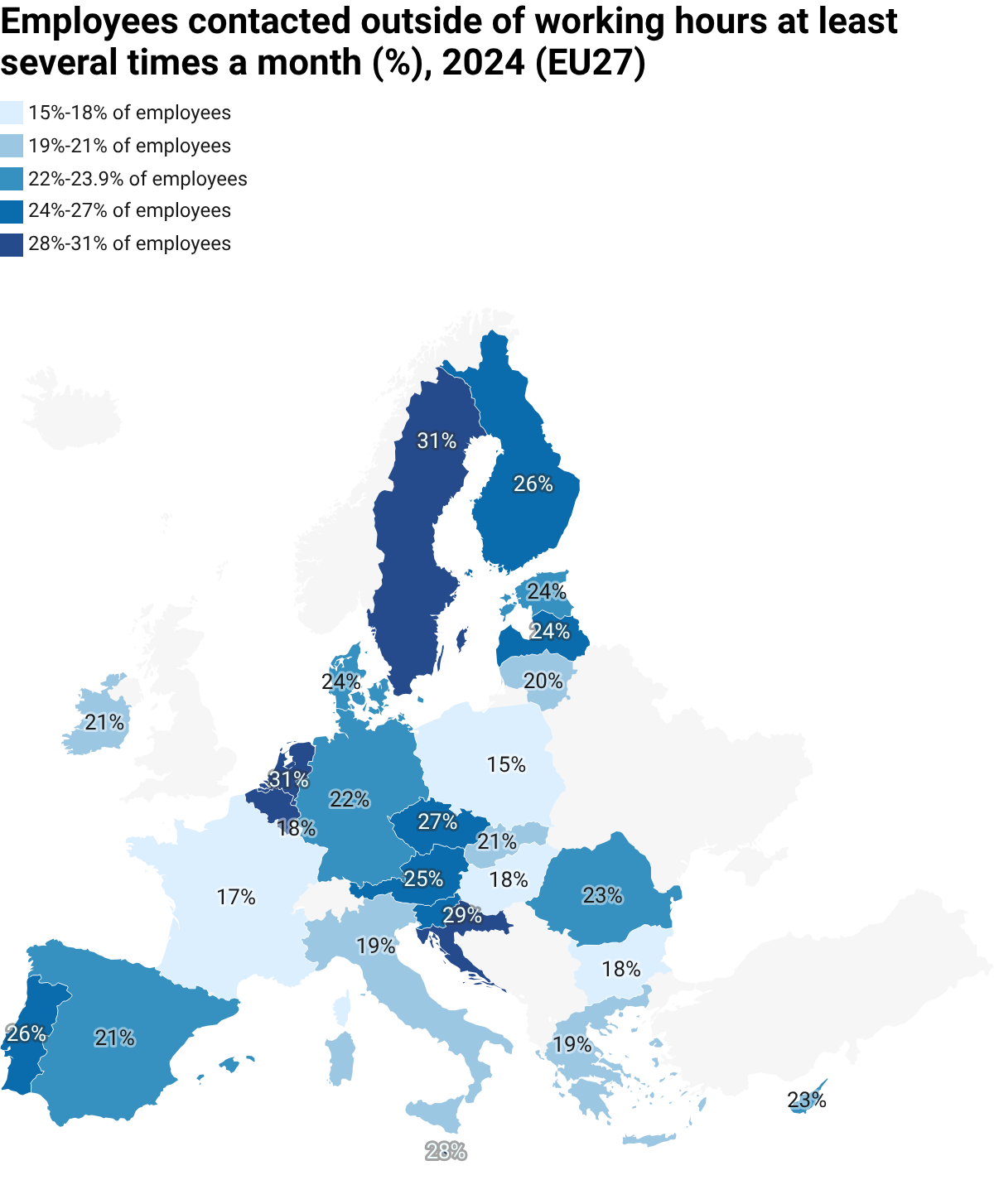
As part of a major study (*) update, Eurofound has published an article examining the right to disconnect. Data gathered by the latest European Working Conditions Survey (EWCS 2024) shows that one in five employees across the EU (i.e. a total of 39.4 million workers) reports being contacted for work-related reasons outside their working hours several times a month. This phenomenon is directly linked to stress: among the persons contacted on a daily basis, nearly 6 in 10 (59%) report experiencing stress at work always or almost all of the time, compared to just 17% for those who are never contacted outside working hours. Workload also plays a role: when employees do not have enough time to complete their tasks during normal working hours, work is more likely to spill beyond contractual hours. The study also looks at the legislation regulating the right to disconnect, which has been enacted in 13 Member States, and emphasises its effectiveness: France, which has been a pioneer in this area, has one of the lowest levels of out-of-hours contact (17%), compared to 31% in Sweden and the Netherlands, where no there is legislation. This data will feed into the debate around the future European law on quality jobs, which the European Commission is due to put forward by the year-end.
(*) Working anytime and anywhere in the EU after the pandemic: The effects on quality of working time
Key Statistic
22,7 %
This is the average proportion of employees contacted outside their working hours at least several times a month in the European Union in 2024.
According to data mapped by Eurofound, this rate varies significantly from one country to another. Sweden and the Netherlands have the highest levels, at 31% each, followed by Croatia (29%) and the Czech Republic (27%). Conversely, Poland has the lowest rate (15%), ahead of France (17%) and Germany (18%).
Three questions for...

Jean-Philippe Lhernould
Professor at the University of Poitiers
Regarding the revision of the European Labour Authority mandate
"The next regulation will need to be clearer about the ELA’s competences, especially where workers from third countries are concerned"
Why is the European Commission considering amending the regulation establishing the European Labour Authority?
It all stems from an institutional obligation. In accordance with regulation 2019/1149, the Commission had to evaluate the ELA’s performance no later than 1 August 2024, with the option of amending the regulation, or even revoking it if there no longer appeared to be any justification for retaining the ELA. On the whole, the evaluation was positive: so the ELA will continue to evolve. The Commission did, however, identify numerous ideas for improvement - for both the authority’s management and its actions - in the aim of strengthening the ELA by revising its objectives, priorities and resources. The ELA has fewer prerogatives than other EU agencies (such as Europol, Frontex, the AMLA, etc.), so it will also have to implement measures for evaluating the effectiveness of its actions, as the Commission has highlighted shortcomings in this area.
Are there already any indications of what might be proposed?
At this stage, all we can do is set out what we’d like to see. We cannot comment much on the proposals that the Commission is still considering. In our opinion, the ELA needs to refocus its efforts on the essentials and scale back its less relevant measures. For example, training activities, which are thought to be expensive, seem too sparse and sometimes too far removed from the ELA’s missions. However, its prerogatives need to be extended to improve the efficiency of its key actions. For example, collecting, sharing and analysing metadata could make it much easier to detect and prevent violations of free movement rules. The ELA could help member States to carry out a strategic risk analysis and identify cases of structural non-compliance - those relating to the posting of workers for example. It could also be given the right to access personal data to deal with such situations and to decide what action to take. Finally, the ELA’s governance needs to be reassessed.
Don’t we also need more clarity about the ELA’s field of responsibility?
That’s a real issue. The ELA is normally only responsible for intra-EU labour mobility situations. However, in practice, many of its actions - tackling undeclared work or the status of drivers in the road transport sector, for example - disregard this requirement. The next regulation will need to be clearer about the ELA’s responsibilities, especially where workers from third countries are concerned. Wouldn’t it be a good idea to redefine the list of regulations and directives within its scope? As for its mediation work - the ELA is responsible for resolving conflicts between member States relating to individual cases -, there’s been little sign of it: we need to find a way of reinventing it.
Editorial

Dear readers,
This is the last-but-one edition of Notes before the summer break. Because 14 July is a public holiday in France, our staff will not be working, and in order to provide better coverage of July’s news stories, the next edition will appear on 23 July rather than 16 July as initially planned. We will also shortly be sending you a satisfaction survey regarding our new format, so that we can take your feedback into account and return in September with an even better offering.
IR Dictionary
Sectoral social dialogue
As in a large number of countries, social dialogue exists at a European level in a significant number of business sectors and is formally incorporated in European Sectoral Dialogue Committees. There are currently 44 such committees, covering sectors as widely varied as the chemical and metal-working industries, agrofood industry and professional football. In each of these sectors, European trade union federations hold discussions with employers' organisations to arrive at various forms of instrument, ranging from the most flexible (joint declarations, good practice guides, joint seminars, etc.) to the most stringent, such as European collective agreements. The documents adopted are available on a European Commission database.
Upcoming Events
2 July
Boulogne-Billancourt (France)
European Works Councils
Face-to-face meeting of the European Works Councils Club, organised by IR Share and Astrees, with EWC secretary members and industrial relations managers, around economist Gilbert Cette.
3 July
Strasbourg
70 years of Institut du Travail
A multiplicity of actors will gather at a symposium held to mark the 70th anniversary of the Institut du Travail, to discuss the major contemporary issues surrounding work, collective bargaining, employees’ collective rights and their rights to express themselves.
22 July
Bruxelles
European Pillar of Social Rights:
The European Commission is due to adopt the new action plan on the European Pillar of Social Rights (see agenda).
16 to 18 September
Oslo
Inequality in the labour market
Conference organised jointly by IWPLMS and IREC: How can trends towards inequality in the labour market be counteracted and what role can actors and institutions play?
The team
This edition has been prepared by Inès Bollet, Victoria Fonseca, Sea Ange Gonebo, Ambre Grenier-Boley, Frédéric Turlan, Iris Turlan and Paula Villalobos. You can read about everyone in the IR Share team on our website.
To find out more about the IR Share team, please consult our website, LinkedIn or IR Notes.
www.irshare.eu
Publisher: IR Share SARL - 5, Les Compères - 89520 Fontenoy - France
Share capital: 1500 euros
Business registration: RCS (Auxerre): 512 567 959.
Publication Director: Frédéric Turlan
Tel.:+33 (0)6 81 41 53 95
Hosting: OVH - 2 rue Kellermann - 59100 Roubaix
CPPAP no.: 0626 Z 93933.
> The IR Notes newsletter is recognised as an “online press service” under Article 1 of Law no. 86-897 of 1 August 1986. In addition to the quality of IR Notes being recognised, “online press service” status allows us to charge a lower rate of VAT (2.1%) on subscriptions to IR Notes.


European social update