Lead story

Social criteria to play a more important role in the rules governing public procurement contracts
On 9 September, the European Commission put forward a proposal for a regulation – the Public Procurement Act – intended to modernise the European framework governing public contracts and concessions at EU level, which account for around 15% of the Union’s GDP (see the Commission’s press release and questions and answers document).
The aim of the reform is to bring the lowest-bidder approach to an end and have it replaced by the “best price-quality ratio”, which is destined to become the standard method used for awarding public procurement contracts. Quality criteria – including environmental, social and innovation considerations – will have to account for at least 30% of the overall score on the basis of which a public contract is awarded, and for up to 50% in the case of labour-intensive contracts, in areas such as cleaning, private security and social services. The text will also prohibits the subcontracting of entire contracts, a practice that is associated with risks of social dumping and exploitation of labour (see also the Commission’s impact assessment report).
Social partners have generally given the text a positive reception, though sometimes for different reasons, which implies that intensive lobbying can be expected when the time comes for EU institutions to scrutinise the text. For example, on the employers’ side, BusinessEurope supports simplification efforts, but is worried that “overloading the rules with secondary objectives risks reducing competition and increasing administrative complexity” (see press release). However, the cautious position taken here conceals a number of fault lines running between different parties in the employers’ camp. In conjunction with the UNI Europa trade union federation, several employers’ associations representing labour-intensive sectors, such as the private security industry, have published joint statements calling for action that goes beyond tackling the lowest-bidder approach and promotes collective bargaining agreements (see UNI Europa – CoeESS statement). SMEunited, which represents craft businesses and SME, explicitly welcomes plans to end the lowest-bidder approach and to introduce a mandatory best price-quality ratio with a minimum weighting for quality criteria (see press release). Employers in the construction industry (FIEC) welcome the obligation to reject abnormally low tenders, and they will be evaluating the proposed measures for overseeing subcontracting (see press release).
Speaking for the trade unions through its General Secretary Esther Lynch, the European Trade Union Confederation (ETUC) welcomed a “vital opportunity to ensure public money promotes quality jobs and collective bargaining”, pointing out that the lowest-bidder approach “has been a disaster for the quality of goods and services” (see press release). All European trade union federations welcome plans to end the lowest-bidder approach – something that they describe as prejudicial to workers and a “race to the bottom”. Nevertheless, several criticisms remain, and they all point in the same direction. As far as subcontracting is concerned, several federations (ETF, FETBB, EFFAT) express regret at the absence of joint and several liability provisions covering the full length of the chain, and also at the inadequate measures being taken to combat abuse. Some federations are calling for the number of subcontracting levels to be restricted. As regards social conditions, these federations deplore the fact that non-compliance with labour law does not constitute a mandatory ground for exclusion, and that social conditionalities remain largely optional (see press releases issued by ETF, FETBB and EFFAT). When it comes to collective bargaining, UNI Europa and the ETUC are calling for companies whose workers are covered by collective labour agreements to systematically be given preference when contracts are awarded (see UNI Europa press release). Other organisations have highlighted gaps that specifically affect their own sectors, such as EFFAT, which regrets the lack of sufficient guarantees relating to the contract catering sector (see press release). It is expected that the text will be adopted from 2027 onwards and enter into force in the first half of 2029.

Legislation
Social sustainability reporting: In the wake of the Omnibus Directive adopted for the purpose of simplifying sustainability reporting, two delegated regulations of 3 July were published in the OJEU on 21 September: 1/ Delegated Regulation (EU) 2026/1560 supplementing Directive 2013/34/EU of the European Parliament and of the Council by establishing sustainability reporting standards for voluntary use by undertakings protected by the value chain cap; 2/ Delegated Regulation (EU) 2026/1563 amending Delegated Regulation (EU) 2023/2772 as regards the simplification of certain sustainability reporting standards. The new European Sustainability Reporting Standards (ESRS) enter into force on 10 November and reports being prepared for 2027 will have to comply with them.
 Projects
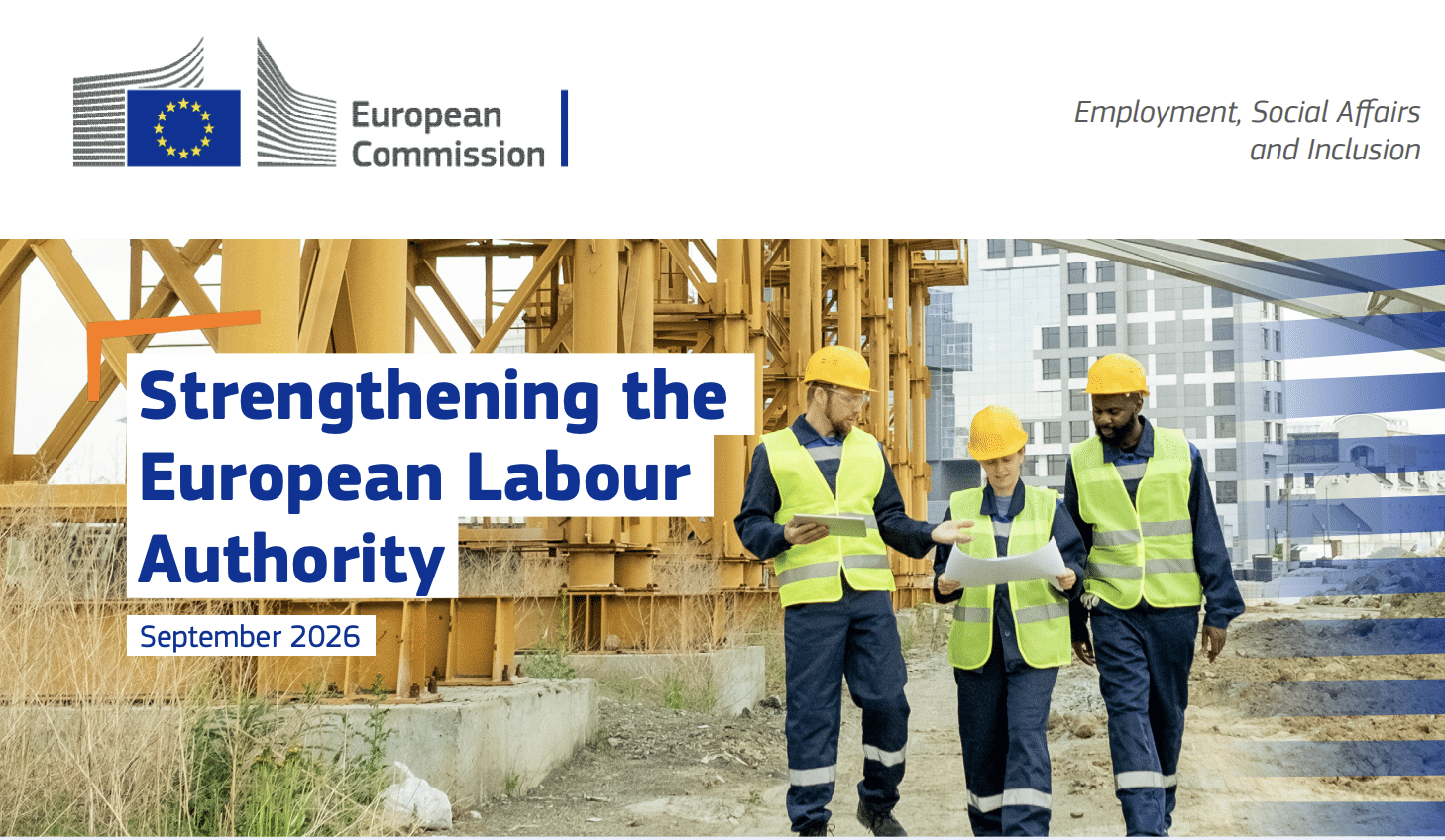
Initiatives to encourage labour mobility: On 15 September, the European Commission put forward a series of measures (the Fair Labour Mobility Package) comprising a communication and five legislative proposals aimed at, among other things, providing mobile workers with better protection from abuse, facilitating recognition of qualifications and streamlining the procedures involved in cross-border working (see press release and questions and answers). This package seeks to reconcile the goals of business competitiveness (simplifying and reducing administrative burdens, etc.) and protection for mobile employees – including third-country nationals who are the ones most exposed to workplace abuse – but without clearly championing either cause, which explains why both the employers and the trade unions have expressed some satisfaction with it, but also concern. The measures put forward by the Commission comprise five legislative proposals:
- The Regulation establishing a European Social Security Pass (ESSPASS) will digitise cross-border social security documents (document A1, European Health Insurance Card), in order to reduce the administrative burden on companies posting workers within the EU.
- The Skills Portability Act “will enable employers to better understand and compare qualifications and skills obtained across the EU and to instantly check their authenticity”, says the Commission.
- The Revision of the Professional Qualifications Directive will shorten the length of time spent on processing and recognising the qualifications needed to access regulated professions, from 4 months to 11 weeks (and 5 weeks in the case of automatic recognition).
- A directive on the recognition of qualifications of third-country nationals who are already present in the Union, setting common rules, fixed deadlines and appeal rights, will enable employers to “accelerate recruitment of talent from outside the EU”.
- The Regulation strengthening the European Labour Authority (ELA) will broaden its mandate, including with regard to third-country nationals who are deemed “particularly vulnerable to workplace abuse”, though without granting it genuine autonomy in terms of triggering inspections.
In its communication, the Commission confirms – as indicated in the communication on the 28th regime for EU companies (see IR Notes 270) – that in 2027, it will prepare a legislative proposal “to allow fully fledged cross-border telework for startups and scaleups across the Union”.
The European Trade Union Confederation (ETUC) welcomes the proposal to strengthen the European Labour Authority (ELA) but is concerned by the mention of “cross-border telework” in the 28th regime, and is seeking an urgent meeting with Vice-President Mînzatu to discuss this point. It emphasises that “any social dumping loopholes or threats of a race to the bottom must be taken off the table” (see press release). Speaking through its Director General Markus Beyrer, BusinessEurope welcomes the progress being made and calls for the creation of a helpdesk for employers at the ELA (see press release).
Social update
Boosting the workforce and enhancing working conditions in the healthcare sector: On 17 September, MEPs adopted an own-initiative report calling on the European Commission to prepare “a comprehensive and long-term European healthcare workforce strategy”, providing for, among other things, an increase of at least one million in the size of the workforce over the period 2028-2034. The report emphasises the need to improve working conditions, firstly by way of a Council recommendation, which among other things, should recognise “unsafe staffing levels as an occupational hazard”, and secondly, an obligatory framework comprising workload controls and doctor-to-patient/nurse-to-patient ratios, and measures to relieve the physical, psychological and administrative burden faced by healthcare workers.
Aid with restructuring in Finland: On 8 September, the European Commission announced a proposal to mobilise 1.1 million euros from the European Globalisation Adjustment Fund for Displaced Workers (EGF) to support 351 workers in Finland dismissed by four paper manufacturers (see press release).
Tackling gender inequalities in health: On 16 September, MEPs adopted an own-initiative report relating to gender inequalities in the field of health and gender-specific conditions. In terms of employment, they deplore the fact that, despite the prevalence of serious menopause and perimenopause symptoms among women, these symptoms are not integrated into occupational health policies and workplace health strategies. They believe that the menopause should be “recognised as a significant public health issue”, with a view to maintaining women’s continued participation in the labour market.
Case law
A tattoo preventing a candidate from taking the competitive entrance exam to join the police force: The Advocate General of the EU Court of Justice has delivered her opinion on an Italian case concerning a candidate who, after passing the written examination, was excluded on the ground that she had a small flower tattoo on her left calf. The Advocate General disputes this automatic exclusion “on the ground that she has a tattoo in an area not covered by her uniform, where that tattoo is visible only when she is wearing the dress uniform required for representation duties, in the version requiring the wearing of a skirt and [court] shoes”. The Court of Justice will have to rule on this matter.
Sectoral social dialogue
A joint declaration condemning harassment and violence in the insurance sector: On 17 September, European social partners in the insurance sector signed a new addendum on eliminating violence and harassment in the workplace, updating the Joint Declaration on Diversity, Inclusion and Non-Discrimination signed in 2022. The text explicitly extends the principle of “zero tolerance” to digital and remote working, “where technology-enabled harassment such as cyberbullying is a growing risk”, say the signatories. It incorporates a gender perspective (the vast majority of victims are women), sets out guidelines and recognises the workplace impact of third-party and domestic violence (see press release).
Across Europe


 Spain
Spain
An action plan to strengthen collective bargaining: On 22 July, the federal government adopted a national action plan to strengthen collective bargaining, in line with the requirement set by the Minimum Wage Directive for Member States whose collective bargaining coverage rate is below 80%. Germany is a long way off reaching this threshold, after seeing its rate fall from 79% in 1996 to 49% in 2024 (see press release). The measures include the federal Bundestariftreuegesetz law, which has been in force since 1 May and makes federal public procurement contracts worth more than 50,000 euros dependent on compliance with working conditions laid down by a collective agreement; and a future right of digital access to workplaces for trade unions. Professor Thorsten Schulten believes that this plan will not turn the situation around: even the Bundestariftreuegesetz, which is by far the most significant measure, comes with a scope of application so modest that its effects will be felt only within a very limited perimeter.
Company updates

 European Works Councils
Trade union coordination over the TK Elevator-KONE merger: On 4 September, the IndustriAll Global Union federation and its European counterpart, IndustriAll Europe, gathered together around 80 trade-union representatives from thirteen countries “to coordinate a unified response to KONE’s proposed acquisition of TK Elevator”. The merger, which was announced in June this year and is currently being evaluated by various competition authorities, is expected to be finalised in 2027 and will create a group of 100,000 employees worldwide, around 45,000 of whom are in Europe. Participants in the meeting agreed to: establish a permanent coordination group; send a letter to the CEOs of both companies demanding various guarantees and “full respect of information and consultation rights”; call for a joint meeting of the two European Works Councils; and engage with the competition control authorities and MEPs of the countries concerned (see press release).
A stronger European Works Council at Vinci: On 28 August, Vinci group management and the special negotiating body derived from its EWC, signed a revised version of the agreement establishing the European Works Council. A number of points in the text have been improved, including boosting the role and resources of the CSR Committee. Going forward, rather than two annual meetings each lasting one half-day, this will now have three meetings, each lasting three half-days, during which management will have to report on all fatal accidents at work. Alternates will now also be entitled to join working groups (these were previously limited to full members). The employee protection clause has also been reinforced.
According to Alexandra Charton, the group’s EWC secretary, “this agreement boosts our ability to represent European employees, to anticipate transformations taking place within the group more effectively, and to provide support with social, health-safety and societal responsibility issues. It represents important continuity for a European social dialogue that is more effective and closer to the ground”.
Restructuring
Transferring business to self-employed workers: The European Transport Workers’ Federation (ETF) has met in Brussels with trade-union representatives from the US logistics group UPS to discuss the progress of restructuring plans affecting the UK and Belgium. In the latter country, the group is planning to shed 525 out of a total of 800 jobs (see Eurofound ERM factsheet). ETF condemns the fact that “more than half the workforce in each country faces redundancy, to be largely replaced by workers doing the same jobs, in a subcontracting chain, on more precarious terms” (see press release). It plans to cite this case in the context of the revision of EU law on public procurement contracts and the future Quality Jobs Act, in the discussions in progress on reducing subcontracting chains.
Fundamental Social Rights
Respect for trade-union rights at Mercedes-Benz: On 15 September, the IndustriAll Global Union federation and the American trade union United Auto Workers filed an official complaint with Germany’s OECD National Contact Point, demanding that the German government facilitate dialogue between Mercedes-Benz and the unions over the treatment of workers in Alabama. Mercedes-Benz’s “Principles of Social Responsibility and Human Rights” explicitly stipulate that the company must respect internationally recognised human rights. However, IndustriAll says that “Mercedes-Benz’s lawyers dismissed the Principles as irrelevant”, arguing that they were merely “a document between something in Germany and some group of unions in Germany” (see press release).
Data and reports

 A guide to negotiating on domestic violence
A study published by the European Trade Union Institute (ETUI) emphasises that treating domestic violence as a workplace issue “requires a holistic approach to ensure that collective agreements and employer policies are coordinated with interventions in the domestic and social spheres”. It calls for the creation of “safe, inclusive and equitable workplaces”, in ways that include collective bargaining. This can ensure that victims have access to paid leave, income protection and adaptations to their workplace, which are intended to prevent them losing their job and to support their economic independence and security. The report contains numerous recommendations for negotiators.
Key Statistic
21
of the 22 EU Member States with a national minimum wage saw a rise in their gross national minimum wage in 2025.
According to the European Foundation for the Improvement of Living and Working Conditions (Eurofound), this demonstrates that the EU directive on adequate minimum wages is having a positive effect on setting the minimum wage.
The data was published on 1 September in Eurofound’s annual review of minimum wages. This benchmark publication emphasises that, for 2026, many States have tried to ensure that their nominal rates reach a certain value, expressed in relation to average or median wages.
Increases in purchasing power among employees on the minimum wage: rates of variation in the gross national minimum wage, in real and nominal terms, in 22 Member States, from January 2025 to January 2026 (as a %)

Three questions for…

Aude Cefaliello
Senior Researcher – Occupational Health, Safety and Working Conditions at the European Trade Union Institute (ETUI)
On the first exhaustive report on regulation of psychosocial risks in Europe
“This topic can be a gateway to discussing subjects of vital importance, such as how work is organised – something that European Works Councils have not focused on enough.”
You’ve produced a new report on psychosocial risks in the EU. What does this add to the previous work undertaken on this subject?
Ours is the first report to provide such a clear and detailed overview of the 27 EU Member States, thanks to the contributions of national experts. Until now, the work published on this topic was based on research relating to certain countries only. The value added by our report is that we’ve now provided an exhaustive vision. The other plus point of this report is that it doesn’t focus solely on psychosocial risks, but also examines the concepts of work-related stress, workplace bullying and workplace violence, mapping these not only in terms of legislation, but also of the collective bargaining arrangements and case law that exist in each Member State.
This report is also a way for you to try to counter the arguments put forward by opponents of any legislative initiative?
Yes, the researchers certainly encountered a variety of arguments on this sensitive subject, for instance that psychosocial risks are too complex, and can’t be defined. The researchers agreed on clear definitions, which were included in the European Parliament’s recent report calling for a legislative initiative. We were then told that psychosocial risks couldn’t be regulated; yet our report shows that psychosocial risks are mentioned in 19 countries’ legislation, and in 16 of these countries, the employer is subject to additional obligations designed to prevent these risks. The next argument put to us was that psychosocial risks are closely linked to national contexts, and to the culture of each country. But here too, examples of regulation exist in all countries, including those of southern and central Europe, and Scandinavia. We were also told that passing legislation would ruin efforts being made to seek solutions via collective bargaining. Yet our report shows that countries with strong legislation also have an active social dialogue in place on this subject. The law acts as a safety net, and collective agreements reinforce it. Lastly, some people believe that because the 1989 framework directive already covers all occupational health and safety risks, there would be no point in passing a specific directive covering psychosocial risks. But we already have a number of specific directives in place – protecting workers from noise, vibrations, working at height, etc. – and we need a directive that will specifically target psychosocial risks. Several studies have highlighted the economic cost of these risks and their harmful impact on health. It’s time to act!
Do European Works Councils have a role to play in preventing psychosocial risks?
It’s very much in EWCs’ interest to take up the subject of occupational health and safety, especially when it comes to psychosocial risks. This topic can be a gateway to discussing subjects of vital importance, such as how work is organised – something that European Works Councils have not focused on enough. Discussing the issue of regulating psychosocial risks enables us to tackle subjects like the deployment of new technologies in the workplace, workers’ autonomy, employee surveillance and work intensity. My impression is that people don’t realise the extent to which psychosocial risks are a means of leverage that can touch, indirectly, on many matters of concern, such as heatwaves and digitalisation.
> See also on the same subject: the report published in English, in March of this year, (see IR Notes 271) by Eurogip, on existing international instruments covering prevention of psychosocial risks (PSR) and a national analysis of 12 countries, including 7 EU Member States (Germany, Belgium, Denmark, Spain, France, Italy and Sweden).
IR Dictionary

Free movement of workers
The free movement of people is one of the fundamental rights of the European Union and undoubtedly one of the most important and most tangible for European citizens. For workers, this right to free movement has existed since the Treaty of Rome, which founded the European Community in 1957. The current Article 45 of the Treaty on the Functioning of the European Union states that such freedom of movement shall entail the abolition of any discrimination based on nationality between workers of the Member States as regards employment, remuneration and other conditions of work and employment. It shall entail the right 1. to accept offers of employment actually made; 2. to move freely within the territory of Member States for this purpose; 3. to stay in a Member State for the purpose of employment in accordance with the provisions governing the employment of nationals of that State laid down by law, regulation or administrative action; 4. to remain in the territory of a Member State after having been employed in that State, subject to conditions which shall be embodied in regulations to be drawn up by the Commission.
Upcoming Events
19 October
Luxembourg
Employment and Social Affairs Council
The team
This edition has been prepared by Inès Bollet, Victoria Fonseca, Sea Ange Gonebo, Ambre Grenier-Boley, Frédéric Turlan, Iris Turlan and Paula Villalobos. You can read about everyone in the IR Share team on our website.
To find out more about the IR Share team, please consult our website, LinkedIn or IR Notes.
www.irshare.eu
Publisher: IR Share SARL - 5, Les Compères - 89520 Fontenoy - France
Share capital: 1500 euros
Business registration: RCS (Auxerre): 512 567 959.
Publication Director: Frédéric Turlan
Tel.:+33 (0)6 81 41 53 95
Hosting: OVH - 2 rue Kellermann - 59100 Roubaix
CPPAP no.: 0626 Z 93933.
> The IR Notes newsletter is recognised as an “online press service” under Article 1 of Law no. 86-897 of 1 August 1986. In addition to the quality of IR Notes being recognised, “online press service” status allows us to charge a lower rate of VAT (2.1%) on subscriptions to IR Notes.

European social update