 |
| |
IR Notes 185 – 4 May 2022
www.irshare.eu
|
|
|
| |
| |
A question for…
Ernesto Martinelli, Head of Global Industrial Relations, Welfare &
Wellbeing at Enel Group
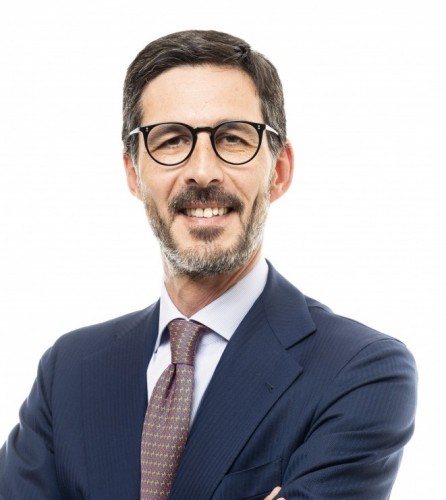
On 29 March, the management of the
Italian energy company Enel and all of the trade unions
(FILCTEM, FLAEI CISL and UILTEC), signed an innovative
agreement on the Status of the Person (Statuto della Persona)
(see IR
Notes no. 183). Is this an
agreement dealing with the scope of the company’s social
responsibility?
There are certainly some elements in this
agreement that touch on the company’s social responsibility, but it
goes much further than this. The purpose of the “Status of the
Person” is to construct a new type of industrial relations in
association with the Italian trade unions. Over the past two years,
the pandemic has brought about many changes and ushered in an era in
which people themselves are positioned at the centre of concerns.
The Status of the Person was born out of the need to rethink current
paradigms in response to the new existential, relational and
environmental needs, in which mankind is the
protagonist.
We are moving
away from a perspective in which the company and its actors are
self-centred entities, to an open ecosystem perspective, which can
offer tools and solutions for enhancing employability across the
entire value chain. The current industrial relations model in the
energy sector is having to cope with massive changes linked to the
energy transition and the climate crisis. Although it has been
signed with the Italian trade unions only, within the group, the
Status of the Person should form part of our joint assets at global
level, using an approach shared with every country. The European
Works Council will be a vital tool in this
endeavour.
All of the
principles contained in the Status of the Person will be implemented
via projects and agreements at local level, as was recently the case
in Italy with one of the principles set out in this status – the
right to disconnect – which is being included in the latest
agreements on new working methods, signed with the Italian trade
unions.
The agreement
contains numerous innovations, including in the area of workplace
health and safety, e.g. an employee will now be entitled to stop
work if they feel they are in danger. Everyone must have faith in
the company’s ability to ensure their safety. We want to develop and
disseminate a strong safety culture throughout the ecosystem,
including among suppliers.
|
|
|

|
| |
Diary
8 to 12
May
Berlin
DGB
Congress.
10 May
On line
A
webinar (in French) organised by the Réalité du Dialogue Social
association, on the theme of “Du
dialogue social dans l’élaboration des plans de vigilance : pour
quoi faire ?” [‘Why do we need social dialogue when we come to
prepare vigilance plans?’], with Eric Charvet (a member of the EDF
group’s global dialogue committee on social responsibility), Aline
Conchon (IndustriAll Europe) and Cyril Cosme (ILO).
11 to 13 May
Bordeaux
Multidisciplinary international symposium organised by COMPTRASEC on “The
platformisation of Work: new forms of employment, new forms of
organisation?” (interpreting offered in English and French).
Registration closes on 8 May: https://nutra2022.sciencesconf.org
12 May
Brussels
Presentation of the draft report on revision of the European Works
Council Directive, by Denis Radtke, to the European Parliament’s
Committee on Employment and Social Affairs.
21 May
Strasbourg
Sciences Po Strasbourg is organising “La
Nuit de l’Europe de Sciences Po Strasbourg” [‘Sciences Po
Strasbourg’s Europe Night’], which is dedicated to sharing ideas and
knowledge. At this event, aimed at researchers, journalists, artists and
students, participants will pool their thinking about all facets of
Europe.
25 May
Strasbourg
Study day on European labour law, organised by Strasbourg
University’s Institute of Employment, taking the theme of “Droits
sociaux et harmonisation sociale en Europe : quelles avancées ?”
[‘Social rights and social harmonisation in Europe: what progress has
been made?’]. Presenters include Mélanie Schmidt and Nicolas Moizard,
(link to register).
2 to 3 June
Paris
Seminar organised by the French Presidency of the EU, entitled
“The
New Challenges of combatting Discrimination in Europe: What role can
equality bodies play?”
16 June
Luxembourg
Employment
and Social Policy Council
22 June
On line
Webinar organised by Global Deal entitled “Social
dialogue – A key pillar of due diligence”.
22 to 24 June
Brussels
Annual conference of the European Trade Union Confederation and the
European Trade Union Institute on the theme of: A blue print
for equality.
27 and 28
June
Hamburg
14th
conference of the EWC Academy for European and SE Works
Councils, featuring Gabriele Bischoff, Udo Rehfeldt and Ilaria
Armaroli.
29 June to 1
July
London
A
global first conference, entitled “Safe To be Me: A Global Equality
Conference”, organised by the British government, which has issued a call
for businesses to share best practices for supporting LGBT+
staff (see press
release).
8 to 10
September
Barcelona
13th ILERA European Congress, on the theme of “Industrial relations and the
Green transition”.
|
|
|
|
|
| |
Who we are?
IR Notes is a
fortnightly newsletter produced by IR
Share and its
network of experts, and is available in several European languages
(English, French, German, Italian, Spanish). It offers Europe-wide
monitoring of employment law, labour relations and employment policy. It
is available by subscription for 18 euros per month .
The team This
issue was producaed by Pascale
Turlan,
Frédéric Turlan
and Aimee
Waldon.
Find out more about
the IR Share
team on our website.
Subscribe to IR Notes
Via the
IR
Share website or by calling us on:
+33 (0)6 81 41 53 95
or
E-mail: frederic.t@irshare.eu
Legal notice.
Publisher: IR Share SARL – 5, Les Compères – 89520 Fontenoy,
France – Tel.: +33 (0)6 81 41 53 95 – share capital 1,500 euros –
commercial register (RCS Auxerre): 512 567 959. Managing editor:
Frédéric Turlan. Hosting: Ideal prod – 14 rue Auguste Morel – 89100
Sens – France – Tel.: + 33 (0)3 86 83 21 21. CPPAP no.: 0626 Z
93933.
|
|
|
|
|
| |
European Industrial Relations Dictionary
In case reading IR Notes inspires you to explore this subject further, we
are providing links to
the European
Industrial Relations Dictionary published by Eurofound. This is
updated at regular intervals by IR Share, which publishes IR Notes. The
term definitions are available in English and can easily be converted
into other languages using on-line translation tools.
|
|
|
|
|

|
|
|
Lead story
Mobilising
to meet a target of zero deaths at work
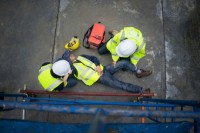
On International Workers Memorial Day (28 April), when those killed or injured at
work are remembered, the European Trade Union Confederation (ETUC) published the Zero
death at work manifesto, signed by trade unionists, researchers, MEPs and
ten or so European ministers. The signatories point out that in the EU, every
working day, 12 working people do not come home from work because they have died at
work. They urge “the European Union, member state governments and employers to bring
an end to deaths at work. We call for zero death at work.” The signatories believe
that this target “is not a utopian dream. The trend in fatal workplace accidents is
down and eradication of fatal accidents is achievable.” The number of fatal
workplace accidents in the EU fell by approximately 70% between 1994 and 2018. The
European Commission points out that “Despite this progress, there were still more
than 3,300 fatal accidents and 3.1 million non-fatal accidents in the EU-27 in 2018,
and more than 200,000 workers die each year from work-related illnesses”, (see Occupational accidents and
diseases). Moreover, since the early 2010s, the decline in the
number of fatal accidents has slowed down significantly. The latest figures
published in Italy show an 11.4% rise in fatal workplace accidents in 2021. In
Spain, the UGT’s occupational health secretary, Ana García de la Torre, points out
that there were 705 deaths at work in 2021 (see press
release). In a joint manifesto (see UGT
and CCOO
websites, and CCOO press
release), launched as discussions commence on drawing up the 2022-2027
occupational health and safety plan, the two confederations explain that as business
picks up again within the framework of the recovery plan, and major investments are
being made in sectors experiencing high accident rates, strengthening “active public
policies aimed at preventing work-related risks is one decisive step, and boosting
inspection activity is another”.
According to an analysis conducted by the
European Trade Union Institute (ETUI), a further 27,041 workplace deaths can be
expected between 2020 and 2029 across all EU countries, if the pace of change
continues at the same rate as during the past decade. While progress is expected in
Poland, where 564 deaths are anticipated over the period in question, and the target
of zero fatal workplace accidents should be reached in 2027, other countries are
still a long way off achieving it. Spain is expected to see 3,191 deaths over the
period 2020-2029, and worse still, the anticipated figure for France is 7,803
deaths. Neither of these two countries is expected to reach the target of zero fatal
workplace accidents in 2030, according to the ETUI. Nevertheless, in a resolution
dated 17 December 2020, the European Parliament has called on Member States to
commit to eliminating work-related deaths and reducing work-related illnesses
by 2030. Even so, in the strategy on health and safety at work 2021-2027 it put
forward six months later (see IR Notes 167 and Framework Directive on Health and
Safety), the Commission merely states that “All efforts must be
deployed to reduce work-related deaths as much as possible”. Despite adopting the
concept of “Vision Zero”, developed by the
International Social Security Association (ISSA), it has not set any deadlines for
meeting this target. The ETUC believes the target is set too low, and “a concerted
joined-up effort” needs to be made, to: “1/ Prevent workplace accidents and
occupational diseases, stopping exposure to hazardous including cancer-causing
substances and be ready for pandemic. 2/ Make physical and mental health of workers
the point of departure when organizing work and designing the workplace.” In a
report published on 28 April (see 5. Studies and reports), the ILO emphasises that
health and safety should also become a matter for social dialogue. The Fondazione Studi Consulenti del
Lavoro in Italy emphasises that the pandemic has raised employers’ and
employees’ awareness of workplace health and safety issues, so now is probably the
right time to place this topic at the heart of social dialogue. The target of zero
accidents has been advocated for years now within large corporations, often with the
involvement of European Works Councils – an actor who should definitely be
mobilised!
|
1. European
Union
Proposal
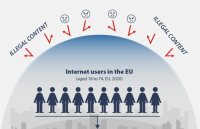
Digital Services Act (DSA) : On
23 April, the European Parliament and Council concluded a political agreement on the
Digital Services Act (DSA), which will set the standards for a safer and more open
digital space for users and a level playing field for companies for years to come
(see press releases issued by the Parliament
and the Council).
This legislation “translates into practice the principle that what is illegal
offline must also be illegal online”, emphasised the President of the European
Commission, Ursula von der Leyen. The Parliament’s rapporteure, Christel Schaldemose
(S&D), said: “citizens will have better control over how their data are used by
online platforms and big tech-companies”. Eurocadres welcomes the conclusion of the
negotiations, “in particular the inclusion of algorithmic transparency and the
protection of personal data”. According to Eurocadres, this law, which will protect
consumers, should be supplemented by the adoption of the directive providing
protection for platform workers, because “only enforceable European action can
protect both consumers and workers” (see press
release).
|

Preventing “strategic lawsuits against public
participation” : Following the adoption of Directive
2019/1937 of 23 October 2019 on whistleblower protection (see Whistleblower protection), on
27 April, the European Commission unveiled measures to enhance the protection of
journalists and human rights defenders against abusive legal proceedings, commonly
known as “strategic lawsuits against public participation” (“SLAPP”). These lawsuits
are brought primarily against journalists and human rights defenders, including
those defending workers, either to prevent them speaking about matters of public
interest or to penalise them. To protect people against this form of harassment,
which affects trade union officials, the Commission has put forward: 1/ a proposal
for a directive covering strategic lawsuits against public participation in
civil matters with cross-border implications. 2/ A recommendation
to encourage Member States to align their rules with the proposed EU law (see press
release). The European Trade Union Confederation, which reports several
cases concerning trade union officials, wants such officials to be expressly
referred to in the future law (which is not the case under the current proposal) and
is calling for this to apply to national situations, too. In other words, a
recommendation alone is deemed not to be a strong enough measure, and the Commission
should adopt legislation to make such protection binding in each Member State (see
press
release).
|
Social
update
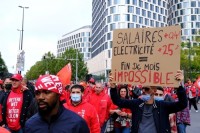
Tense wage negotiations :
Following the efforts made during the Covid-19 pandemic and now
that inflation has returned to Europe, a number of wage negotiations are proving
particularly tense. In the United Kingdom, members of Unite the Union recorded an 86
per cent yes vote in favour of strike action, in response to “GSK making a derisory
pay offer of just 2.75 per cent, a substantial real terms pay cut for the workforce,
with the true rate of inflation (RPI) currently standing at nine per cent” (see
Unite press
release). Similar tensions are apparent at the Stanlow oil refinery, which
belongs to the Veolia group, where Unite is denouncing management’s proposal to
increase pay by 3.5%, resulting in “a substantial pay cut” (see press
release), and at Whirlpool, which is offering a 2.5% increase (see press
release). However, Unite is satisfied with some businesses, such as Airbus,
which is offering a 8.6% pay rise over 13 months, plus a backdated lump-sum payment
of 5.1%. Employees will also have an additional day’s holiday in 2023 and 2024 (see
press
release). In Germany, as wage negotiations got under way in the steel
industry, IG Metall’s collective-bargaining committee set the tone by calling for a
8.2% pay rise over 12 months (see press
release). “Quite rightly, workers were expecting their pay to improve again
after two years of wage restraint”, says the IndustriAll Europe trade union
federation, “but they are now seeing their purchasing power eroded by galloping
inflation, high energy prices and high prices for consumer goods. Employers don’t
appear to be prepared to meet workers’ wage claims.” IndustriAll’s Deputy General
Secretary, Isabelle Barthes, is calling on “governments to support households and
employers to compensate workers. Social dialogue and collective bargaining must be
strengthened, so that wealth can be redistributed more fairly in society.” In light
of high levels of dissatisfaction on the ground at nation level, European Works
Councils are also starting to address the subject of a just redistribution of added
value.
|
2. Member
States
Spain

Regulation of internships : As
stipulated by Royal
decree-law 32/2021 of 28 December 2021 enacting urgent labour reform
measures, on 22 April, the government convened a round table session devoted to
drafting the exact wording of “intern status”, in conjunction with the trade-union
confederations CCOO and UGT and the employers’ organisations CEOE and CEPYME. This
initiative, which echoes the concerns of MEPs who want better regulation of
internships, seeks to protect the rights of interns employed by companies and
institutions, to reduce levels of precarious employment and to tackle possible
abuses in the form of recruiting “bogus interns”. According to the Ministry of
Employment, between 2020 and March 2022, the Labour Inspectorate identified 3,164
jobs held by bogus interns (see press
release).
|
France
- Environmental information :
Under the law of 22 August
2021 combating climate disruption (see IR Notes 169) a
decree
dated 26 April sets out the environmental information to be provided to
workforce representatives, in the absence of any company agreement dealing with
this subject (see item 10 of the table in Article 2). This information, which
concerns the company’s general environmental policy, the circular economy
(assessment of the quantity of hazardous waste, sustainable use of resources:
water and energy consumption, etc.) and climate change (e.g. record of
greenhouse gas emissions), must now appear in the “economic, social and
environmental database” holding all of the information and data to be passed on
to representatives.
|
Ireland
- Transposition of the directive on work-life
balance : On 21 April, the government passed a work-life
balance bill, which transposes elements of Directive
2019/1158. Among other things, the bill grants new rights to parents and
carers, to encourage a better work-life balance. As a result, after six months’
service, parents and carers will gain the right to apply for flexible working.
The employer can however refuse to grant flexible working or postpone the start
of the flexible working period, for multiple reasons. Carers will be granted
five days of (unpaid) leave per year for serious medical care purposes. Lastly,
the current entitlement to breastfeeding breaks, which allows women to take time
off from work each day in order to breastfeed, will be extended from six months
to two years. This legislation should be passed and enacted prior to the summer
recess (see press
release).
|
Italy
- Agile working : The
Bilateral Hybrid Working Observatory (Osservatorio
nazionale bilaterale in materia di lavoro agile) provided for by the
memorandum of understanding of 7 December 2021 on hybrid working, was
established on 21 April. The Observatory, which is made up of government
representatives and representatives of the social partners who signed the
memorandum, is tasked with monitoring the progress of hybrid working (“agile
working”), the collective bargaining required for introducing these
arrangements, and applying the guidelines set by the memorandum. The Minister of
Employment, Andrea Orlando, believes that “around 4.5 million employees will
continue to work remotely, as a matter of routine, even after the pandemic has
come to an end”. Expressing the view that “agile working” can help to improve
workers’ living conditions, to reduce pollution and congestion in city centres,
and to save energy”, the Minister nevertheless emphasises that “we need to make
sure that this form of work does not lead to longer working hours, to isolation
for workers or to the “emptying” of some city centres.” (see press
release).
|
3. Third
countries
United
Kingdom – Scotland
- A trade union fund for just transition :
At the Scottish Trades Union Congress (STUC) in Aberdeen,
Scotland’s First Minister Nicola Sturgeon announced £100,000 in annual grant
funding to support just transition capacity within the trade union movement.
This grant is intended to fund full-time trade union officials who will
coordinate worker engagement on just transition, amplify and share best practice
and provide policy support to create “good, green jobs and a truly just
transition”, Nicola Sturgeon explained (see government
press release).
|
United
Kingdom
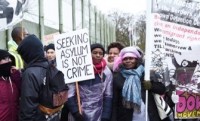
UK-Rwanda agreement on asylum seekers :
The British government and Rwanda have signed a cooperation
agreement to send migrants and asylum seekers of various nationalities arriving in
the UK to Rwanda, especially those who set off from the French coast and cross the
Channel (see government press
release). At the same time, Parliament is scrutinising a government bill
that will allow offshore centres to be set up, where migrants can be relocated until
their application is processed and from where they can be turned back before they
enter British territorial waters. The UN High Commission for Refugees (HCR) warns
that this law is likely to be in breach of the Geneva Convention for Refugees. The
agreement has prompted a strong reaction from Unite the Union, which condemned
“outright” this “hideous, inhumane proposal to send those seeking asylum in the UK
to detention in Rwanda”. The union believes that the new mechanism is designed to
force asylum seekers to settle in Rwanda, and denounces the fact that in doing so,
the government “will task men and women working in the UK, inevitably including
Unite members, with the odious responsibility of processing and transporting these
vulnerable human beings at an enormous cost to the public purse”. Unite’s view is
that “this policy diminishes our international standing as a country which champions
respect for humanity” (see press
release).
|
4.
Companies
European
works councils
Safeguarding social commitments :
On 21 April, the Engie EWC adopted an opinion
on the Engie group’s sale of its Equans subsidiary to the Bouygues group. This text is
particularly enlightening in terms of showing how closely the Engie EWC is involved
in the process of selling off this subsidiary (see IR Notes 184). The
EWC and Bouygues management had earlier signed a memorandum
of understanding, on 13 April, safeguarding the social commitments given by
Bouygues management to the EWC at the time of the sale and setting up a temporary
social dialogue body dealing with Equans’ European activities and similar activities
at Bouygues. This body, which is independent of the Bouygues EWC, will remain in
place for a maximum of 18 months after the deal has been closed, during which time
Equans management will negotiate a methodology agreement to adapt this temporary
body into a permanent one.
- Solidarity with Ukraine:
The management of the Norwegian group Hydro, the Norwegian
Confederation of Trade Unions LO and the group’s European Works Council have
launched a fund-raising campaign to help people affected by the conflict in
Ukraine. Hydro does not have any employees in Ukraine, but employs around 400
Ukrainians at its extrusion plants in Poland. “We encourage our union members
and everyone else in Hydro to donate the equivalent of one working hour to
support UNICEF,” says Tor Egil Skulstad, secretary of Hydro’s European Works
Council (see press
release).
|
European
company

Applying the “before-after” principle to a
transformation into a European company : The Advocate
General of the EU Court of Justice has delivered his opinion in a case concerning
compliance with German law on joint management, where a company is being converted
into a European company (SE). When the SAP group was converted into a
SE, the agreement on employee involvement maintained parity on the group’s
supervisory board, but removed a specific mechanism allowing two trade union
officials who are not group employees to sit on the board (see IR Notes 180). The
Court of Justice has been asked to rule whether the specific ballot for the election
of trade union representatives to the supervisory board of a SE that arose from the
transformation of a German public limited company must be maintained, under Article
4, paragraph 4, of the SE Directive (the “before-after” principle), or whether it
may be dispensed with by negotiating the agreement on employee involvement referred
to in Article 4, paragraph 1, of the directive. In his opinion, the Advocate General
clearly finds in favour of the IG Metall and Ver.di trade unions which brought this
case to court: Article 4, paragraph 4, must be interpreted as meaning that “the
agreement on employee involvement in an SE created by way of transformation must
provide for a separate ballot for the election, to employee representatives’ posts
within the Supervisory Board, of a certain proportion of candidates put forward by
the trade unions, where that specific requirement is provided for and mandated by
the national law applicable to the company to be transformed.” (see CJEU,
Opinion, 28 April 2022, Case C-677-20, IG Metall and Ver.di, and press
release).
|
5. Studies
and reports
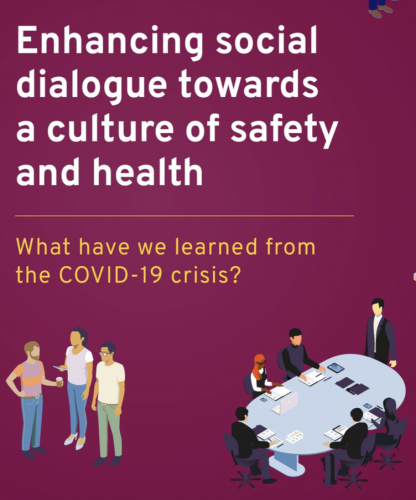
Social dialogue as a weapon against Covid-19 :
On 28 April, which was World Day for Safety and Health at Work,
the ILO published a report entitled “Enhancing
social dialogue towards a culture of safety and health: What have we learned
from the COVID-19 crisis?”, showing how social dialogue contributed to the
rapid and effective implementation of measures during the Covid-19 crisis. The ILO’s
Director-General, Guy Ryder, said: “The lessons learned from this crisis about the
importance of social dialogue in strengthening safety and health at the national and
workplace level, need to be applied to other contexts. This would help reduce the
unacceptable level of occupational deaths and disease that occur every year.”
|
|
|











