 |
| |
IR Notes 232 – 13 June 2024
www.irshare.eu
|
|
|
| |
| |
A question for…
Sophia Reisecker, Head of the European and International Affairs
Department of the Austrian trade union GPA and rapporteur of the
European Economic and Social Committee opinion on the revision of the
EWC Directive.

What
are the main points you make in your report on the revision
of the EWC directive, which was adopted by the European
Economic and Social Committee on 30
May?
In order to form our opinion, we commented
on the Commission’s objectives and checked whether the measures it
proposes actually meet these objectives. Based on this analysis, we
made a number of recommendations on what should be changed in the
Commission’s proposal. For instance, we have proposed incorporating
climate change, digitalisation, demographics and skills shortages
into the remit of the European Works Councils. We also suggest
establishing a panel of experts comprising representatives of the
social partners, Member States and the Commission to assess the
effective implementation of the directive, as previously outlined in
other directives. Furthermore, we have endorsed a demand from the
European trade union movement, to extend the directive to companies
operating under a licensing or franchising system. With regard to
the future of existing European Works Council agreements, we have
attempted to find common ground with the employers, but were unable
to do so due to their stance on maintaining the pre-directive
agreements. We did, however, recognise that there were European
Works Councils based on pre-directive agreements that were working
well and that it would be risky to call them into question. This is
why we proposed to safeguard these European Works Councils, as long
as both management and employee representatives wanted to keep them
and not renegotiate the agreement. Unfortunately, we were unable to
reach a consensus with the employers, who questioned the very need
for the revision and too many of the important measures proposed by
the Commission.
|
|
|

|
| |
Diary
12 June
Bourg-la-Reine
IRES-ISST study day, taking as its theme the publication
« Que
sait-on du travail ? » [“What do we know about work?”],
which was coordinated by Bruno Palier.
17 June
Strasbourg
Seminar organised by the UMR DRES Labour Law team (in
English), entitled “Which institutions to promote a well-functioning
wage bargaining in Europe? Comparison between France, Germany and the
Scandinavian countries” (see Programme
and Registration).
18
June
Laval (Quebec) and on
line
Laval University’s
Department of Industrial Relations and the CRIMT are organising a hybrid
lecture entitled « Travail : Démocratiser, démarchandiser,
décarboner. État des lieux et défis pour les sciences
sociales » [“Democratising, decommodifying and decarbonising
work: a look at the current situation, and the challenges facing social
science”], to be presented by Professor Isabelle Ferreras (Free of charge but registration
required).
25 June
Strasbourg
Symposium entitled la
diversification du droit de la non-discrimination au travail en
Europe [‘diversification of the law governing workplace
non-discrimination in Europe’], featuring Mélanie Schmitt, Nicolas
Moizard, Achim Seifert, Pascale Lorber, Juan Carlos Álvarez Cortés,
Aleksandra Bochenska and others.
27 to 30 June
New
York
20th
annual congress of the International Labour and Employment Relations
Association (ILERA)
5
July
Bordeaux
Symposium
organised by the Labour Institute of Bordeaux University, entitled
« Depuis Maastricht, 30 ans d’Europe sociale – La Cour de justice et
le droit social de l’Union européenne » [“30 years of social
Europe since Maastricht – The Court of Justice and EU labour law”].
Contact: institutdutravail@u-bordeaux.fr
19 and 20
September
Bordeaux
Annual international conference of the International Research Chair in
Comparative Studies on Occupational Health (CIECST) entitled “Ageing of
the working population: occupational health, return to work, and
retirement policy issues” (see registration).
|
|
|
|
|
| |
Who we are?
IR Notes is a
fortnightly newsletter produced by IR
Share and its
network of experts, and is available in several European languages
(English, French, German, Italian, Spanish). It offers Europe-wide
monitoring of employment law, labour relations and employment policy. It
is available by subscription for 273 euros per year .
The team This issue
was producaed by Sylvain
Nadalet,
Iris
Turlan and
Frédéric
Turlan .
Find out more
about the IR
Share team on our website.
Subscribe to IR Notes
Via the
IR
Share website or by calliang us on:
+33 (0)6 81 41 53 95
or
E-mail: frederic.t@irshare.eu
Legal notice.
Publisher: IR Share SARL – 5, Les Compères – 89520 Fontenoy, France –
Tel.: +33 (0)6 81 41 53 95 – share capital 1,500 euros – commercial
register (RCS Auxerre): 512 567 959. Managing editor: Frédéric Turlan.
Hosting: ALTEO by Damien Cornillet – Château – 89500
Villeneuve-sur-Yonne. CPPAP no.: 0626 Z 93933.
|
|
|
|
|
| |
Follow us on LinkedIn!

Why not connect to the IR Notes LinkedIn page, so that you can keep up with
developments in the issues we’re covering, between two editions?
You’re welcome to follow us! There are already 620 of you following
us!
|
|
|
|
|
| |
European Industrial Relations Dictionary
In case reading IR Notes inspires you to
explore this subject further, we are providing links to the European
Industrial Relations Dictionary published by Eurofound. This is updated at
regular intervals by IR Share, which publishes IR Notes. The term
definitions are available in English and can easily be converted
into other languages using on-line translation tools.
|
|
|
|
|

|
|
|
Lead
story
Social
Europe: waking up again or heading for a long lethargy?
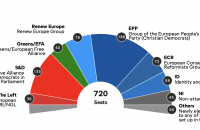
Despite polling particularly well in large EU Member States (Germany, France, Italy,
Poland) and in Austria, the far-right parties have not achieved domination in the
European Parliament, meaning that the current alliance between the EPP
conservatives, the Socialists and Democrats (S&D) and the Renew
centrist-liberals can look ahead to establishing a new coalition with an absolute
majority. This majority might reappoint the European Commission’s current President,
Ursula von der Leyen. So, is nothing about to change? The European trade union
movement is concerned by the large number of votes gained by the far-right parties,
with which it is engaged in a constant battle, pointing out that these parties
systematically vote against workers’ interests. The movement believes that there
cannot be “business as usual”, nor any discussions aimed at forming an alliance
between conservatives, liberals and the far right. These results “make clear that
business as usual cannot continue”, said ETUC General Secretary Esther Lynch.
“Europe needs to urgently resolve the economic and social insecurity that lies
behind growing anger and fear in our society” (see press
release). The IndustriAll Europe trade union federation is calling on
democrats to “work together to deliver what Europe needs to tackle the challenges of
our times: investment, cohesion and solidarity” (see press release). It
wants to see a just transition, as does the European Transport Workers’ Federation,
which is calling for greater investment in public services and public transport (see
press
release). On the other hand, none of the three employers’ European
organisations have yet issued a press release. This impression of stability should
not however mask the fact that the recent progress made by social Europe will be
hard to reproduce: 1/ Parliament, which is by nature fairly
progressive, has emerged with a more conservative profile, and the far right has a
greater influence; 2/ in light of the national results, the
Council too, is likely to see a strengthening of government coalitions made up of
far-right parties or even led by the far right, which will make it even less
progressive. Social Europe can still rely on a number of MEPs, such as Dennis Radtke
(EPP), who know how to push the boundaries, but he will no longer be able to count
on the support of his colleague Agnes Jongerius (S&D) who did not stand this
time. Jacques Delors, the emblematic Commission President and father of Social
Europe, said: “If the European Union is to work, it will need competition to boost
it, solidarity to unify it and cooperation to strengthen it.” However, we are
currently losing the latter two of these three driving forces.
|
1. European
Union
Legislation

Combating human trafficking : On
27 May, the Council definitively adopted the directive
amending Directive 2011/36/EU on preventing and combating trafficking in human
beings and protecting its victims. Some aspects of this law apply to legal
persons, i.e. companies: 1/
The sanctions regime applicable to companies found guilty of human trafficking has
been expanded: Member States will be able to exclude these companies from tender
procedures and concessions. 2/
Member States must ensure that they do not prosecute or apply penalties to
victims in relation to criminal offences that they have been compelled to commit,
such as undeclared work, as a direct result of being subject to trafficking. The aim
is to encourage them to report the crime or to seek support and assistance. 3/ The directive criminalises
the use of a service provided by a victim of human trafficking, when the company is
aware that the person providing the service is a victim of trafficking. This is in
addition to the obligation requiring companies to exercise due diligence. The text
will have to be transposed within two years (see Council press
release).
|
Projects
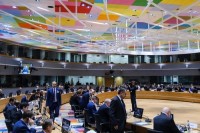
Council’s position on the European Works Council
directive: : On 5 June, the Council adopted the fourth compromise
text on the proposal for a directive on the revision of the European Works Council
directive (see IR
Notes 222). This text, which is now the Council’s negotiating position, will
be presented on 20 June for adoption by the Employment and Social Affairs Council.
Trilogue negotiations will commence after the new European Parliament has been
established. This Parliament will first have to adopt its negotiating mandate, based
on the Radtke report (see IR Notes 228).
Some of the revisions contained in the compromise are as follows: 1/ Transnationality: “measures
considered by management” that can “reasonably be expected to affect employees” of
that undertaking or group, “or its establishments in one Member State”, and the
consequences of those measures that can reasonably be expected to affect their
employees in another Member State, can be classified as transnational. Recital 5
states that the concept of transnational matters “covers those measures which could
affect employees in a substantial way, i.e. in a way which does not affect them in a
trivial manner and does not only concern individual employees or ordinary
operational decisions”. Furthermore, “the standard of reasonableness should be
objectively ascertained, having regard to the nature and purpose of the measures
that are envisaged and the circumstances of the case”. 2/ Expert assistance: the text
stipulates that the financial and material resources to be allocated to the EWC
shall include the possible use of experts, “including legal experts”. 3/ Recourse: European Works
Councils or special negotiating bodies shall enjoy “effective access to judicial
proceedings or, where relevant, administrative proceedings”. “The reasonable costs
of legal representation and participation in such proceedings are borne by the
central management” unless Member States take “other measures to avoid any de
facto restriction of such access for reasons of lack of financial
resources”. 4/ Existing agreements:
the compromise abolishes all of the derogations provided for by previous
directives that permit agreements to depart from the substantive content of
directives. Thus it stipulates that where a EWC agreement has been concluded under
the previous directives and does not comply with the new directive’s amendments to
Article 6 (which specifies the content of agreements establishing a EWC), the
management must open a negotiation, either on its own initiative, or at the request
of at least 100 employees (or their representatives) of at least two establishments
in two different Member States. If no agreement can be reached after two years, the
subsidiary requirements will apply. The compromise states that this provision must
not prevent compliance with the new directive’s minimum requirements. 5/ Subsidiary requirements: the
scope of EWCs’ competence is extended to include matters linked to the green and
digital transitions. At least one meeting per year must be held in person.
|

Social partners’ positions : The
struggle for influence over Member States’ representatives on the Council within the
framework of revision of the EWC directive grew more acute with the publication, on
31 May, of a new joint
statement issued by the European employers’ organisations (CEEMET, HOTREC,
EuroCommerce, EBF, ECEG, and BusinessEurope), in which they reiterate their
opposition to a number of measures, including abolition of the derogations granted
by previous directives (see above). This initiative prompted the European Trade
Union Confederation and six European trade union federations to send a letter
to Member States’ representatives, on 3 June, stating: “We are […] surprised by
the sharp opposition of the employers’ side to any progress in this dossier.” The
trade unions, which are calling on the Council to adopt the directive without delay
after the next European Parliament has been established, say that “it gives the
impression that, despite statements to the contrary, the employers’ side seek to
deliberately undermine the right to information and consultation of their European
workforce”.
|
Trench warfare around the EWC directive :
The European Economic and Social Committee (EESC) failed to
speak with just one voice when its opinion
on the proposal for revision of the European Works Council Directive was
adopted by a narrow majority (see IR Notes 222).
The Committee is made up of three groups – workers, civil society organisations and
employers (see European Economic and Social
Committee). However, the employers did not support the opinion,
which welcomes the Commission’s initiative, takes the view that most of the measures
it contains are useful, and echoes the European trade union movement’s demands. In
fact the employers’ group submitted an amendment that entirely rewrites the opinion.
As a result, this differing opinion is now appended to the opinion, after it was
supported by more than 25% of EESC members, including some civil society
representatives. This means that the EESC’s opinion will not carry the same force
that it would have done, had it been adopted with a broad consensus. Nevertheless,
it may provide support for the progressive political groups in Parliament. In terms
of its substance, the opinion adopts a trade union demand, which has been excluded
from the Commission’s proposal, for “companies that sell goods or provide services
through franchise or licence agreements” to be covered by the scope of the
directive. The opinion includes an innovative suggestion: “creation of an expert
group supporting the implementation [of the legislation]”. It also proposes
expanding the scope of issues covered by the European Works Council’s competence to
include “investment, training, occupational health and safety, data protection and
climate transition”, and advocates that EWCs should “be given the right to propose
their own issues”. In terms of confidentiality, like the European trade union
movement, the EESC is calling for “EWC members [to be able to] share information
with national or local trade unions and worker representatives.”
|
Case law

Do airline pilots eat more than air hostesses? :
On 6 June, the Advocate General of the EU Court of Justice
delivered his opinion, in a case concerning discrimination between flight deck crew
and cabin crew employed by the same Spanish airline, Air Nostrum. To cover
subsistence costs incurred during the course of their duties, flight deck crew enjoy
a daily allowance of between 65 and 100 euros, depending on whether the trip in
question involves a domestic or an international flight, whereas cabin crew receive
between 37.06 and 59.06 euros for the same flights. These allowances are set by two
different company agreements, concluded by the employer with the trade unions
representing each of the two categories. Given that 93% of flight deck employees are
men, and 93% of cabin crew are women, the Spanish courts have asked the EU Court of
Justice to rule on whether this constitutes indirect discrimination (see Indirect discrimination). Can
the existence of two separate collective agreements provide objective justification
for this difference in treatment? In the Advocate General’s opinion, the answer is
no. The Court of Justice will rule on the case later this year (CJEU,
Opinion, 6 June 2024, Case C-314/23)
|
2. Member
States
Spain
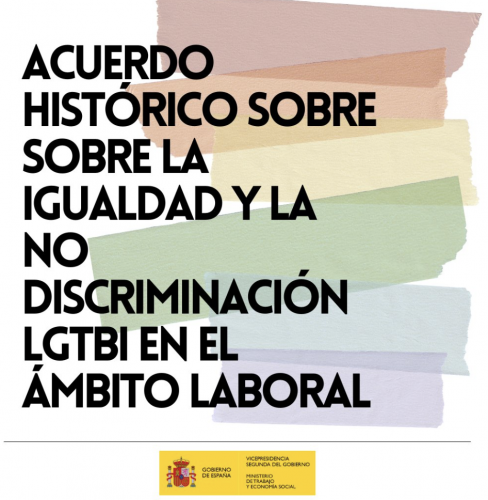
LGBTI : On 6 June, the Ministry
of Employment announced that a national agreement had been reached with the trade
unions and employers’ organisations, aimed at creating a more egalitarian working
environment for LGBTI persons, and supplementing Law 4/2023 of 28 February,
enacting genuine and effective equality for trans persons and guaranteeing the
rights of LGTBI persons (see IR Notes 199 and
article in El
País).
|
Italy

Artificial intelligence : On 2
June, the government presented a draft law
on artificial intelligence (AI), adopting the content of the European
regulation approved on 13 March into its domestic law (see IR Notes 226).
Article 10, which is devoted to employment relationships, states that AI must be
used to enhance working conditions and protect workers’ health, and to boost the
quality of work performance and employee productivity, in compliance with EU law.
Leaving these objectives aside, the measures set out in the law are – to say the
least – short on detail, and more will be required. It is stated that the use of AI
in the workplace must be safe, reliable and transparent, and must neither be
prejudicial to human dignity nor breach the confidentiality of personal data.
Workers must be informed that AI is in use at the time they are recruited.
|
3. Third
countries
United
Kingdom

Abolishing EWCs : On 16 May, the
government launched a public
consultation on the abolition of European Works Council legislation, which
has been kept in place after Brexit, so that the EWCs of companies with their
registered office in the United Kingdom can continue to function, while at the same
time ensuring that no new EWCs can be created (see Brexit and labour standards).
However, as “it was never the government’s intention that EWCs in the UK should
continue to operate indefinitely”, the government is proposing to abolish the legal
framework governing EWCs. This would remove the current dual obligation for UK
companies to maintain a EWC governed by their own domestic law, while at the same
time having to set up a EWC governed by the legislation of an EU Member State, in
order to comply with European legislation. The government claims that abolishing the
67 UK-based EWCs would lead to savings of between £4.4 and £7.2 million for UK
companies. In addition, removing EWCs “could reduce the current environmental
impacts”. The consultation document says that this move will not affect employees’
rights: a number of EWCs are ineffective, and their role can be taken over by trade
unions or other forms of employee representation.
|
4.
Companies
European
works councils

Reorganisation : In March, the
Unilever group announced that
it was putting up its ice cream business (7,500 employees) up for sale, without
informing and consulting its EWC about this move. The EWC has since signed a
cooperation agreement with the three Italian trade union federations FAI-CISL,
FLAI-CGIL and UILA-UIL, so that it will carry more weight in the discussions.
|

Negotiation : On 3 and 4 June,
the Swedish publishing group Karnov (1200 employees)
assembled a special negotiating body in Paris, for the purpose of negotiating a EWC
agreement. Following the acquisition of some of the Spanish and French businesses
owned by the Dutch group Wolters Kluwer, which has its own EWC, Karnov is now a
group of European stature. The agreement is being negotiated under Swedish law.
|
Corporate
social responsibility

Employee share ownership : On 29
May, the food manufacturer Bel
announced that it was adopting the status of “mission-led company”, as provided for
by French law, and launching a global employee share ownership plan. This plan,
which was first introduced in France in April 2014, will be rolled out in all of the
company’s other countries by 2026, with the aim of moving towards a value creation
model that benefits all stakeholders (see press
release).
|
|
|











