 |
| |
IR Notes 235 – 3 September 2024
www.irshare.eu
|
|
|
| |
| |
A question for…
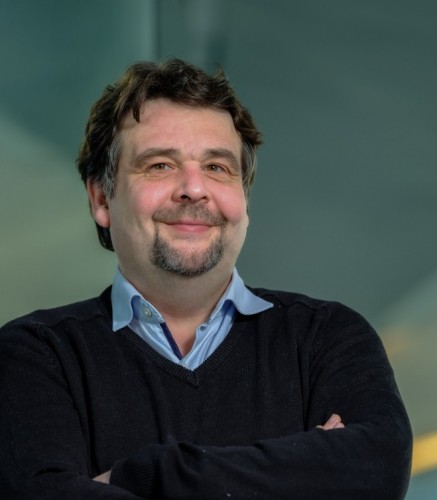
Dennis Radtke MEP (EPP), member of the European Parliament’s Committee on
Employment and Social Affairs
What are your first impressions of
the European Parliament’s new Employment and Social Affairs
Committee, which will have more representatives from the far
right?
It’s
still too early to form an opinion because we’ve only met once so
far, to elect the Chair and Vice-Chairs. We haven’t done any
legislative work yet. I hope that we’ll be able to rekindle the
excellent spirit that prevailed during the previous term. We were
able to reach compromises on important texts such as the directives
on adequate minimum wages, pay transparency and protection of
platform workers. Although some key members, such as Agnes
Jongerius, are no longer on the committee, which is a great loss for
us, we’ll gradually witness the emergence of new personalities, with
whom we can build relationships based on trust. It’s difficult to
prejudge how the committee will function. During the previous term,
no one would have put money on us being able to achieve a majority
on the texts I mentioned. What’s more, in Li Andersson, we have a
Chair who has already made a good impression. She’s young, but has
experience of running a ministry in Finland, and we’ve had some
intense and interesting discussions. So I’m optimistic about this
new term.
|
|
|

|
| |
Editorial
IR Share is changing
Dear readers,
We’re delighted to announce that IR Share, which
publishes IR Notes, began its transformation this summer with a
revamp of its website (www.irshare.eu). The aim is to promote IR Notes to European
actors in the field of social dialogue, to provide visibility for
our other activities (studies, research, training) and to make it
easier for our readers to access our resource hub, where almost
2,000 documents are available on line. They include around a
thousand EWC agreements, SE works council agreements, reports, case
law documentation, etc. We’d love to hear what you think – please
submit your comments and suggestions here!
However, that’s not all! We’re also going
to include an automatic translation module to make it easier to
browse the site, and add a short profile of some other expert
members of the network… before we set about the task of transforming
IR Notes. So there’s still a lot of work to be done!
|
|
|
|
|
| |
Diary
19 and 20
September
Bordeaux
Annual international conference of the International Research Chair in
Comparative Studies on Occupational Health (CIECST) entitled “Ageing of
the working population: occupational health, return to work, and
retirement policy issues” (see registration).
24 September
Strasbourg
Lecture on “Les
implications de la directive transparence salariale en France et
en Allemagne” [‘Implications of the pay
transparency directive in France and Germany’], with Judith
Brockmann (Kassel University) and Nicolas Moizard (Strasbourg
University). Contact: fru6703-contact@unistra.fr
26 and 27
September
Brussels
ETUC’s annual European Works Council Conference (programme).
9 October
Budapest
Informal meeting of Ministers of Employment and Social Policy
4 November
Strasbourg
Lecture
on “L’égalité
dans les relations de travail, comparaison
France-Allemagne“ [‘Equality in workplace
relationships: comparing France and Germany’], with Gerhard Binkert
(Landesarbeitsgericht Berlin-Brandenburg [Regional Labour
Court]) and Yves Struillou (Conseil d’État [Council of State]).
Contact: fru6703-contact@unistra.fr
|
|
|
|
|
| |
Who we are?
IR Notes is a
fortnightly newsletter produced by IR
Share and its
network of experts, and is available in several European languages
(English, French, German, Italian, Spanish). It offers Europe-wide
monitoring of employment law, labour relations and employment policy. It
is available by subscription for 273 euros per year .
The team This issue
was producaed by Iris
Turlan and
Frédéric
Turlan .
Find out more
about the IR
Share team on our website.
Subscribe to IR Notes
Via the
IR
Share website or by calliang us on:
+33 (0)6 81 41 53 95
or
E-mail: frederic.t@irshare.eu
Legal notice.
Publisher: IR Share SARL – 5, Les Compères – 89520 Fontenoy, France –
Tel.: +33 (0)6 81 41 53 95 – share capital 1,500 euros – commercial
register (RCS Auxerre): 512 567 959. Managing editor: Frédéric Turlan.
Hosting: ALTEO by Damien Cornillet – Château – 89500
Villeneuve-sur-Yonne. CPPAP no.: 0626 Z 93933.
|
|
|
|
|
| |
Follow us on LinkedIn!

Why not connect to the IR Notes LinkedIn page, so that you can keep up with
developments in the issues we’re covering, between two editions?
You’re welcome to follow us! There are already 625 of you following
us!
|
|
|
|
|
| |
European Industrial Relations Dictionary

In case reading IR Notes inspires you to
explore this subject further, we are providing links to the European
Industrial Relations Dictionary published by Eurofound. This is updated at
regular intervals by IR Share, which publishes IR Notes. The term
definitions are available in English and can easily be converted
into other languages using on-line translation tools.
|
|
|
|
|

|
|
|
Lead
story
A new
European Commission: what developments lie ahead for European labour law?
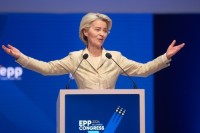
We shall have to wait for the future European Commission to be appointed, and for
Parliament to vote to approve this, before Ursula von der Leyen (photo) can prepare
her new work programme. Nevertheless, after being re-elected on 18 July this year on
the basis of her “Political
guidelines for the next European Commission 2024−2029”, she will have to
adhere fairly closely to the content set out in this policy document. Its social
chapter represents continuity with her previous term of office, without introducing
any flagship initiatives. The only explicit announcement of a binding law is the
proposal “to introduce a right to disconnect”, which presupposes the adoption of a
directive. New rules can also be expected, which are aimed at “increasing
participation in the labour market, especially by women and young people” and
“supporting young parents for a healthy work-life balance”. Also referenced in the
document are: 1/ “initiatives”
that include “looking at how digitalisation is impacting the world of work, from AI
management, to telework and the impact of an ‘always on’ culture on people’s mental
health”. 2/ “strategies” for
reducing poverty, combatting racism, promoting education and vocational training,
encouraging equal treatment for LGBTQI+ persons and striving for gender equality by
tackling “the scourge of femicide and violence against women [and] obstacles
preventing women from progressing in their careers or their education”. 3/ “plans” to tackle the housing
crisis, strengthen the Child Guarantee and implement the European Pillar of Social
Rights, as “part of a renewed commitment to strengthening European social dialogue”.
4/ A “roadmap” to “ensure a
just transition for all”, so that “quality jobs” can be offered. This roadmap, which
will be “developed together with the social partners”, “will support fair wages,
good working conditions, training and fair job transitions for workers and
self-employed people, notably by increasing collective bargaining coverage”. 5/ A “pact” with EU trade unions
and employers for European social dialogue, to be delivered in early 2025. Lastly,
the document announces a “revision of the Public Procurement Directive”, with a view
to modernising and simplifying the rules currently in force. This will enable the
European trade union movement to call for stronger social clauses and for public
procurement contracts to be awarded only to companies that apply collective labour
agreements, which would be a useful means of exerting leverage with a view to
reaching the target of 80% of employees being covered by a collective agreement, as
set by the directive on fair minimum wages. These guidelines remain vague and they
leave the question of means and resources – both financial and legal – to be
discussed between the Council and Parliament, and to be resolved by the balance of
power within a Parliament that is somewhat more conservative than its predecessor.
|
1. European
Union
Social
update
A new Committee on Employment and Social Affairs
: Over the summer, Parliament appointed the members of its
various committees, which draw up reports, in preparation for their adoption at a
plenary session. The composition of the Committee on Employment and Social Affairs
is now significantly different, with around 80% of its members sitting on it for the
first time. It has lost a number of previous members who were close to the trade
union movement, including Dutch MEP Agnes Jongerius (S&D) and Danish MEP Nikolaj
Villumsen (The Left), as well as some influential personalities, such as France’s
Sylvie Brunet, who supported the platform workers directive and Malta’s Alex Agius
Saliba (S&D), who put forward a proposal for a directive on the right to
disconnect. However, two heavyweights have remained on the committee: Gabriele
Bischoff (S&D) and Dennis Radtke (EPP), the German MEPs whose work has focused
in particular on the issues of democracy at work and revision of the European Works
Council directive. Their presence should ensure a degree of continuity in monitoring
the revision of this directive. Another very active Parliamentarian, Leila Chaibi
(The Left), who championed the platform workers directive, has also been
reappointed, this time as coordinator of its political group. The Luxembourg MEP
Marc Angel (S&D), who is a mainstay of the trade union movement, also remains.
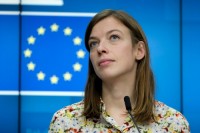
Li Andersson (photo), the former Minister of Education within Sanna Marin’s
government, and ex-leader of the Left Alliance party, has been elected as President
of the Committee, and will be the bête noire of far-right MEPs. She wants
the committee to take several issues forward: reform of the rules governing public
procurement contracts, regulation of long subcontracting chains and the use of
artificial intelligence in the workplace, as well as enhancing social dialogue and
the security of working conditions.
|
Case law

Overtime worked by part-time workers :
On 29 July, the Court of Justice ruled on a German case
involving care assistants who were working part-time (CJEU,
29 July 2024, Cases C‑184/22 and C‑185/22, KfH Kuratorium für Dialyse und
Nierentransplantation). This is an issue that is frequently encountered:
when these carers work longer hours than those specified by their part-time
employment contract, the additional hours do not qualify for the overtime
supplements paid to full-time care assistants when they work longer than their
contractually agreed 38.5-hour working week. The applicants also claimed that this
difference in treatment between part-time workers and full-time workers constitutes
indirect discrimination against female workers, given that it affects women workers
more, as they are employed on a part-time basis more frequently than male employees
are. The Court of Justice agrees: 1) Full-time workers and part-time
workers are treated differently. The Court emphasises that setting a uniform
threshold of 38.5 hours represents, for persons working as part-time care
assistants, “in view of the normal working time agreed in their contracts, a greater
burden in so far as at least part of the hours worked in excess of that normal
working time, although remunerated, does not give rise to entitlement to a
supplement”. 2) This
difference in treatment is not justified by any objective reason: neither by the
possible “objective of deterring employers from requiring workers to work overtime
in excess of the individually agreed working hours for those workers”, nor by that
of “preventing full-time workers from being treated less favourably than part-time
workers”. 3) The indirect
discrimination here “may be characterised by the sole fact that persons of one sex
are put at a particular disadvantage compared with persons of the other sex”,
whereas there is no “need for there to be, among the full-time employees,
considerably more men than women”. This is the case here, as women represent 84.74%
of part-time workers and 68.20% of full-time workers. Consequently, more women than
men are affected by this difference in treatment.
|

Collective redundancies : On 11
July, the Court of Justice delivered a judgment
in a Spanish case concerning the application of Directive 98/59 on collective
redundancies consequent upon an employer’s retirement. In the case in point, the
employer decided to retire, and informed the company’s 54 employees that their
contract of employment would be terminated in one month’s time. Under Spanish law,
the procedure for consulting workers’ representatives in the event of collective
redundancies does not apply in cases where these redundancies result from the
employer’s retirement (if the employer is a natural person). The Court of Justice
points out that collective redundancies within the meaning of this directive occur
where contracts of employment are terminated without the consent of the workers
concerned. As a result, it holds that Spain’s domestic law is in breach of the
directive. The directive becomes applicable as soon the specified redundancy
thresholds are reached. The Court points out that this scenario is not comparable
with that of an employer’s death – in connection with which it handed down a
previous judgment
rejecting the directive’s application, because unlike an employer who has died, an
employer who decides to take retirement is in a position to hold consultations aimed
at preventing redundancies, limiting their number, or at the very least, mitigating
their consequences.
|

Vaccination against Covid-19 :
On 29 August, the European Court of Human Rights delivered a judgment
concerning 26 healthcare professionals and social workers who were punished for
refusing to be vaccinated against Covid-19. They were temporarily suspended from
service without pay and assigned to alternative duties, for which they were paid 600
euros per month. In view of the wide margin of discretion afforded to States for the
purpose of defining their healthcare policy, the Court held that the disputed
measures were proportionate and justified in light of the legitimate aim being
pursued, namely protecting the health of the population in general, including that
of the applicants, and protecting the rights and freedoms of others. It also noted
that the losses suffered by the applicants were an inevitable consequence of an
“exceptional and unforeseeable” context, i.e. a global pandemic that was rife at the
time.
|
2. Member
States
Germany

Remuneration paid to works council members :
In a ruling
dated 10 January 2023, the Federal Court of Justice [Bundesgerichtshof]
opened the way to penalising Volkswagen managers who awarded excessive levels of pay
to works council members (see IR Notes 171). At
that time, the Ministry of Employment set up a tripartite committee to examine the
legal security of the remuneration paid to works council members. It submitted its
proposals in November 2023, and they were incorporated into the bill amending the
Workplace Labour Relations Act, which was definitively adopted by Parliament, by a
unanimous vote. The law,
which came
into force on 25 July, sets out details of how, for the purpose of determining a
works council member’s remuneration, to compile a group of employees comparable to
the member in question, both at the time their term of office commences and also
while their term is in progress. It also explains how an employer is to guarantee
that the member will be afforded career progress equivalent to the progress they
would have made, had they not held this office. Overall, this law has been welcomed
by the trade unions, although some criticisms remain. IGBCE believes that the
knowledge, qualifications and skills acquired by EWC members while they hold office
continue to be overlooked (IGBCE
press release).
|
Luxembourg
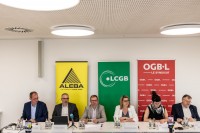
Banking sector : On 11 July,
social partners in the banking sector signed the Collective
Bargaining Agreement for the Luxembourg Banking Sector for the period
2024-2026 (see joint
press release issued by the social partners and detailed factsheet
published by the ALEBA trade union). In addition to an exceptional bonus of 500
euros, the agreement provides for a minimum training budget in the event of
outplacement (between 5,000 and 8,000 euros) for every employee who is made
redundant, a 10% increase in the annual training budget (from 1.5 to 1.65% of the
total wage bill), and an individual training time allocation of at least 16 hours
per year.
|
3.
Companies
Transnational collective bargaining

Fundamental rights : On 26
August, the management of the Swedish garment group H&M (143,000 employees)
renewed the global
framework agreement it signed in 2015 with the IndustriAll Global Union
federation and its Swedish affiliate IF Metall (see press
release). The new
agreement, which applies throughout the value chain (with more than one
million employees), contains a number of significant changes compared to the
previous version. Particular emphasis is placed on the application of this new
agreement, which includes a budget of 100,000 dollars earmarked for communication
and training actions, and the creation of a procedure for resolving any disputes
regarding the agreement’s interpretation, using mediation conducted by the ILO or a
third party chosen by mutual agreement between the signatories. An appendix lists
all of the ILO conventions and recommendations to be complied with, including the
Violence and Harassment Convention (No. 190). Two other appendices set out the role
played by the governance bodies put in place at several levels and the procedures
applicable for resolving any breaches of the agreement occurring at factory level.
|

Subcontracting : On 22 July, the
French parcel delivery company Geopost (57,000 employees, a
subsidiary of the La Poste group) and the Uni Global Union federation signed an
amendment to the global
framework agreement first signed in 2017. The amendment
expands the agreement’s scope of application to include all subcontractors,
self-employed workers, temporary work agencies and all employees of the group and
its subsidiaries worldwide, regardless of their form of employment. “This is a huge
step forward!” says the French trade union CGT-FAPT, which also emphasises
management’s undertaking to restrict subcontracting to a single level. The
fundamental rights guaranteed by the agreement include payment of decent wages based
on the ILO’s definition, and reasonable working hours that allow employees to enjoy
adequate rest periods and a work-life balance. The trade unions will also have
access to the contracts placed by the company with its service providers, to help
with understanding the payment structure in place (see CGT FAPT press
release).
|
4. Studies
and reports
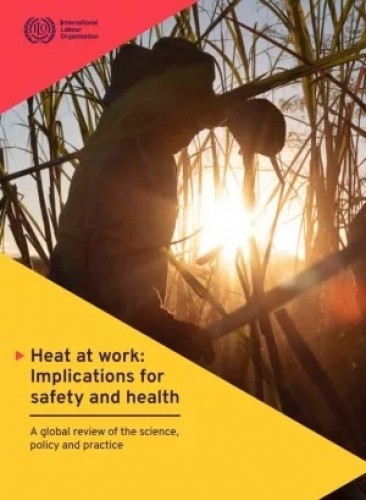
Excessive heat in the workplace :
The ILO has published a study on Heat
at work and its implications for safety and health. This document, which is
very easy to read, provides an overview of the contributions made by research into
this topic, and of legislative initiatives taken around the world, by describing in
detail the regulations in force in four EU countries (Belgium, Cyprus, Spain,
Greece) and putting forward solutions that can be implemented at workplace level.
The data shows that while overall, Europe is the region of the world least affected
so far, it also lies in second place (16.4%) among regions with the most rapidly
increasing rate of heat-related occupational injuries since 2000, after the Americas
(33.3%). This is linked to the fact that Europe is also the region with the most
rapidly increasing workforce exposure to excessive heat (17.3%) over that same
period.
|

Developments in working life :
The European Foundation for the Improvement of Living and
Working Conditions (Eurofound) has published individual
country reports on the main developments in industrial relations and working
conditions in the 27 EU Member States and Norway (see the “working papers”
tab on the web page). These country reports are the only sources of information
available for monitoring developments in these countries, in terms of social
dialogue, collective bargaining, working time and initiatives regarding employment
contracts, reducing the gender pay gap, health and safety, and work-life balance.
|
- Increased industrial unrest in the
EU: Based on the abovementioned country reports, in an
article
on the subject of labour disputes in Europe in 2023, Eurofound points out that
there has been a rise in industrial unrest. While data on industrial action are
“scarce and fragmented”, the information gathered by Eurofound from its network
of correspondents (including IR Share) shows that the downward trend in
industrial unrest in the EU observed before the Covid-19 pandemic seems to have
come to an end, at least in some countries. The main reason behind these
disputes is that wages have not kept up with the rising cost of living.
|
|
|











