 |
| |
IR Notes 237 – 2 October 2024
www.irshare.eu
|
|
|
| |
| |
A question for…
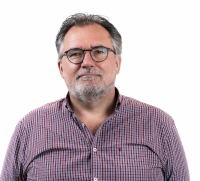
Bruno Demaître, senior policy advisor at industriAll Europe
You’ve launched a digital tool to
assist employees whose company is planning a restructuring – the
Transnational
Restructuring Navigator.
What’s the purpose of this
initiative?
When
I arrived at industriAll Europe, just
over four years ago, one of my missions was to update a
restructuring manual that had previously been compiled by the
European Metalworkers’ Federation, one of the three federations that
gave birth to industriAll Europe. It quickly became apparent that a
tool like this, with a hundred or so pages, was no longer fit for
purpose. We opted for a website, to make the content more accessible
to a wider public. This also meant it could be updated at regular
intervals and could incorporate an automatic translation tool to
facilitate access for as many workers’ representatives and trade
union leaders as possible. The website’s aim is to enable workers
who are faced with transnational restructurings, and more
particularly European Works Council members, to access a set of
resources and an initial level of recommendations. By selecting the
type of restructuring they are faced with, the level of worker
representation they are interested in and the stage the
restructuring is at (ranging from mere rumour through to
implementation), they can quickly access proposals for action that
match their own situation. For more specific recommendations, which
are accessible only to our members, and to obtain a higher level of
support, workers are recommended to contact their trade union or one
of the six European trade union federations that have supported the
project.
|
|
|

|
| |
Diary
4
October
Paris
Conference organised by the Réalité du Dialogue Social
association, entitled « Nouveau parlement
européen : quelles perspectives pour l’Europe sociale ?
» [“A new European Parliament:
what are the prospects for social Europe?”]. Participants
include Maxime Cerutti (BusinessEurope), Isabelle Schömann (ETUC), Rémi
Boyer (Clariane), Livia Hentschel (DGB) and Jean-Michel Pottier (CPME).
7 to 10
October
Strasbourg
Plenary session of the European Parliament.
9 to 10
October
Budapest
Informal
meeting of Employment and Social Policy Ministers.
17 and 18 October
Brussels
European
Council.
4 November
Strasbourg
Lecture on “L’égalité
dans les relations de travail, comparaison
France-Allemagne“ [‘Equality in workplace
relationships: comparing France and Germany’], with Gerhard Binkert
(Landesarbeitsgericht Berlin-Brandenburg [Regional Labour
Court]) and Yves Struillou (Conseil d’État [Council of State]).
Contact: fru6703-contact@unistra.fr
14
November
Paris
International
conference organised by the INRS, anticipating the transformations
taking place in the world of work and preventing occupational hazards
(programme).
2 to 3 December
Brussels
Meeting of
the Council of Employment and Social Policy.
|
|
|
|
|
| |
Who we are?
IR Notes is a
fortnightly newsletter produced by IR
Share and its
network of experts, and is available in several European languages
(English, French, German, Italian, Spanish). It offers Europe-wide
monitoring of employment law, labour relations and employment policy. It
is available by subscription for 273 euros per year .
The team This issue
was producaed by Ambre
Grenier-Boley
, Iris
Turlan and
Frédéric
Turlan .
Find out more
about the IR
Share team on our website.
Subscribe to IR Notes
Via the
IR
Share website or by calliang us on:
+33 (0)6 81 41 53 95
or
E-mail: frederic.t@irshare.eu
Legal notice.
Publisher: IR Share SARL – 5, Les Compères – 89520 Fontenoy, France –
Tel.: +33 (0)6 81 41 53 95 – share capital 1,500 euros – commercial
register (RCS Auxerre): 512 567 959. Managing editor: Frédéric Turlan.
Hosting: ALTEO by Damien Cornillet – Château – 89500
Villeneuve-sur-Yonne. CPPAP no.: 0626 Z 93933.
|
|
|
|
|
| |
Follow us on LinkedIn!

Why not connect to the IR Notes LinkedIn page, so that you can keep up with
developments in the issues we’re covering, between two editions?
You’re welcome to follow us! There are already 635 of you following
us!
|
|
|
|
|
| |
European Industrial Relations Dictionary

In case reading IR Notes inspires you to
explore this subject further, we are providing links to the European
Industrial Relations Dictionary published by Eurofound. This is updated at
regular intervals by IR Share, which publishes IR Notes. The term
definitions are available in English and can easily be converted
into other languages using on-line translation tools.
|
|
|
|
|

|
|
|
Lead story
Stellantis
establishes a benchmark European Works Council

On 18 September, the management of car manufacturer Stellantis and a special
negotiating body assisted by the IndustriAll Europe trade union federation, signed
an agreement
on the establishment of a European Works Council within this group, formed
in 2021 from the merger of PSA and Fiat Chrysler Automobiles (see IndustriAll Europe
press release). The new
agreement, which will be governed by Dutch law, dissolves the three existing EWCs of
the group’s various entities. The text, which is one of the few concluded within a
very large group in recent years, is important insofar as some of the negotiations
were conducted on the basis of texts linked to revision of the European Works
Council directive, and because it is likely to be used as a benchmark during
forthcoming renegotiations of agreements, taking account of the future revised
directive. This EWC is competent to deal with transnational issues that have “a
significant impact on the Group’s employees’ interests, if they affect at least 5%
of the employees in each of at least two of the referred Countries”. The council’s
remit includes powers to deal with environmental concerns, decarbonisation policies,
digitalisation and the main outlines of the group’s social policy and HR plans. It
comprises 37 members, including two UK members who have a consultative role. The
agreement establishes a 12-member select committee, on which the number of seats
assigned to each country is pro rata to the size of its workforce, and each
national delegation is required to choose the members who will represent it on the
select committee. The EWC will meet twice a year (for at least 2½ days), as will the
select committee. The select committee’s powers include exercising the EWC’s
information and consultation prerogatives where exceptional circumstances arise, if
the select committee and management can agree on this. The EWC will also “have the
right to express an opinion on any matter which has not been submitted for a formal
consultation procedure, but which the employee representatives have identified as
being relevant and of international importance”.
Members will benefit from a
minimum of 2 and a maximum of 6 days of collective training for each four-year term
of office they hold, based on a training plan drawn up by the select committee at
two-yearly intervals. The agreement’s confidentiality clause is fairly specific, and
emphasises that the confidentiality obligation is not applicable between full and
deputy members, nor to employees’ local representatives or trade union officials,
“who will however need to respect the same non-disclosure obligation as imposed on
the EWC members”. The member protection clause stipulates that the EWC must be
informed of any disciplinary measures taken against a member and that it will have
“the possibility to discuss the matter with Management before any sanction has been
decided”. The European Works Council has no budget of its own. Members will be
granted a 4-day time credit to discharge their mission (this figure rises to 8 days
for select committee members and 16 days for the chairperson, deputy chairperson and
secretary. The council may be assisted by a representative of IndustriAll Europe,
and Stellantis management will cover travel and accommodation costs, and also
“fees”, which as far as we can tell, is a first for EWC agreements, at least
explicitly. The council may also be assisted by a chartered accountant, for the
purpose of analysing financial statements, and if necessary, by an expert of its
choosing, in the case of “exceptional topics” linked to a consultation process.
Lastly, the agreement’s termination clause envisages the EWC surviving, on the basis
of the directive’s subsidiary requirements, if attempts to negotiate a further
agreement are unsuccessful.
|
1. European
Union
Social
update
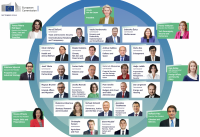
The new European Commission :
When, on 17 September, Ursula von der Leyen, President of the
European Commission, unveiled the photo gallery of her future commissioners to the
European Parliament, she caused consternation among trade unions and left-wing MEPs.
For the first time, the Employment and Social Affairs portfolio is disappearing from
the landscape. “Scrapping the Commissioner for Jobs and Social Rights […] sends
entirely the wrong message to working people about the priorities of the new
Commission”, says Esther Lynch, who calls on Ursula von der Leyen “to urgently
reinstate the Commission portfolio for Quality Jobs and Social Rights” (see ETUC press
release). The Jobs and Social Rights Commissioner portfolio, previously held
by Nicolas Schmit, is being replaced, in part at least, by the portfolio held by
Vice-President Roxana Mînzatu, who was formerly Romania’s Minister of European
Funds. The socialist becomes the Commissioner for “People, Skills and Preparedness”.
Despite this job title seeming to be one dreamt up by a firm of consultants, she
will in effect be taking over Commissioner Schmit’s remit in the area of labour law.
Her mission
letter is consistent with the roadmap put forward by Ursula von der Leyen
ahead of her re-election (see IR Notes 236). In the second sentence of this letter,
the Commissioner is informed that she will also be responsible for “the portfolio of
skills and education, quality jobs and social rights.” The emphasis is on skills and
training workers. Another of her tasks will be to “embed a new culture of
preparedness that can help people to adapt to change and to risks that exist in our
society.” However, she will also be expected to strengthen the European Pillar of
Social Rights via a new action plan and to develop a “Quality Jobs Roadmap” in order
to ensure a “just transition for all”. Her missions also include: a new Pact for
Social Dialogue with European social partners (early 2025); a European strategy to
address the root causes of poverty and an “Affordable Housing Plan”. She is also
requested to “focus” on the impact of digitalisation in the world of work, which
will include an initiative on algorithmic management, and introducing the right to
disconnect. In addition, she will have to work on “improving” Europe’s approach to
occupational health and safety, to ensure healthier workplaces and mental health at
work.
|

A research institute for employers :
On 1 October, thirteen sectoral employers’ organisations
representing members at European and national level, created the European Employers’
Institute (EEI). The EEI seeks to be the employers’ equivalent of the European Trade
Union Institute (ETUI), and will serve as “a central hub for cross-industry research
on topics of common interest to employers, providing robust data and insights to
inform EU policy decisions on social and employment matters.” (see press
release).
|
Sectoral
social dialogue
Extractive industries : On 23
September, European social partners in the extractive industries adopted Joint
recommendations for the next European Mandate (2024-2029) to defend their
activities by strongly calling for actions to avoid deindustrialisation in Europe
and ensuring good quality jobs (see IndustriAll Europe press release).
|
2. Member
States
Austria

- Climate change : The
flooding caused by Storm Boris has prompted several trade unions to call for
greater protection for workers. At the present time, employees who notify their
employer that they are unable to reach their place of work as a result of
natural disasters – either because it is impossible to travel or they have to
stay at home to protect their property – are still entitled to be paid (see practical
guide Arbeiten Im Klimawandel published by the Chamber of
Labour). The Vienna Regional High Court has also ruled in favour of continuing
to pay employees who provide assistance to their family in an emergency
situation where their immediate intervention is required (see article
in Der Standard). For its part, the ÖGB confederation points out that
members of its various federations are entitled to claim compensation from its
“disaster fund”, to cover property damage suffered during severe weather events.
They are entitled to claim 250 euros where the damage is valued at up to 4,000
euros, and 400 euros for higher amounts (see for example, PRO-GE’s information
sheet). The Vida federation has put forward two demands, calling for all
employees to remain on full pay during emergency operations, when they are
either: 1/ providing
assistance to their families, neighbours or other persons affected, at the time
of natural disasters; or
2/providing support to the emergency services, on a
voluntary basis, by taking part in such operations. At the present time, they
continue to be paid only if the situations in question meet “major disaster”
criteria, i.e. an event that mobilises more than 100 people for at least eight
hours. According to the PRO-GE federation, the cost of paying these employees’
wages could be met from the emergency fund, which was recently boosted to the
sum of 1 billion euros by the federal government, in response to the storm (see
press
release). In light of the growing number of climate change-related
natural disasters, these proposals seek to provide better protection and
financial security for workers and volunteers who find themselves caught up in
crisis situations.
|
Finland

Discrimination on grounds of pregnancy :
According to a report
commissioned by the Ministry of Social Affairs and Health, one in four pregnant
women suffers discrimination related to their pregnancy (see press
release). The survey reveals that nearly half of all pregnant women are
having to deal with negative situations, such as the fear of losing their job.
Termination of fixed-term employment contracts is the most common consequence of
this discrimination. According to the survey, just 1% of those questioned had
reported their case to an anonymous workplace discrimination reporting channel. One
in ten people had reported a case of discrimination to a trade union. Although there
is greater awareness of such reporting channels in 2023 than there was in 2012,
victims’ confidence in them has declined, indicating that the fear of repercussions
has increased. For the first time, this report offers comprehensive data on this
subject, thereby highlighting the need for greater protection for the employment
rights of pregnant women, says the ministry.
|
Netherlands

Misuse of traineeships : The
Dutch labour inspectorate has ordered the airline Transavia to pay a fine of 46,000
euros for breaching the law
on minimum wages
and periods of leave (see article
on NOS website and press
release issued by the Ministry of Social Affairs). Between February and June
2022, 60 students from five vocational training colleges (MBO) held the same
responsibilities, worked the same hours and carried out identical tasks to those
performed by commercial flight crew. The labour inspectorate’s intervention forced
Transavia to retroactively pay these students an equivalent remuneration to that
earned by the company’s permanent employees.
|
3.
Entreprises
European
Works Council
Unfair competition : On 20
September, the Siemens Energy
EWC and the IndustriAll Europe trade union federation published a Joint
appeal, expressing their concern that the European wind industry is facing
aggressive competition from Chinese manufacturers. “We expect politicians to stand
up for us, the entire wind value chain and for our jobs”, says the EWC’s Chairwoman,
Nadine Florian, emphatically.
|
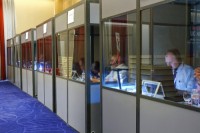
Interpreting and AI : After
becoming aware of the first attempts to use AI to perform interpreting at a European
Works Council meeting, the French branch of the International Association of
Conference Interpreters (AIIC),
the Association
française des interprètes de conférence indépendants (AFICI) and the Société
française des traducteurs (SFT) jointly signed an open
letter (EN) on 22 April, and sent it to various authorities, to alert them
to “the risks posed in the short term, by developments in the field of artificial
intelligence, to the quality, linguistic reliability and confidentiality of
international exchanges”. Subsequently, on 13 June, the SFT published a well-argued
statement
on the same issues.
|
Company
agreement
Support with parenthood : On 16
September, the German bank ING-DiBa and the Verdi service
industries trade union announced an agreement
regarding their next collective bargaining agreement, which will apply to around
5,000 employees and enter into force in 2025 (see press
release). Innovative measures in this agreement include a four-week “family
start-up time”, to be introduced for the second parent at the time of a child’s
birth, or when they adopt a child or take on the role of guardian. This initiative
goes some way towards meeting the requirements of European directive 2019/1158,
which seeks to bring about an equitable distribution of family responsibilities. The
German federal government is currently working on the task of transposing this law.
Kevin Voss, secretary of Verdi’s banking sector, commented: “It’s essential for
young families to spend as much time together as possible when the family unit is
expanding.” He believes this is “excellent news for the company’s future parents and
demonstrates our commitment to corporate social responsibility” (see press
release).
|
4. Studies
and reports

The European Foundation for the Improvement of Living and Working Conditions
(Eurofound), of which IR Share is a member, has published an article
on the effects of the #MeToo movement, which has led to changes in the law in
several countries. Based on information gathered from Eurofound’s network of
European correspondents, researcher Sara Riso reviews the various approaches taken
in Member States to combat sexual harassment and highlights recent policy changes.
She notes that national legislations are increasingly adapting to the rapid
evolution of social media and to the growing prevalence of online activities in the
workplace, which may constitute a fertile breeding ground for sexual harassment (see
full
report).
|
|
|











