 |
| |
IR Notes 239 – 31 October 2024
www.irshare.eu
|
|
|
| |
| |
A question for…
Andrew Watt, General Director, European Trade Union Institute

You’re
now the ETUI’s new
General Director (see Appointment, below), so what will be
the main priorities in its work over the coming
years?
Europe faces a set of interdependent
challenges, including climate change, geographical social cohesion
and economic productivity (often jointly referred to as a
“polycrisis”). These are, or at least certainly have the potential
to be, an explosive mixture. None of these problems can be solved
without taking workers’ voices into account, and this is an
important way of resolving tensions between competing objectives.
The Institute must focus its attention on its main activities. In my
view, if you ask anyone in the street “What do the trade unions
do?”, they will probably answer that the unions are there to
negotiate wages and working conditions. In all likelihood, political
decision-makers, central bankers and employers would give you the
same answer, though maybe with a broader view of the unions’ role,
taking in “social dialogue”. I believe we can do more when it comes
to the basic issues of collective bargaining and setting wages and
salaries, and I’d like the ETUI to become the definitive point of
reference for wage negotiation-related matters and
data.
|
|
|

|
| |
Diary
4 November
Strasbourg
Lecture on “L’égalité
dans les relations de travail, comparaison
France-Allemagne“ [‘Equality in workplace
relationships: comparing France and Germany’], with Gerhard Binkert
(Landesarbeitsgericht Berlin-Brandenburg [Regional Labour
Court]) and Yves Struillou (Conseil d’État [Council of State]).
Contact: fru6703-contact@unistra.fr
12 November
Strasbourg
Commissioner Roxana Mînzatu, future Executive Vice-President for
“People, Skills and Preparedness”, will appear at a hearing before MEPs
from the Parliament’s “Employment and Social Affairs” and “Culture and
Education” committees.
14
November
Paris
International
conference organised by the INRS, anticipating the transformations
taking place in the world of work and preventing occupational hazards
(programme).
2 to 3 December
Brussels
Meeting of
the Council of Employment and Social Policy.
|
|
|
|
|
| |
Appointment
Andrew Watt General Director, European Trade Union Institute
Following a transition period, the era of
Philippe Pochet, who was the emblematic director of the European
Trade Union Institute (ETUI) from 2008 to 2023, has now come to an
end, with Andrew Watt’s arrival at the head of the independent
research and training centre, which is affiliated to the European
Trade Union Confederation (ETUC). The economist is returning to the
ETUI, where he previously worked as a senior researcher coordinating
research on economic, social and employment policies, from 2000 to
2012. He then joined the Macroeconomic Policy Institute (IMK) of the
Hans Böckler Foundation, where he handled macroeconomic questions
affecting Europe. He says that he plans to maintain a degree of
continuity, navigating between a just transition, democracy at work,
and health and safety, but at the same wishes to place greater
emphasis on the trade unions’ traditional remit (see A question
for…. above).
|
|
|
|
|
| |
Who we are?
IR Notes is a
fortnightly newsletter produced by IR
Share and its
network of experts, and is available in several European languages
(English, French, German, Italian, Spanish). It offers Europe-wide
monitoring of employment law, labour relations and employment policy. It
is available by subscription for 273 euros per year .
The team This issue
was producaed by Victoria
Fonseca, Ambre
Grenier-Boley, Iris Turlan
and Frédéric
Turlan.
Find out more
about the IR
Share team on our website.
Subscribe to IR Notes
Via the
IR
Share website or by calliang us on:
+33 (0)6 81 41 53 95
or
E-mail: frederic.t@irshare.eu
Legal notice.
Publisher: IR Share SARL – 5, Les Compères – 89520 Fontenoy, France –
Tel.: +33 (0)6 81 41 53 95 – share capital 1,500 euros – commercial
register (RCS Auxerre): 512 567 959. Managing editor: Frédéric Turlan.
Hosting: ALTEO by Damien Cornillet – Château – 89500
Villeneuve-sur-Yonne. CPPAP no.: 0626 Z 93933.
|
|
|
|
|
| |
Follow us on LinkedIn!

Why not connect to the IR Notes LinkedIn page, so that you can keep up with
developments in the issues we’re covering, between two editions?
You’re welcome to follow us! There are already 649 of you following
us!
|
|
|
|
|
| |
European Industrial Relations Dictionary
In case reading IR Notes inspires you to
explore this subject further, we are providing links to the European
Industrial Relations Dictionary published by Eurofound. This is updated at
regular intervals by IR Share, which publishes IR Notes. The term
definitions are available in English and can easily be converted
into other languages using on-line translation tools.
|
|
|
|
|

|
|
|
Lead
story
Intelligent
oversight of AI

On 25 October, the Sanofi
group’s Italian subsidiary, the employers’ organisation Assolombarda and the
trade-union federations FEMCA-CISL, FILCEM-CGIL and UILTEC-UIL signed a Pact
for Digital Technologies and Artificial Intelligence, with the support of
the Digital Innovation Observatories of Milan’s Politecnico university (see Artificial intelligence). This
document, which is the result of a collaborative effort involving key figures from
the organisation and social partners, establishes principles for the effective,
responsible and conscious use of innovative technologies, thus providing Sanofi
employees with a framework for their implementation within the corporate ecosystem.
This pact, which is the first of its kind in Italy, represents the outcome of a
journey that began with the creation of a Digital Innovation Observatory – a body
that was established to jointly monitor the company’s digital progress and its
impact on work, which also involved organising a great many training sessions on the
day-to-day use of artificial intelligence tools.
The pact sets forth several
principles: 1)
Human-centricity and accountability, with a commitment to “use digital technologies
and AI with care, recognizing the central role of the human being and the importance
of their involvement and supervision in decisions made or assisted by AI”. This
involves establishing “clear human oversight throughout the entire lifecycle of
these technologies, while providing transparency in both the development and usage
of systems and the decision-making processes”. 2)
Ethical adoption and a shared
commitment, requiring the signatories to “leverage digital technologies and AI in a
manner that upholds the dignity, rights, and liberties of individuals”, and to use
these tools “for projects that have societal impacts, contributing to equitable,
inclusive, and sustainable development, prioritizing the safety of human life,
health, and the environment in the design and use of these technologies, in
accordance with ESG principles”. 3)
Empowerment and engagement: the parties will ensure that the
outputs produced by these tools “are understandable and explainable to end-users and
stakeholders”. This means they must “foster a culture of digital competence and
critical awareness within the organization by promoting continuous training on the
potentialities and implications of digital technologies and AI”. The company must
provide its employees with “the necessary skills to ensure the safe and responsible
use” of these technologies. These guiding principes exist hand in hand with rules of
“golden behavior”, such as ensuring that “the use of these systems’ outputs is
always accompanied by information verification, cross-referencing with reliable
sources, and the evaluation of the output itself.” The Italian agreement will be
submitted to the group’s European Works Council, which has already followed a
training module on this topic.
|
1. European
Union
Social
update

Posting of workers : To mark the
Forum
on the Posting of Workers organised by the European Labour Authority (ELA),
BusinessEurope and four sectoral-level employers’ organisations (Ceemet, ECEG, FIEC,
WEC), have issued a joint
statement in response to the European
Commission’s report on the application and implementation of Directive EU
2018/957 of 28 June 2018 concerning the posting of workers in the framework of
the provision of services (see IR Notes 230).
The employers’ organisations believe there is no point in revising the directives on
posting at this stage, but at the same time call for the revision of Regulation
883/04 on the coordination of social security systems. They see no need to
“over-regulate” the posting of third-country nationals (TCN – see Third-country nationals): once
these TCN have entered the EU and are legally residing and working in an EU Member
State, they should be treated as regular posted workers in a single market logic and
be the subject of the same rules and effective visa procedures. The organisations
also support a number of initiatives mentioned in the Commission’s report, such as
the introduction of a tool to help employers determine the remuneration payable to
posted workers, including all obligatory items. This “remuneration calculator”
should be developed by the ELA. They call on the Commission to rapidly put forward
its initiative on e-Declaration, as a universal tool to be used on a voluntary basis
by the Member States, and at the same time advocate a sector-based approach in order
to enhance the supervision of posting, citing the example of social ID cards that
function well in the construction sector in several countries.
|

European Works Councils operating under Irish
law : On 24 October, MEPs Gabriele Bischoff (S&D) and
Dennis Radtke (EPP), rapporteur of the proposal for a revision of the European Works
Council directive, submitted a written question to the European Commission, in
response to the matter of the Verizon EWC, in which they explain that “The Irish
Labour Court dismissed the case (TID241),
stating the EWC Chariman is not acting as an individual before the court, but on
behalf of the EWC, and the EWC, as a collective, cannot pursue claims under Irish
law”. The two MEPs point out that “If an EWC, as a collective body, does not have
the right of recourse to the Irish courts, how does the Commission consider that the
rights under Directive 2009/38/EC can be enforced in Ireland?”, and asks the
Commission if it intends to bring legal proceedings against Ireland for breaching EU
law, following its initial letter of formal notice, sent on 19 May 2022.
|
Case law

Temporary work : The Court of
Justice has ruled on a Spanish case concerning the application of Directive 2008/104
of 19 November 2008, on temporary agency work (CJEU,
24 October 2024, Case C-441/23, LM) (see Temporary agency work). After
completing a six-month traineeship at Microsoft, the claimant was then recruited
successively by three different undertakings, all of which were service providers to
Microsoft. Within the framework of her duties, she was responsible for performing
the contractually agreed services and in the last of these three jobs, she performed
marketing services for Microsoft which were not provided by any of its employees.
While she was pregnant, Microsoft terminated the contract with the service provider
that employed her. Her employer subsequently dismissed her when she returned from
parental leave, due to a reduction in the number of orders placed with them. One of
the questions referred to the Court of Justice was that of deciding whether
Directive 2008/104 applies only to temporary-work agencies recognised as such under
national law, or also to an undertaking that assigns a worker to another
undertaking, even though the first undertaking is not recognised by domestic
legislation as a temporary-work agency because it does not have the relevant
administrative authorisation. The Court of Justice rules that if the directive
applied only to undertakings which hold a prior administrative authorisation to
operate as a temporary-work agency, this “(i) would mean that the protection of
workers would vary between Member States, depending on whether or not national law
requires such authorisation, and within the same Member State, depending on whether
or not the undertaking in question holds such authorisation, and would risk
undermining the objectives of that directive, which are to protect temporary agency
workers, and (ii) would undermine the effectiveness of that directive by
inordinately and unjustifiably restricting its scope”. Accordingly, it concludes
that the directive applies to this case. The Court had also been asked to determine
firstly, whether the employer could be classified as a temporary-work agency, and
secondly, whether the worker was a temporary agency worker. The Court provides the
following guidance for the national court: 1.
If the latter finds that the worker’s employer is an undertaking
whose activity – whether or not its main activity – is to conclude contracts of
employment or employment relationships with workers in order to assign them
temporarily to user undertakings to work there under their supervision and
direction, it would have to take the view that Directive 2008/104 applies.
2. If the undertaking at which
the worker carries out his or her activity, firstly imposes on the worker the
services to be performed, the manner of their performance and the requirement to
comply with its instructions and internal rules, and, secondly monitors and
supervises the way in which the worker performs his or her duties, then it must be
deemed to be a user undertaking within the meaning of the directive.
|
Sectoral
social dialogue
- Personal and Household Services :
On 16 October, European social partners in the personal and
household services sector issued a joint
statement, calling on the European Commission to take urgent action to
tackle the severe labour and skills shortages facing the sector.
|
2. Member
States
Germany
Strong measures to boost employment :
On 2 October, the Federal cabinet approved new measures aimed at
boosting the labour market, strengthening social cohesion and promoting growth. One
of these initiatives allows employees to try out a job before making a firm
commitment to their new employer (see press
release).
|
- Fewer workers now covered by collective
bargaining agreements : Since 1996, the proportion of
employees working at companies that are subject to collective labour agreements
has fallen by 25 percentage points (see study). In
2023, 51% of employees did not benefit from any collective bargaining agreement,
while just 42% were covered by a branch-level agreement and 8% by a company
agreement. The level of collective bargaining coverage varies according to
several factors, such as the size of the company and the region concerned, with
a more favourable environment in the West of Germany (see press
release).
|
Austria
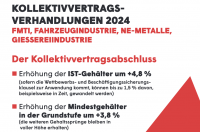
Collective bargaining agreement in the
metalworking industry : The Pro-GE and GPA trade unions have
finalised a new collective bargaining agreement for the metalworking industry,
affecting around 200,000 employees (see press
release). This agreement includes a 4.8% pay rise and a mileage rate, plus
an increase in the income earned by apprentices (see press
release). Companies that are experiencing difficulties will be able to
negotiate a lower pay rise, provided that this is offset by more free time, a single
payment or other forms of compensation.
|
Finland

Residence permits : The Ministry
of Employment recently presented a bill to Parliament, aimed at systematising
oversight of work-related residence permits granted to foreigners from countries
that are not EU members (see press
release). This new legislation stipulates that foreign workers who lose
their job will have three months to find a new job in Finland. If they fail to do
so, they will have to leave the country. In some cases, such as highly specialised
experts, posted workers and senior managers, the period allowed for job-hunting will
be extended to six months. These measures will apply to approximately 50,000
non-European foreign workers.
|
France
- Gender balance : The
government has issued an edict transposing Directive (EU) 2022/2381 of 23
November 2022 on improving the gender balance among directors of listed
companies. The edict
was published in the 16 October edition of the country’s Official Journal. It
supplements the rules laid down by the Copé-Zimmermann law of 27 January 2011.
|
Netherlands

Early retirement for workers doing arduous jobs
: The government, in consultation with the trade unions and
employers, has concluded an agreement to facilitate access to early retirement for
workers employed in arduous jobs (see press release). Under this agreement, people whose jobs are
recognised as being arduous, as defined by a third-party body appointed by the
Ministry of Social Affairs, will be entitled to retire up to three years
early. Workers who are experiencing financial difficulties will also qualify for an
additional allowance, capped at a gross annual level of 3,600 euros, to ease their
pathway to early retirement.
|
Portugal
Wage rises : On 1 October, the
government signed the 2025-2028
Tripartite agreement on wage increases and economic growth, with the
Portuguese Confederation of Companies (CIP), the Portuguese Confederation of
Commerce and Services (CCP), the Portuguese Tourism Confederation (CTP), the
Portuguese Farmers’ Confederation (CAP) and the General Workers’ Union (UGT) (see
government press
release). This agreement fixes the increase in the minimum wage at 870 euros
gross from next year, i.e. a rise of 50 euros. The minimum wage will progressively
be raised to 920 euros in 2026, to 970 euros in 2027, and to 1,020 euros in 2028.
The agreement also includes tax incentives for companies that pay higher wages,
allowing them to deduct 50% of the cost of these increases from their corporation
tax (IRC) bill.
|
3.
Companies
European
works councils

Immersion in Brussels : The 52
full and alternate members comprising the construction group Vinci’s EWC, who come from 10 EU
countries, have taken part in a week-long training course, focusing on strategic
issues facing the group’s employees. Among other topics, they focused their
attention on the CSRD directive and the impact of artificial intelligence. They met
with representatives of the European trade-union federation EFBWW, visited the
European Parliament and held discussions with political groups on subjects that
preoccupy EWCs, such as the proposed revision of the European Works Council
directive, due diligence and protecting workers against asbestos. They also took
part in a dialogue with management on the issues of global social protection and
bringing the group’s environmental actions into line with social and ecological
challenges. Another topic they looked at, that of sustainable employability, is also
being examined by an EWC working party, with a view to drafting a charter of good
practice applicable in all European countries, to promote sustainable employability
at Vinci.
|

A new EWC : In mid-October,
after three years spent on this task, the Kyndryl group (90,000 employees),
which came into being following the demerger in 2021 of IBM’s infrastructure
services, completed its negotiations on the creation of an European works council.
|
4. Studies
and reports

Cyberbullying : A Eurofound study
highlights significant differences between the regulations in force in EU Member
States and Norway, in terms of intimidation, harassment and cyberbullying in the
workplace. Cyberbullying is often regarded as an extension of conventional bullying
in EU Member States, although Denmark’s laws explicitly recognise the offence of
“cyberbullying”. To this end, ratification of ILO Convention no. 190 is expected to
lead to regulatory changes in those countries that adopt it. Incidence of
work-related harassment and intimidation varies from 2% to 40%, with higher levels
apparent in certain sectors (e.g. healthcare and education). Although cyberbullying
in the workplace is less common and has been less closely studied than face-to-face
bullying, it nevertheless affects employees’ mental health to an equal extent, and
thus calls for specific preventive measure.
|
|
|











