 |
| |
IR Notes 241 – 27 November 2024
www.irshare.eu
|
|
|
| |
| |
A question for…
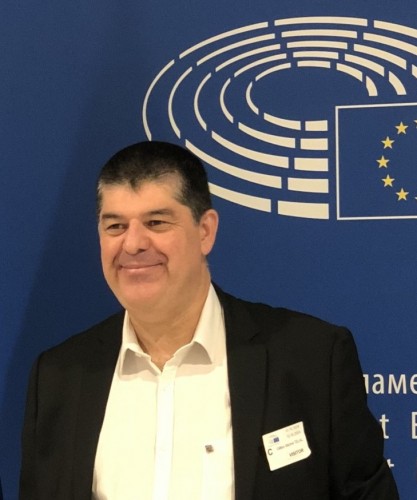
Gilles Telal, secretary of the Exxonmobil EWC and President of the French
federation CFE-CGC Enermine et Industries Transverses.
What
initiative was your European Works Council able to take,
following the announcement in April, by US oil company
ExxonMobil, of a restructuring programme in France, which
resulted in job
losses?
As with previous refinery sell-offs, in
Italy (2018) and Norway (2019), the EWC wanted to be consulted, but
management’s response is always the same. Despite these plans always
being transnational in nature, given that they impact the shared
service centres in Prague and Budapest, in each case management
claims that the impact isn’t significant, in terms of activity and
the number of employees concerned. Our agreement, which dates back
many years, doesn’t specify a threshold above which a reorganisation
plan can be deemed “significant”. Management’s view is “never”. In
the case in point, on 11 April, ExxonMobil announced the closure of
its chemicals business on the site at Gravenchon (Seine-Maritime),
with the loss of 677 jobs in 2025, and the sale of the Fos-sur-Mer
refinery (310 employees). So, it would seem these changes are “not
significant”? If we want to challenge their decision not to consult
the EWC, we’d have to go to court, which means taking the case to a
Belgian court and also obtaining agreement from our members to take
such legal action. However, a number of these employees are not
protected or unionised, and they may fear for their future job
prospects. Moreover, some members are appointed by management,
making it hard to take collective action. It’s time for a revision
of the European Works Council directive. This in turn will open the
way to renegotiating these old agreements, which are hampering
European employees’ representatives efforts to make progress and the
optimisation of a constructive social dialogue. We decided to assist
the employees in question by calling on the authorities in France,
via our trade union federations, to put together an aid application,
seeking EU funding from the European Globalisation Adjustment Fund
to assist with the redeployment of our redundant employees. However,
the level of complexity involved in putting together such an
application is horrifying, and we don’t yet know whether management
will provide the internal resources needed to submit an application
to the Ministry of Employment, which in turn would approach the
European Commission.
|
|
|

|
| |
Diary
2 to 3 December
Brussels
Meeting of
the Council of Employment and Social Policy.
|
|
|
|
|
| |
Who we are?
IR Notes is a
fortnightly newsletter produced by IR
Share and its
network of experts, and is available in several European languages
(English, French, German, Italian, Spanish). It offers Europe-wide
monitoring of employment law, labour relations and employment policy. It
is available by subscription for 273 euros per year .
The team This issue
was producaed by Francisco Javier
Gómez Abelleira, Ambre
Grenier-Boley,
Victoria
Fonseca,
Iris Turlan and Frédéric
Turlan.
Find out more
about the IR
Share team on our website.
Subscribe to IR Notes
Via the
IR
Share website or by calliang us on:
+33 (0)6 81 41 53 95
or
E-mail: frederic.t@irshare.eu
Legal notice.
Publisher: IR Share SARL – 5, Les Compères – 89520 Fontenoy, France –
Tel.: +33 (0)6 81 41 53 95 – share capital 1,500 euros – commercial
register (RCS Auxerre): 512 567 959. Managing editor: Frédéric Turlan.
Hosting: ALTEO by Damien Cornillet – Château – 89500
Villeneuve-sur-Yonne. CPPAP no.: 0626 Z 93933.
|
|
|
|
|
| |
Follow us on LinkedIn!

Why not connect to the IR Notes LinkedIn page, so that you can keep up with
developments in the issues we’re covering, between two editions?
You’re welcome to follow us! There are already 658 of you following
us!
|
|
|
|
|
| |
European Industrial Relations Dictionary
In case reading IR Notes inspires you to
explore this subject further, we are providing links to the European
Industrial Relations Dictionary published by Eurofound. This is updated at
regular intervals by IR Share, which publishes IR Notes. The term
definitions are available in English and can easily be converted
into other languages using on-line translation tools.
|
|
|
|
|

|
|
|
Lead
story
EU remains
at a crossroads between budgetary austerity and massive investments
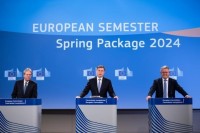
How will the EU’s economic, budgetary, social and environmental policies evolve in
the coming months? The answer lies in the first part of the “Autumn Package”,
presented by the European Commission on 26 November (see press
release). This is one stage of the European Semester, introduced in 2010,
which provides an annual framework for coordinating the proposed budgetary and
economic policies adopted in the EU and the euro zone (see European Semester). It is the
first exercise undertaken since the reform of the EU’s new economic governance
framework entered into force in April 2024 (see Council press
release). In June, the Commission sent Member States guidelines for drawing
up their medium-term fiscal-structural plans. These plans set out the States’
budgetary targets, and their priority reforms and investments. They were submitted
in September and the Commission has just endorsed them, sometimes conditionally. In
the meantime, Mario Draghi’s report
inviting the EU to invest heavily in order to tackle the decline in its
competitiveness in relation to the United States and China, has been submitted to
the Commission (see IR
Notes
236). Officially, the new framework will help States to achieve
macroeconomic stability, growth and fiscal sustainability, “which are critical for
the EU’s economic strength in today’s challenging global environment”. It “also
encourages reforms and investments that will lay the foundations for long-term
economic stability and sustainable growth”. Lastly, “it helps build a more
resilient, fair, competitive, and secure EU economy for the benefit of citizens”.
Among other things, this exercise therefore aims to bring about “a gradual and
realistic reduction of public debt levels, which significantly increased following
the COVID-19 pandemic and the subsequent energy crisis”. This goal must feature in
the medium-term plans for reforms and investments adopted by each country, in order
to address common EU priorities (green and digital transitions, social and economic
resilience, energy security and the build-up of defence capabilities). Once these
medium-term plans have been endorsed by the Council, the Commission will monitor
whether Member States are respecting their commitments. States will then present
annual progress reports. In the coming weeks, the Commission will present the second
part of the European Semester Autumn Package, which will include the Annual
Sustainable Growth Strategy, the euro area recommendation, the Alert Mechanism
Report and the proposal for a Joint Employment Report. Will this new exercise be
able to rescue the EU’s economy from stagnation? The Commission’s guidelines, which
are not very transparent and seek to achieve a compromise between, on the one hand,
Member States who are opposed to any joint expenditure, and on the other, those who
expect the EU to borrow heavily in order to finance the ‘investment shock’ advocated
by Mario Draghi, offer the best guarantee that Europe will remain stuck in a rut.
Ludovic Voet, ETUC’s Confederal Secretary, is critical: “These plans bear no
resemblance to the economic challenges faced by Europe, its industries and workers”,
he says, adding: “These plans make clear once again that the Stability and Growth
Pact places self-defeating restrictions on member state spending. Europe needs a
fiscal policy which promotes investment, prioritises the wellbeing of working people
and protects the planet”.
|
1. European
Union
Legislation
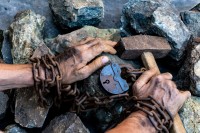
Forced labour : On 19 November,
the Council adopted the regulation prohibiting products made using forced labour.
This law prohibits the marketing within the EU and the making available on the EU
market, as well as the export from the EU market, of any product made using forced
labour (see press
release and IR
Notes 192 and IR Notes 229).
The regulation will enter into force after it has been published in the OJEU, and
will become applicable three years later.
|
Projects
Electronic posting declarations: :
On 13 November, the Commission unveiled a proposal to create
a single digital declaration portal for service providers posting
employees to another Member State. This mechanism is provided for by the proposal
for a regulation “on a public interface connected to the Internal Market
Information System for the declaration of posting of workers and amending
Regulation (EU) No 1024/2012”. This platform, which was inspired by the one introduced for posting
declarations in the road transport sector, is intended to: 1/ cut the administrative
burden linked to posting of workers, with the amount of time companies spend on
making declarations expected to fall by 73% on average; 2/ promote cooperation between
Member States, as this portal will be part of the Internal Market Information (IMI)
system; 3/ strengthen
protection for workers, in particular by making it easier for “effective and
adequate inspections” to be carried out within Member States. These States will be
able to use this system on a voluntary basis, and according to the Commission, nine
of them have already announced that they would like to introduce this mechanism.
However, the General Secretary of the European Trade Union Confederation (ETUC) is
critical of the “social cost of this proposal”, which “would far outweigh the small
savings for companies”. She sees it as an example of a “false economy” resulting
from the “Commission’s Trump-style deregulation agenda”, which aims to cut
bureaucratic burdens by 25% (see ETUC’s letter).
EFBWW General Secretary Tom Deleu is another critic of the proposal: “This proposal
will make it easier for letterbox companies to continue and even increase their
business model of fake postings”. For their part however, the employers support the
plan. In their recent statement
on the report on the application of the Posting Directive, the employers
called on the Commission to swiftly introduce the single electronic declaration.
BusinessEurope too, is pleased with the initiative and believes that in the
long-term, the single market “would benefit from having only one single notification
portal with unified information and documentation obligations” (see press
release).
|
- Revision of the European Works Council
Directive : On 3 December, MEPs on the European
Parliament’s Committee on Employment and Social Affairs will vote on
Parliament’s negotiating mandate to commence negotiations with the Council, with
a view to adopting the proposal for a directive put forward by the European
Commission (see agenda).
|
Social
update

Traineeships Directive : On 20
November, six employers’ organisations published a joint
statement calling for the withdrawal of the proposal
for a directive on quality traineeships, on which some Member States are
trying to reach agreement. The employers argue that the proposed directive “does not
adhere to the principle of subsidiarity” and that it is misaligned with the
Commission’s goal of simplifying business processes. “Given the diversity of
national systems and regulatory frameworks, the signatories believe that the issue
of traineeships should be addressed at the national level”.
|
Directive on “adequate minimum wages” :
EU Member States had until 15 November to transpose the
directive on adequate minimum wages into their domestic law (see IR Notes 192 and IR Notes 188). In a
press
release, the European Commission expresses its satisfaction that the
directive “has already started to produce positive effects even before the end of
its transposition period, prompting debates at national level on the adequacy of
minimum wages”. Eurofound’s annual
review of minimum wages revealed that “linking of minimum wages to certain
percentages of average or median wages, as suggested in the directive,” continued in
2023, “with an increasing number of countries adopting this practice.” The
Commission also emphasises that “over the past two years, statutory minimum wages
have increased significantly in most Member States, compensating the impact of high
inflation on the purchasing power of low-wage earners”. The Commission states that
it will assess whether the directive has been incorporated into national law in a
complete and correct way by each Member State, and take action if and when
necessary. The European Trade Union Confederation’s view, however, is a much less
positive one. It acknowledges the positive effects set out by the Commission (see European
Trade Union Institute study) but condemns the fact that most EU countries
have failed to meet the transposition deadline (see press
release).
|

Competitiveness and invitations to tender :
At his confirmation hearing before MEPs, on 12 November,
Stéphane Séjourné, the European Commission’s Executive Vice-President-designate for
Prosperity and Industrial Strategy, set out his vision of the EU’s future industrial
policy and also addressed a number of social issues. Among other things, he called
for the creation of a European Competitiveness Fund, combining public guarantees and
private capital, and for the development of new savings products at European level.
He promised to promote the idea of introducing a number of mandatory social
conditions, such as better working conditions, into public invitations to tender. He
emphasised the need to ensure a supply of quality jobs, while at the same time
defending an approach that strikes a balance between social progress and economic
competitiveness.
|

Boosting skills and quality jobs :
Like that of Stéphane Séjourné (see above), the confirmation
hearing of Roxana Mînzatu, Executive Vice-President-designate for People, Skills and
Preparedness, was among the last ones scheduled for confirming the new Commission’s
composition. The aim here is to approve the appointments of Conservative and
far-right Commissioners, before approving those from the Renew and the Socialists
and Democrats Groups. The appointment drew criticism of her job title from the
Chairs of the Committees on Employment (EMPL) and Culture (CULT), who pointed out
that it did not include the words “employment” or “social rights”. In reply,
Roxana Mînzatu stressed that these issues were among her top priorities. In her
first speech, she highlighted the need to promote quality jobs and encourage
lifelong learning, emphasising the importance of skills portability. She also called
for better inclusion of persons with disabilities in the jobs market, and encouraged
the use of new technologies, such as AI, for developing key skills. She is promising
to implement an ambitious new action plan for the European Pillar of Social Rights
(see hearing
report and written
answers to MEPs).
|
2. Member
States
Germany
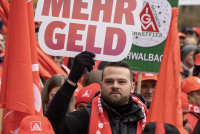
Wage agreement in the metalworking sector :
On 12 November, at negotiations conducted on an experimental
basis at regional level, social partners in the metalworking and electronic
industries reached a new collective bargaining agreement covering Bavaria and
Germany’s coastal Länder. The outcome will also be adopted in Germany’s
other regions. This agreement provides for a 2% wage increase on 1 April 2025 for
the branch’s 4 million employees, followed by a 3.1% increase in April 2026,
accompanied by a 600 euro one-off bonus paid by February 2025. The industry’s
230,000 apprentices will be granted a 140 euros per month pay rise from January
2025. IG Metall also secured a “social component” for its members, with an 8 point
rise in the “agreed annual bonus”, which will rise from 18.5% to 26.5% of the
benchmark pay level in February 2026, i.e. from 630 to 900 euros (see press
release). (Foto: Frank Rumpenhorst).
|
Spain

Hearing prior to dismissal : On
18 November, the Social Chamber of the Supreme Court issued an important ruling that
will require companies to hold a hearing for employees prior to any disciplinary
dismissal proceedings. Currently, this requirement applies under Spanish law only in
exceptional circumstances. The only formal requirement is for a letter of dismissal
to be sent before the actual date of termination of the employment contract. Even
though the employer’s decision can be challenged at an employment tribunal, the fact
is that the employee is not entitled to defend themselves against the company’s
accusations before they receive their letter of dismissal. The Supreme Court has
applied ILO Convention 158, Article 7 of which stipulates that “the employment of a
worker shall not be terminated for reasons related to the worker’s conduct or
performance before he is provided an opportunity to defend himself against the
allegations made, unless the employer cannot reasonably be expected to provide this
opportunity”. In this ruling, the Supreme Court makes changes to its previous case
law, which dated back to the late 1980s. This doctrine held that the comprehensive
dismissal letter system met the requirements of Article 7 of the Convention and that
this article could not be considered to be directly applicable without a legislative
intervention. However, the Court now considers that Article 7 of the Convention is a
directly applicable provision. With effect from the publication date of this ruling,
any disciplinary dismissal must be preceded by a hearing of the employee (see article
by Professor Francisco Javier Gómez Abelleira and Supreme Court press
release).
|
Romania

Minimum wage : The “European
minimum wage” law, which transposes the European directive on adequate minimum
wages, has been promulgated by President Klaus Iohannis. The minimum wage will rise
to 4,050 leu (approx. 815 euros) on 1 January 2025. This amount has been negotiated
between the government, the trade unions and employers (see press
release).
|
|
|











