 |
| |
IR Notes 244 – 22 January 2025
www.irshare.eu
|
|
|
| |
| |
A question for…
Jean-Philippe Lhernould, Professor of Private Law at the University of
Poitiers

Do
you think the Advocate General’s legal reasoning is sound,
in the case of Denmark v. the EU legislature, challenging
the minimum wage directive (see Lead
story)?
He sets out a very detailed opinion, giving
extensive consideration to the arguments put forward by all parties.
It’s based on an in-depth analysis of European case law, the text of
the directive and all of the sources mobilised.
In the end, it’s hard not to give credit to
his reasoning, which boils down to taking the view that a directive
that directly interferes in the area of pay is incompatible with the
‘pay’ exclusion in Article 153 paragraph 5 TFEU. Actually, this is
the case with Directive 2022/2041, the object of which is to
regulate pay. The fact that firstly, the EU legislature has
restricted itself to adopting vague requirements, and secondly, the
directive does not prejudice the social partners’ autonomy, doesn’t
change the reality of this object. Likewise, stating that the
directive only defines measures of a procedural nature, relating to
setting wages, can’t disguise the fact that it’s intended to have an
effect on wage levels.
Admittedly, the Advocate General points out
that the exception of Article 153 paragraph 5 should be subject to
strict interpretation, but the case law underlying this affirmation
has been developed in connection with directives (on fixed-term
contracts, part-time working, etc.) that apply only indirectly to
pay. However, his opinion emphasises that a strict interpretation of
the exception should not go so far as to deprive it of any useful
effect. More broadly, the Advocate General regards a Community
instrument that directly interferes in the area of wages as being
incompatible with the exception in Article 153 paragraph 5, if its
object is to regulate pay, regardless of the severity or flexibility
of such regulation.
It’s
impossible to know whether the Court will follow his opinion.
Several options are on the table: full or partial (collective
bargaining provisions) annulment; annulment with delayed effect,
accompanied by the proposal of a different legal basis; or no
annulment. It’s true that the directive has no tangible effect on
Danish and Swedish laws, but that won’t be enough to warrant a
rejection of the action for annulment. Ultimately, what must be
decided is a constitutional matter, linked to the division of powers
between the Union and its Member States.
|
|
|

|
|
|
|
|
| |
Who we are?
IR Notes is a
fortnightly newsletter produced by IR
Share and its
network of experts, and is available in several European languages
(English, French, German, Italian, Spanish). It offers Europe-wide
monitoring of employment law, labour relations and employment policy. It
is available by subscription for 273 euros per year .
The team This issue
was producaed by
Victoria Fonseca,
Iris Turlan and Frédéric
Turlan.
Find out more
about the IR
Share team on our website.
Subscribe to IR Notes
Via the
IR
Share website or by calliang us on:
+33 (0)6 81 41 53 95
or
E-mail: frederic.t@irshare.eu
Legal notice.
Publisher: IR Share SARL – 5, Les Compères – 89520 Fontenoy, France –
Tel.: +33 (0)6 81 41 53 95 – share capital 1,500 euros – commercial
register (RCS Auxerre): 512 567 959. Managing editor: Frédéric Turlan.
Hosting: ALTEO by Damien Cornillet – Château – 89500
Villeneuve-sur-Yonne. CPPAP no.: 0626 Z 93933.
|
|
|
|
|
| |
Follow us on LinkedIn!

Why not connect to the IR Notes LinkedIn page, so that you can keep up with
developments in the issues we’re covering, between two editions?
You’re welcome to follow us! There are already 672 of you following
us!
|
|
|
|
|
| |
European Industrial Relations Dictionary

In case reading IR Notes inspires you to
explore this subject further, we are providing links to the European
Industrial Relations Dictionary published by Eurofound. This is updated at
regular intervals by IR Share, which publishes IR Notes. The term
definitions are available in English and can easily be converted
into other languages using on-line translation tools.
|
|
|
|
|

|
|
|
Lead
story
Is the Court
of Justice going to annul the minimum wage directive?

Is the von der Leyen Commission’s flagship “social” measure set to be wiped off the
map by a court ruling? This is what may happen in a few months’ time, if the Court
of Justice accepts the opinion
of its Advocate General, delivered on 14 January, on the case brought by Denmark
against the European Parliament and the Council of the EU, concerning Directive
2022/2041 of 19 October 2022 on adequate minimum wages in the EU (AMW
Directive). It had been known from the outset that there was a risk of this
directive being annulled.
In terms of substance, the legal problem is fairly
straightforward. The areas over which the EU has competence to legislate are defined
in the Treaty on the Functioning of the European Union (TFEU). In the field of
social affairs, they are set out in Article 153 paragraph 1: for example, it can act
to “protect workers’ health and safety”, improve “working conditions” and protect
“workers where their employment contract is terminated”. On this legal basis, it can
pass directives imposing minimum requirements on its Member States. On the other
hand, as stated in Article 153 paragraph 5, the EU’s competence “shall not apply to
pay, the right of association, the right to strike or the right to impose
lock-outs”. That is why there are no directives regulating the right to strike or
indicating how collective bargaining should be conducted.
So, how can the
adoption of this directive on the minimum wage, which the directive itself defines
as “a minimum remuneration” (Art. 3 para. 1 of the directive), be justified? The
approach adopted by the EU legislature has been to select Article 153 paragraph 1 b
as the legal basis for the directive, with a view to “improving living and working
conditions in the Union, in particular the adequacy of minimum wages for workers in
order to contribute to upward social convergence and reduce wage inequality” (see Working conditions). As the
Advocate General notes, the legislature was extremely careful in its wording of the
directive, indicating that it “neither aims to harmonise the level of
minimum wages across the Union nor does it aim to establish a uniform mechanism for
setting minimum wages”. He emphasises that the wording adopted shows that the
legislature “did not ignore that […] it was walking on thin ice”. This risk of
moving beyond the EU’s sphere of competence is all the more sensitive in that the
other aim of the directive is to promote collective bargaining, which is itself an
excluded subject, given that the EU is prohibited from intervening in the “right of
association”, from which the right to conduct collective bargaining is derived. In
conclusion, he takes the view that, since the object of the AMW Directive is to
“regulate ‘pay’”, it “directly interferes with the ‘pay’ exclusion in Article 153(5)
TFEU”. Consequently, the EU legislature “was not competent to adopt that instrument
and, thus, acted in breach of the principle of conferral laid down in Article 5(2)
TFEU”. This finding should lead “the Court to conclude that the AMW Directive must
be annulled in full”.
This was music to the ears of the Danish Employment
Minister, Ane Halsboe-Jørgensen, who had argued that the EU had strayed onto “thin
ice”, and called on the Court of Justice to annul the directive, three months after
its adoption, a move that was immediately supported by Sweden. She says she will now
await “the final verdict of the Court of Justice, but in football parlance, we’re
3-0 up at half-time” (see press
release). The Danes’ intransigent position reflects the opposition of some
Nordic trade unions to this directive, which they regard as direct interference in
activities that are the preserve of the social partners: setting wages and
collective bargaining. The directive also reopens the wounds left by the Court of
Justice ruling in the Laval
un Partneri case (see Laval case) in 2007, which
held that a Swedish trade union was not entitled to blockade a building site, in
order to force “a provider of services established in another Member State to enter
into negotiations with it on the rates of pay for posted workers and to sign a
collective agreement”. This fear of EU interference in the Nordic social model even
came close to prompting several Nordic trade unions to withdraw from the European
Trade Union Confederation (ETUC), whose former President Laurent Berger viewed the
adoption of this directive as “a victory” and “good news for European workers”. The
Advocate General’s opinion is a huge let-down for the ETUC (see Social update). It
is now up to the Court of Justice to pronounce on whether or not, in matters of law,
the EU legislature has flouted the Treaty. And the verdict may well be a painful
one.
|
1. European
Union
Social
update

Reactions to the AG’s opinion on the “adequate
minimum wages” directive : The European trade union movement
is hugely disappointed with the opinion delivered by the Advocate General of the EU
Court of Justice (see Lead story). The ETUC has expressed indignation: “the most
important piece of workers’ legislation at EU level in a generation may be under
threat”. ETUC General Secretary Esther Lynch adds: “This opinion, if confirmed,
would be a huge blow to working people and their trade unions and would completely
undermine the objective of social progress enshrined in the EU treaties” (see press
release). European trade union federations, such as the EPSU public service
workers’ union, which recalls the precedent set by the Laval and Viking rulings,
support the ETUC’s position, pointing out that these “massively undermined
collective bargaining and pro-EU sentiment”. This would once again be the case if
the Court of Justice followed the Advocate General’s opinion (see press
release). “We expect the CJEU to uphold its longstanding case law and
confirm the directive in its entirety, in line with the legal opinions of the
Parliament, the Council, the Commission and the vast majority of member states”,
explains Oliver Roethig, Regional Secretary of UNI Europa (see press
release). At national level, a number of confederations have also warned the
Court of Justice that if it annuls the directive, “the objective of social progress
enshrined in the EU treaties would be completely undermined, and this in turn would
place working-class support for the European project at greater risk”, in the words
of the Spanish trade-union confederation CCOO (see press
release). However, this view is not shared by the Nordic confederations
(with the exception of the Finns, who support the ETUC’s position). Flemming H.
Grønsund, Vice-President of the Danish confederation FH, is highly optimistic: “It’s
still too early to celebrate. We’re now waiting for the Court of Justice to issue
its final decision, but of course I’m feeling extremely confident after today’s
consultative opinion!” (see press
release). There was a similar reaction from the Swedish trade union
confederation LO and the Swedish employers. LO’s Confederal Secretary Veli-Pekka
Säikkälä, says that “if the Court reaches a different conclusion from the Advocate
General, there may be consequences for Sweden’s membership” (see article in Lag&Avtal).
|

“Omnibus” directive : On 26
February, the European Commission is due to unveil an “Omnibus package”, which is
expected to include a proposal for a directive and a communication (see College of
Commissioners agenda).
This is in response to the concerns expressed by Heads of State and of Government,
following the Draghi
report, which blamed the EU’s economic slowdown in part on excessive
regulations and reporting obligations (see IR Notes
236). The purpose of this legislative initiative is therefore to group
together several amendments and revisions of existing laws under a single proposal,
in the name of simplifying and combatting the bureaucracy allegedly hampering EU
companies. In point of fact this will mean the Commission unravelling a number of
texts adopted during its previous term, especially within the framework of the Green
Deal on sustainable transition. It therefore plans to rationalise or simplify the
regulations introduced by: 1/
the Corporate Sustainability Reporting Directive (CSRD), which strengthens the
transparency obligations applicable to companies, with regard to their
environmental, social and governance (ESG) impacts; 2/ the green taxonomy
regulation, which defines criteria that can guide investors and promote sustainable
finance by helping to identify sustainable economic activities; 3/ the directive on European due
diligence (CSDDD), which obliges companies to identify, prevent and mitigate the
negative impacts of their activities on human rights and the environment within
their value chains.
|
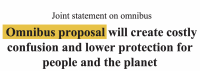
Reactions to simplification proposals :
In response to the moves to challenge the texts resulting from
the Green Deal (see above), on 14 January, trade unions and NGOs published a Joint
statement on the Omnibus proposal, arguing in favour of maintaining these
directives and regulations, which encourage a “race to the top”, to protect human
rights, the environment and climate. In France, the College of Sustainable
Development Managers (C3D), a grouping of almost
400 CSR managers employed by large corporations, expressed its support for these
European laws in a letter to Ursula von der Leyen (not published), stating that
companies that lag behind in meeting their commitments (there are reported to be
more such companies in Germany than elsewhere) should not be allowed to prosper in
this way (see article
written by our colleagues at Novethic).
|
2. Member
States
Denmark

Adolescent labour : With effect
from 1 January, the government, with the agreement of the parties that support it
and the social partners, has amended a number of rules to allow young people aged 13
and over, to work during their free time. The government deplores the fact that
there are currently 70,000 fewer young people in the labour market than in the
1980s. “It’s fundamentally healthy and stimulating for our young people to have a
part-time job, earn their own money and gain experience”, insists Minister of
Employment, Ane Halsboe-Jørgensen. So, once they reach the age of 13, young people
will now be able to take on a growing number of tasks, such as manning a supermarket
check-out desk, reading aloud to children at a day nursery or working as a kitchen
assistant at an old people’s home (see list
of activities). From now on, young people aged 13 and over will be allowed to
operate non-hazardous machinery (e.g. ice cream makers, cash registers, etc.), while
those who are aged 15 and have completed their primary school studies will be
allowed to work irregular hours in several sectors, e.g. in hospitals, old people’s
homes and factories. By way of example, this might involve hospital cleaning work,
starting at 4am in the morning, or working in a warehouse until midnight, checking
goods in and out (see press
release).
|
France

Ionising radiation : A decree of 30
December 2024 amends the provisions of the Employment Code, concerning
protection of workers from ionising radiation risks. Since 1
January, in cases involving the discovery of ‘orphan’ radioactive
sources or pollution by radioactive substances necessitating a clean-up operation
(decontamination sites), the employer must demarcate a “radiological safety zone”.
On the periphery of this zone, the dose equivalent rate must remain below 0.5
microsieverts per hour. From 1 January 2027 onwards, the employer will also have to
designate an employee holding the position of “radiation protection operative”. This
person will be placed under the technical supervision of the “radiation protection
adviser”. Radiological monitoring is stipulated for certain employees who have to
access at-risk zones, to ensure that their exposure remains within the prescribed
doses (in particular, below 6 millisieverts during the course of 12 consecutive
months, for exposure to ground radon).
|
3.
Companies
European
works councils

New agreement : On 13 December
2024, the French group Apave
(16,500 employees), which specialises in risk management, signed a European Works Council agreement replacing
the initial text concluded in 2023, following a review of its operation, held for
the first time. The group, which has expanded its geographical scope in recent
years, now has 10,852 employees who come within the scope of the EWC, in 12
countries. The main countries are France (8,804 employees), Spain (1,367) and Italy
(221). The EWC will hold two plenary meetings a year, the first one in
videoconferencing format. The second will take place in one of the various countries
represented on the EWC. The preparatory meeting may take up two days. The EWC is
competent to deal with proposals that concern at least two countries and at least 30
employees in each of these two countries. The text provides for 5 training days per
term of office and permission to use the services of the accountancy expert
appointed by the Apave Group Committee for the purpose of analysing financial
statements. Its members will be granted an annual time credit, amounting to 25 hours
for ordinary members, 35 hours for select committee members and 55 hours for the
secretary.
|

Toolkit for the transport sector :
The European Transport Workers’ Federation (ETF) has updated its
practical
guide, prepared in collaboration with Syndex, and has published a number of
multilingual training videos, which are intended to support trade unions and
employee representatives with the task of setting up a EWC or enhancing the
operation of existing EWCs (see press
release and access to videos).
|
4. Studies
and reports

Artificial intelligence : The
manifesto “For a social
dialogue serving the proper uses of AI and a new stage of social progress in
companies and administrations”, published on 7 January, is the fruit of
the Dial-IA project. This
pioneering initiative is intended to raise social partners’ and employees’ awareness
levels, in order to promote social dialogue regarding AI in the workplace. The
project is coordinated by France’s IRES research institute, with the support of the
Ultralaborans association and four French trade unions (CFE-CGC, CFDT, FO-Cadres and
Ugict-CGT), and is co-financed by the Agence nationale pour l’amélioration des
conditions de travail [‘National Agency for the Improvement of Working
Conditions’]. The manifesto is the outcome of 18 months’ work undertaken by a team
of around 50 experts, including trade union representatives, employers, researchers
and representatives of the authorities. A toolbox has been created for employee
representatives, with resources that will help to identify the challenges involved
and to prepare social dialogue strategies for dealing with this subject. A further
significant AI event will also be taking place in Paris next month (6 to 11
February), with the Artificial Intelligence Action Summit.
|
|
|











