 |
| |
IR Notes 248 – 19 March 2025
www.irshare.eu
|
|
|
| |
| |
A question for…
Christophe Degryse, researcher at the European Trade Union Institute
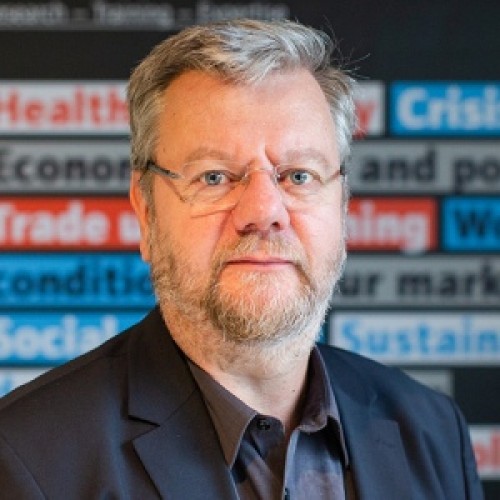
Can
you describe the context of the Pact for European Social
Dialogue, signed on 5 March between the European Commission
and European social partners?
It comes at a time when cross-industry
European social dialogue has produced nothing of substance for four
years now: neither consultation of social partners (TFEU, Article
154) nor negotiations between them (Article 155) have borne any
fruit whatsoever during this period. Admittedly, the Commission has
consulted them on a series of proposals for a directive, but this
has not led to anything concrete. Furthermore, after the employers
broke off negotiations on telework and the right to disconnect, even
the ETUC came to the conclusion that the multiannual work programme
was dead and buried. As for the Pact for Social Dialogue signed on 5
March, its context is one of radical political, economic and social
changes, yet it doesn’t seem to take these into account. Today,
there’s a great deal of talk about Trump and trade wars, and the war
in Ukraine; about European vulnerabilities in the areas of energy,
sourcing of pharmaceuticals and minerals; about technological
dependency; about the industrial consequences of climate transition;
and now, there’s even talk of a wartime economy! I don’t understand
why this context isn’t even mentioned in the pact: it’s as if we
were still living in a kind of bubble in which admittedly, support
is being reaffirmed for social dialogue, for a renewal of
undertakings, and for closer attention to the implementation of
social dialogue texts, but nevertheless, inside this bubble, we
don’t seem to be asking ourselves questions about the role this
social dialogue and these economic and social actors will play in
the new world that is emerging. What do we expect effective social
dialogue to achieve for labour markets in the event of a public
health crisis, an extreme climate event, major industrial upheaval,
energy shortages, etc. What role do social partners plan to play on
behalf of their workers and companies in these contexts? The pact
doesn’t address these questions and for the most part, it seems to
make do with declarations of intent. Finally, whereas the Draghi
report affirms that a consensus on the EU’s sustainable
competitiveness calls for “more effective and proactive” social
dialogue, the pact emphasises that social dialogue should contribute
to achieving competitiveness. That’s not exactly the same
thing.
|
|
|

|
|
|
|
|
| |
Who we are?
IR Notes is a
fortnightly newsletter produced by IR
Share and its
network of experts, and is available in several European languages
(English, French, German, Italian, Spanish). It offers Europe-wide
monitoring of employment law, labour relations and employment policy. It
is available by subscription for 273 euros per year .
The team This issue
was producaed by Ambre Grenier-Boley,
Victoria Fonseca,
Iris Turlan and Frédéric
Turlan.
Find out more
about the IR Share team on our
website.
Subscribe to IR Notes
Via the
IR
Share website or by calliang us on:
+33 (0)6 81 41 53 95
or
E-mail: frederic.t@irshare.eu
Legal notice.
Publisher: IR Share SARL – 5, Les Compères – 89520 Fontenoy, France –
Tel.: +33 (0)6 81 41 53 95 – share capital 1,500 euros – commercial
register (RCS Auxerre): 512 567 959. Managing editor: Frédéric Turlan.
Hosting: ALTEO by Damien Cornillet – Château – 89500
Villeneuve-sur-Yonne. CPPAP no.: 0626 Z 93933.
|
|
|
|
|
| |
Follow us on LinkedIn!

Why not connect to the IR Notes LinkedIn page, so that you can keep up with
developments in the issues we’re covering, between two editions?
You’re welcome to follow us! There are already 690 of you following
us!
|
|
|
|
|
| |
European Industrial Relations Dictionary
In case reading IR Notes inspires you to
explore this subject further, we are providing links to the European
Industrial Relations Dictionary published by Eurofound. This is updated at
regular intervals by IR Share, which publishes IR Notes. The term
definitions are available in English and can easily be converted
into other languages using on-line translation tools.
|
|
|
|
|

|
|
|
Lead
story
Cross-industry European social dialogue is now clinically dead
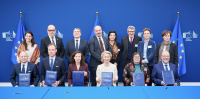
On 5 March, the European Commission and European social partners signed a “Pact for
European Social Dialogue”. This is the third attempt to revive European social
dialogue, and it may prove to be the last one, as long as the actors involved at
cross-industry level carry on failing to deliver any concrete results. The first
attempt was in 2016, when the Commission, the Dutch Presidency of the EU and
European social partners adopted a quadripartite statement entitled “A
new start for social dialogue” (see IR Notes 58).
Subsequently, on 3 February 2021, European commissioner Nicolas Schmit published the
report
on strengthening EU social dialogue (see IR Notes 157),
which agreed to most of the requests formulated by European social partners in a Joint
statement published in December 2020. On 25 January 2023, the Commission
renewed efforts to make progress by adopting, on the same day, a communication
on strengthening social dialogue in the European Union and a recommendation
to Member States on this subject (see IR Notes
201). Clearly this was not enough, and the Commission, together with
European social partners, then adopted a Tripartite
Declaration for a Thriving European Social Dialogue on 31 January 2024,
marking the 40th anniversary of the Val Duchesse summit (see Val Duchesse), organised by
the former Commission President Jacques Delors, who launched a process that led to
the creation of European social dialogue (see IR Notes
223).
The atmosphere surrounding the recent signing of the new Pact for
European Social Dialogue announced in this declaration might be described as one of
indifference… for very good reasons. Firstly, its content is merely a repetition
of previous texts (see “Cross-industry social dialogue” section below). And
secondly, its appearance comes at a time when European social dialogue has reached a
standstill:
1/ The
number of texts derived from European social dialogue has fallen from six during the
period 1996-2006 (including two agreements converted into directives, on part-time
work and fixed-term contracts), to two agreements since 2016: one on active ageing,
which was fairly minimalist, and the other on digitalisation, which avoided imposing
any standards at all on the world of work.
2/ In a forthcoming article (*),
Christophe Degryse, a researcher at the European Trade Union Institute (see
interview opposite), makes the point that cross-industry European social partners
have failed to adhere to their multiannual work programme. The 2019-2021 programme
did not deliver a single proposal on the topic of psychosocial risks at work. Worse
still, in the 2022-2024 programme, they not only failed to negotiate a European
framework agreement on telework and the right to disconnect, which was due to be
subsequently implemented via a European directive, but also to complete three of the
five other planned initiatives, including the preparation of a framework of action
on environmental transition.
3/ European social partners
possess a “super-power” – one that exists in no other democratic entity in the
world: they can decide to negotiate agreements at the time when the Commission
consults them on the merits of a European initiative, and they can then call on the
Council and Parliament to adopt their agreement in the form of a European directive,
published almost verbatim. They have been consulted several times since the start of
the von der Leyen Commission’s first term – on proposals for a directive on minimum
wages (2020), protecting platform workers (2021), revision of the European Works
Councils directive (2023), regulating traineeships (2023) and on telework and the
right to disconnect (2024). However, European social partners have failed to take
the initiative and launch joint negotiations on any of these important subjects,
with the exception of telework and the right to disconnect, before the employers’
delegation walked away from the negotiations just when the home straight was in
sight, saying that some of their members were not in agreement with them.
It is
no longer good enough to keep repeating the incantation to strengthen European
social dialogue, if the actors engaged in it are not themselves convinced that – as
the Draghi report points out – more effective social dialogue will be central in
building the consensus needed to build sustainable competitiveness.
©Dati Bendo, European Union, 2025
(*) Piasna A. and Theodoropoulou S. (eds.) (2025) Benchmarking Working Europe 2025,
Chapter 6, ETUI-ETUC.
|
1. European
Union
Legislation
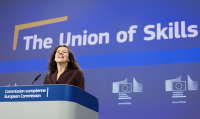
Union of Skills : On 5 March,
the European Commission published a communication
on the Union of Skills designed to support the development of human capital
within the EU, accompanied by a Basic Skills Action Plan and an Education
Strategic Plan to improve skills in science, technology, engineering and mathematics
(STEM) (see press
release). The communication proposes a global approach ranging from
“children at school to those reaching retirement”, to empower people across Europe
with the skills they need to thrive. The five pillars developed by the communication
are: strengthening basic skills; strengthening lifelong training; facilitating
recruitment; attracting and retaining talent; and having strong governance. The
Commission announces the setting up of a “skills guarantee pilot project” that will
offer workers who are affected by restructuring processes or threatened with
unemployment, the opportunity to pursue their career at another company or in
another sector. “We’re going to test it, probably in the car industry”, said Roxana
Mînzatu, Executive Vice-President for Social Rights and Skills, Quality Jobs and
Preparedness. In view of the obstacles associated with recognising diplomas within
the EU, the Commission wants to embark on a skills portability initiative to
facilitate EU-wide recognition and acceptance of skills and qualifications. This
initiative will encourage the use of digital diplomas. The Commission also plans to
establish the “European Skills Intelligence Observatory”, which will provide “data
and foresight regarding skills and allow for early warning alerts regarding skills
shortages in critical or strategic sectors”.
©
Xavier Lejeune, European Union, 2025
|
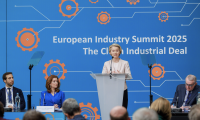
EU industrial strategy : On 26
February, the European Commission published a communication on the Clean
Industrial Deal: A joint roadmap for competitiveness and decarbonisation,
which aims to boost companies’ competitiveness by helping to decarbonise the economy
and cut energy costs, while at the same time protecting them from unfair
competition. The text tackles the issues of skills and providing support for
workers. The Commission says that it wants to provide “support to workers in
transition”, and explains that it “will discuss with social partners a framework to
support restructuring processes at EU and Member States level. The framework will be
focused on just transition, on anticipation of change, quicker intervention when
there is a threat of restructuring, and an improved information and consultation
framework”. The Commission is therefore responding to a repeated demand from the
European trade union movement and Parliament to strengthen oversight of
restructurings. The organisation representing employers in the metal-working
industries (CEEMET), who believe that “existing national and EU legislation already
address collective redundancies and the restructuring process, making additional EU
measures in this field unnecessary”, do not like this wording (see press
release). The Commission also plans to provide better support for companies
carrying out restructuring, by adapting the operating rules of the European
Globalisation Adjustment Fund (see European Globalisation Adjustment
Fund). The Commission plans to “see how [this fund] can
contribute more”, given that it is heavily under-utilised. It also wants to improve
“the delivery of the Just Transition Fund (JTF)” and to create “a European Fair
Transition Observatory” (in 1st quarter 2026), which will ensure “a transparent
dialogue with social partners, regional and local authorities, civil society and
other stakeholders on just transition aspects”. Finally, the communication also
discusses “the use of social conditionalities in public funding” to ensure “that
workers benefit from the support provided to industry, including to promote
collective bargaining”. And in the same spirit, the Commission explains that it
wants to “support labour and social standards”, including in the context “of the
Commission’s forthcoming evaluation of the legislative framework on public
procurement”.
© Christophe Licoppe, European
Union, 2025
|
Social
update

Women’s Rights : On 8 March, the
European Commission unveiled a Roadmap
for Women’s Rights, together with, in annex, a Declaration
of principles for a gender-equal society and the new Report
on gender equality published by the European Institute for Gender Equality
(EIGE). The declaration is not prescriptive in nature but contains a number of
recommendations regarding the world of work. It states that “projections show that
improved gender equality could elevate the EU GDP per capita by 6.1 to 9.6% by 2050”
and that “the cost of violence against women in the EU is estimated at €289 billion
euros per year”.
© Christophe
Licoppe, European Union, 2025
|
Cross-industry social dialogue
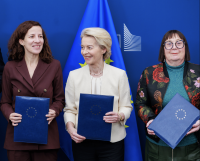
A pact to relaunch social dialogue :
The Pact
for European Social Dialogue recycles much of the content of the previous
texts already concluded, in the form of a relaunch (see Lead story), without
contributing anything new of significance (see joint
press release). Thus it adopts the idea of appointing a “European Social
Dialogue Envoy” at the Commission, and “social dialogue coordinators” within each
Directorate General; and of establishing a mechanism to receive reports from the
European social partners, in circumstances where the latter “jointly identify that
social dialogue is not being respected and appropriately promoted at EU level”. The
pact also points out that “making a clear distinction between social partner and
public consultations”, which are differentiated within the TFEU, “is therefore
essential”. The Commission once again promises to consult social partners on
subjects that do not fall within their sphere of competence, as defined by Articles
153 and 154 of the TFEU, but are of “particular relevance” to them. This could have
been the case for consultation aimed at simplifying the corporate sustainability
reporting and due diligence directives. However, the Commission has invited 50
representatives from companies and employers’ organisations, and ten civil society
organisations, including the ETUC and IndustriAll Europe. It is questionable whether
they really want a balanced level of social partner involvement… They will also be
consulted ahead of preparation of the Commission’s work programme.
The pact
also contains a number of promises made by social partners themselves, with a view
to discharging their current missions more effectively. Among other things, they
plan on “jointly identifying what actions are necessary to improve the
implementation at national level of their autonomous framework agreements”, which
are generally recognised as being poorly implemented at the present time.
Discussions on matters where there is disagreement are deferred to a future date:
the question of how sectoral social dialogue committees should be funded is not
dealt with, nor is that of what method should be used to ensure that EU,
cross-industry and sectoral agreements are implemented in the form of a directive.
The text makes reference to a discussion that has already taken place with social
partners, via its communication
on strengthening social dialogue in the European Union, published in 2023,
which clearly did not come to anything.
©Dati Bendo, European Union, 2025
|
2. Member
States
Germany

A national plan to combat forced labour and
exploitation: : On 12 February, the federal government
adopted an action plan comprising 83 measures (see action
plan). The Federal Ministry of Labour and Social Affairs plans to introduce
mechanisms providing support to workers, plus a network bringing together various
actors from the world of work and social partners (see press
release). The Länder [individual states] have drawn up 125
additional measures (see appendix).
|

Monitoring of digital platforms :
In an open letter, 79 civil society organisations and alliances
grouping together more than 1,000 other organisations, including the trade union
federation ver.di, have called on the CDU/CSU and SPD negotiators responsible for
drawing up the government’s programme to strengthen the monitoring of digital
platforms, which, say the signatories, divide up the population and exclude
minorities (see letter). ver.di’s
President has emphasised that “the algorithms used by platforms lack transparency
and often seem biased.” (see press
release).
|

Agreement on the use of AI : On
12 October 2024, social partners in the cinematographic industry signed an appendix
to their new collective agreement, which sets new standards on transparency, consent
and financial compensation for the use of generative AI (see ver.di
and UNI
Europa press releases). For example, actors will be paid for AI-generated
scenes based on a formula that calculates the equivalent number of shooting days.
|
Finland
Working life development strategy :
The Ministry of Economic Affairs and Employment and the Ministry
of Social Affairs and Health have launched a project aimed at improving productivity
and wellbeing at work by 2035 (see press
release). The strategy and its implementation are being prepared by a
tripartite management group, and will be completed by summer 2026. It is based on
consultation of nearly 100 experts and on research performed in 2024.
|
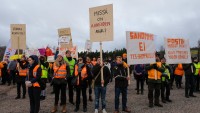
Restricting the right to strike :
On 13 March, the government put forward a draft law aimed at ensuring
that essential work can continue during industrial action. Up to now, this subject
has been regulated by the social partners. The purpose is to ensure that “the
critical functions of society can be maintained during the industrial action in
cases where the parties do not reach an agreement for one reason or another”, says
the Minister of Employment (see press
release). The three trade unions SAK, Akava and STTK are critical of the
initiative, arguing that Finland is moving away from the Nordic model by using the
law to regulate this issue (see SAK press
release).
|
Sweden

Working women’s health :
According to the Swedish Work Environment Authority, women are
twice as likely as men to fall ill at work (see press
release). They account for 70% of occupational illnesses, with some sectors,
such as healthcare, being particularly vulnerable. Employers and employees can take
measures to reduce these inequalities in several ways, including by rethinking the
distribution of roles within a given profession.
|
3.
Companies
European
Works Councils

Renegotiation : The management
of the US computer technology group Oracle and its European Works
Council have revised their EWC
agreement. The EWC will elect a select committee comprising 5 members
(including the Chair and a Deputy Chair). The select committee will meet twice a
year, and also at the time of the annual plenary meeting. The select committee is
entitled to call a second plenary meeting each year, which management cannot refuse
without a valid reason. It will also meet whenever exceptional meetings are held.
Such meetings may be organised in the event of a restructuring affecting 1.5% of the
group’s entire workforce or 50% of the employees in one Member State and 50% of the
employees in another Member State. The agreement provides the EWC with a budget of
50,000 euros each fiscal year (which cannot be carried forward) to cover experts’
fees. In exceptional circumstances, this budget may be exceeded with management’s
agreement. In the event of a dispute, management will provide “the reasonable and
necessary legal fees and any necessary court fees to pursue the dispute”. EWC
members will be afforded the time needed to carry out their functions. EWC members’
line managers will be made aware of the important nature of their duties under this
agreement and invited to take these into account during workload planning and
appraisals. The agreement provides for a communique to be issued following the EWC’s
annual and exceptional meetings. The text of this communique will be prepared by the
select committee and promptly approved by management, which undertakes to then send
it out to all employees. The text will state how EWC members can pass on the
information received via the EWC to their counterparts at local level.
|
|
|











