 |
| |
IR Notes 251 – 30 April 2025
www.irshare.eu
|
|
|
| |
| |
A question for…
Hélène Sultan-Taïeb, Professor at the Department of Organization and
Human Resources – School of Management – University du Québec à Montréal
(UQAM)

What
are the main things to be learned from the study that you
and Isabelle Niedhammer (Inserm) performed, examining the
costs of cardiovascular diseases and depression attributable
to psychosocial work exposures in the European Union?
The most important message of all is really
the need to act! We know how to prevent psychosocial risks (PSR) at
work. A wealth of literature is available, and so too are a number
of guides issued by several occupational health bodies such as the
European Agency for Safety and Health at Work, offering solutions to
prevent the five psychosocial risks that we selected for our study.
These are: “job strain”, which is a combination of high levels of
psychological demand at work and a low degree of latitude in
performing the work; effort-reward imbalance; job insecurity – i.e.
the fear of losing your job in the next six months; long working
hours (i.e. more than 55 hours per week); and in the case of
depression only, workplace bullying.
The work we undertook means the cost of
inaction can be quantified. It shows that this cost is very high,
both for employer and workers. For example, in the case of
depression, the two main components of depression-related costs
attributable to PSR at work are absenteeism and presenteeism.
Together, they represent 87% of the total cost, i.e. 90 billion
euros per year across all 27 EU Member States plus the United
Kingdom. The burden of these absenteeism-related and
presenteeism-related costs is borne solely by employers, in the form
of lost production and lower productivity, disorganisation within
the workforce, burn-out among their remaining employees,
etc.
We also need to
factor in the cost of cardiovascular diseases, which are usually
overlooked when the issue of psychosocial risks at work is
discussed. For example, it is estimated that around 8% of coronary
heart disease cases among the employed population are attributable
to these psychosocial factors. Admittedly this is less than for
depression, where 26% of cases are attributable to these factors.
However, 8% is not a negligeable amount! Yet this subject is
discussed relatively little, in contrast to the consensus in the
scientific literature regarding the effects of PSR on cardiovascular
diseases with a “high level of evidence”.
In addition to the substantial cost they
represent for employers, PSR clearly represent a high cost for
workers too, in the form of 6,000 deaths per year in Europe linked
to coronary heart disease attributable to exposure to PSR, and 5,000
deaths per year linked to PSR-related depression, i.e. suicides. The
results of our study really should prompt companies and social
partners to take concrete action to address this issue!
(*) ETUI, The
costs of cardiovascular diseases and depression attributable to
psychosocial work exposures in the European Union
|
|
|

|
|
|
|
|
| |
Who we are?
IR Notes is a
fortnightly newsletter produced by IR
Share and its
network of experts, and is available in several European languages
(English, French, German, Italian, Spanish). It offers Europe-wide
monitoring of employment law, labour relations and employment policy. It
is available by subscription for 273 euros per year .
The team This issue
was producaed by Ambre Grenier-Boley,
Camille
Hue and Frédéric
Turlan.
Find out more
about the IR Share team on our
website.
Subscribe to IR Notes
Via the
IR
Share website or by calliang us on:
+33 (0)6 81 41 53 95
or
E-mail: frederic.t@irshare.eu
Legal notice.
Publisher: IR Share SARL – 5, Les Compères – 89520 Fontenoy, France –
Tel.: +33 (0)6 81 41 53 95 – share capital 1,500 euros – commercial
register (RCS Auxerre): 512 567 959. Managing editor: Frédéric Turlan.
Hosting: ALTEO by Damien Cornillet – Château – 89500
Villeneuve-sur-Yonne. CPPAP no.: 0626 Z 93933.
|
|
|
|
|
| |
Follow us on LinkedIn!

Why not connect to the IR Notes LinkedIn page, so that you can keep up with
developments in the issues we’re covering, between two editions?
You’re welcome to follow us! There are already 694 of you following
us!
|
|
|
|
|
| |
European Industrial Relations Dictionary
In case reading IR Notes inspires you to
explore this subject further, we are providing links to the European
Industrial Relations Dictionary published by Eurofound. This is updated at
regular intervals by IR Share, which publishes IR Notes. The term
definitions are available in English and can easily be converted
into other languages using on-line translation tools.
|
|
|
|
|

|
|
|
Lead
story
Diverging
paths on the road to quality jobs

On 16 April, the European Commission organised a meeting with European social
partners to discuss the objectives of the future “Quality Jobs Roadmap” (see press
release). The aim of this initiative, which is expected to be presented by
the end of 2025, is to support competitiveness, foster social fairness and
contribute to just transitions. The Commission will be entering into a dialogue with
social partners, including a dedicated hearing scheduled for 5 May, before these
exchanges are broadened into regular meetings of EU social dialogue committees at
cross-industry and sectoral levels. At the same time, discussions will be organised
in the Member States. The Commission has also promised to draw up a new EU action
plan to implement the European Pillar of Social Rights by the end of 2025 (see. European Pillar of Social
Rights).
In a policy
orientation note, BusinessEurope emphasises the complexity of the task of
assessing job quality, arguing that the existing frameworks “have clear and
significant limitations that might overlook key complexities and lead to unintended
negative consequences” (see press
release). BusinessEurope also maintains that it is important to look at the
quantity of jobs created: its view is that the EU should focus on creating
conditions that will encourage the emergence of productive and lasting jobs in
competitive enterprises on the one hand, and on supporting employability for workers
on the other hand. In addition, it calls on the Commission to exercise caution when
considering any additional binding measures, pointing out that the EU acquis are
already “comprehensive” in areas such as working time, health and safety, and
working conditions.
Ceemet, representing European employers in the metalworking
industry, “cautions against the assumption that regulation alone can ensure job
quality” (see press
release). It invites the Commission to focus its efforts on two areas:
skills development, and health and safety. On the second point, its Director
General, Delphine Rudelli, praised the “strength of the existing EU legal framework”
and called for “improved implementation and enforcement rather than additional
legislation”. She also pointed out that “social dialogue and collective bargaining
[…] shouldn’t be imposed by legislation”.
The European Trade Union
Confederation (ETUC), on the other hand, urged the Commission to “be bold” and
deliver a “Quality Jobs Package with new legislative initiatives and real
investment”. Tea Jarc, ETUC Confederal Secretary, set out the trade unions’ main
demands (see press release), as
detailed by representatives of several European federations. Jan Willem Goudriaan,
EPSU General Secretary, emphasised the need for legislative initiatives concerning
psycho-social risks and artificial intelligence at work (see press
release). For her part, Isabelle Barthès, IndustriAll Europe Deputy General
Secretary, called for “a legal tool to ensure the effective anticipation and
management of employment and skills”, stating that this “requires strengthening
collective bargaining, information and consultation rights and establishing a right
to training to ensure job-to-job transitions.” (see press release).
|
1. European
Union
Legislation

CSRD and due diligence : Directive
2025/794 of 14 April 2025, which postpones certain corporate sustainability
reporting and due diligence requirements, was published in the OJEU on 18 April.
This so-called “Stop-the-clock” directive, which was passed in the wake of the
“Omnibus I” proposal for a directive put forward by the European Commission (see IR Notes
247), makes do with pushing back the entry into application of certain
requirements, as stipulated firstly by Directive
2022/2464 of 14 December 2022 on corporate sustainability reporting (the
“CSRD” directive), and secondly by Directive
2024/1760 of 13 June 2024 on corporate sustainability due diligence (the
“CS3D” directive). A forthcoming so-called “content” directive, which is under
discussion, will aim to simplify EU rules and thereby reduce “reporting burdens and
enhance “competitiveness” (see press
release). The new directive postpones by two years the sustainability
reporting requirements applicable to companies that were not part of the first wave,
which covered large companies and parent companies that are listed and have more
than 500 employees, and a total balance sheet value of 25 million euros or a net
turnover of 50 million euros. These entities began to publish the information in
question this year for FY 2024. The other large companies or groups with more than
250 employees (with the same turnover thresholds) will have to publish this
information in 2028 for FY 2027. SME, with the exception of micro companies, small
and non-complex institutions, captive insurance companies and captive reinsurance
companies, will have to publish this information in 2029 for FY 2028. However, the
timetable is likely to be called into question if the “content” directive raises
workforce thresholds, and thereby removes many companies from its scope of
application.
In addition, the deadline set for Member States to transpose the
due diligence directive has been extended by one year, so that they can take into
account the possible amendments currently under discussion at the Council and
Parliament. The new deadline is therefore 26 July 2027. The requirements applicable
to companies have been postponed by two years, and these will now apply as follows:
1/ from 26 July 2027 onwards,
to companies that have their registered office in the EU, had more than 5,000
employees and generated a net worldwide turnover of more than 1.5 billion euros in
the last financial year preceding 26 July 2027, and to companies from third
countries that realised this turnover in the EU; 2/ from 26 July 2028 onwards, to
companies that have their registered office in the EU, more than 3,000 employees and
generated a net worldwide turnover of more than 900 million euros in the last
financial year preceding 26 July 2028, and to companies from third countries that
realised this turnover in the EU; 3/
from 26 July 2029 onwards, to all other companies covered by the
directive.
Member States will have until 31 December 2025 to transpose this
directive.
|
Social
update
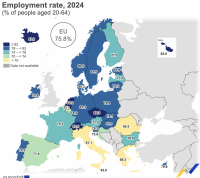
Employment rate : 75.8% of the
EU’s 20 to 64-year-olds were employed in 2024, according to data published by
Eurostat on 14 April (see press
release). This is the highest proportion recorded since the start of the
time series in 2009. The employment rate rose by 0.5 percentage points compared with
2023 and by 1.2 points compared with 2022. The highest rates were recorded in the
Netherlands (83.5%), Malta (83%) and Czechia (82.3%). The lowest rates were observed
in Italy (67.1%), Greece (69.3%) and Romania (69.5%).
|
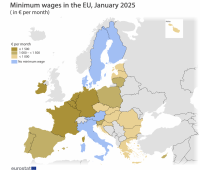
Minimum wages : According to
data published by Eurostat, on 10 April, on minimum wages in the EU, (see press
release), just three countries have a minimum wage level above 60% of the
median wage (France, Portugal and Slovenia all have a rate of 66%). Bear in mind
that the directive on adequate minimum wages invites Member States to raise their
minimum wage to 60% of the median wage. The 60% target is still a long way off in
Belgium (49%), Malta (46%), Estonia (43%) and Latvia (43%).
> See
also: Eurofound, National
minimum wages, 2025 and Substantial
rises in national minimum wages for 2025 – linked to the EU directive?)
|
Case law

Incapacity pension and part-time work :
A female Spanish employee who was working part-time because of
child care responsibilities, suffered an accident at work in 2019 and was dismissed
soon afterwards. In 2021, she was awarded a permanent invalidity pension, calculated
on her earnings from part-time work. She disputed the use of this calculation
method, and asked for her pension to be based on full-time earnings, arguing that
this was indirect discrimination on the grounds of her sex. In point of fact, more
than 90% of those benefitting from reduced working hours between 2020 and 2022, were
women. However, the Court of Justice emphasises that “those statistical data do not
target all workers specifically disadvantaged by the calculation rule” applicable to
invalidity pension, “nor do they make it possible to establish, a fortiori, the
respective proportions of male and female workers who would be put at a disadvantage
by the application of that provision of national law”. If the Spanish court were to
find evidence “that the national legislation at issue […] puts female workers at a
particular disadvantage, it would still have to determine whether it pursues a
legitimate aim and whether it is necessary and proportionate to that aim” (CJEU, 10
April 2025, Case C-584/23, Alcampo e.a.).
|
Sectoral
social dialogue
|
Trade
unionism
- Subcontracting : The
European Trade Union Confederation (ETUC) and the European Federation of
Building and Woodworkers (EFBWW) have urged the EU to take decisive measures to
limit the use of subcontracting by promoting direct employment (see press
release).
|
2. Member
States
Germany
Government agreement : On 9
April, the CDU-CSU-SPD coalition signed an agreement that contains numerous measures
related to the world of work. Among other things, the coalition wants to increase
the minimum wage and to make working hours more flexible (see website).
The trade unions and employers have reacted positively, as they are happy with the
measures being taken to boost industry and collective bargaining, but they are now
awaiting the implementation of these measures (see press releases issued by DGB,
IG
Metall, IGBCE
and, for the employers, BDA
and BDI).
|
Belgium

Returning to employment : As of
1 April, employees who are made redundant with at least 30 weeks’ notice are
entitled to apply to the public employment service (ONEM) for a fixed 1800 euro
budget to fund measures to enhance their employability, such as training or
personalised support (see press
release). The aim is to make it easier for them to quickly get another job
or go self-employed.
|
Ireland

Competitiveness : On 15 April,
the government approved the fast-track creation of a national Action Plan on
Competitiveness and Productivity, which aims to bolster the country’s economic
resilience in the face of inflationary pressures and global trade tensions (see press
release). Several social measures initially announced, such as the
introduction of a minimum income, automatic membership of a mandatory retirement
savings scheme, and increased statutory sick leave, have been paused, in the name of
competitiveness. The Irish Congress of Trade Unions (ICTU) has condemned an
“anti-worker Action Plan”, and criticised the fact that social reforms are being
sacrificed in favour of cutting labour costs, yet with no guarantees regarding job
quality (see press
release).
|
3.
Companies
European
works councils

Offshoring : As previously
announced at a meeting of the company’s European Works Council’s select committee
(see IR Notes
246), on 23 April, at a plenary meeting of the EWC, the management of ArcelorMittal set out details of
the reorganisation of its support functions in Europe, involving the transfer of
between 1250 and 1400 jobs from Western European countries to India or Poland. At
the same time, management announced around 400 job cuts in France from its
production operations, which employ some 7,100 people, in addition to the jobs being
transferred (between 210 and 260). EWC secretary Jean-Luc Ruffin (CGT trade union)
is extremely concerned: “First of all support functions are being moved offshore,
but tomorrow, our production facilities will be going too” (see also IndustriAll
Europe press release).
|

Sustainability report : On 2
April, the “decarbonisation” working party of the Suez EWC submitted its
recommendations concerning the group’s
2024 sustainability report, which has been drawn up in accordance with the
French law transposing Directive 2022/2464 of 14 December 2022 (the “CSRD”
directive). As far as we are aware, this EWC is one of the first to produce a
(non-public) document setting out its expectations and recommendations. “The aim is
to make sustainability a genuine matter for social dialogue and concrete actions,
and not just a compliance document”, says EWC secretary Christine Chiffre. “This
means the EWC views the report as a tool for preparing a collective initiative to
promote a just transition within the group.”
|
Transnational negotiation

Health and safety at work : On
23 April, the management of the Clariane (formerly Korian) group
– which manages care homes for elderly and dependent persons – and its European
Company Works Council, accompanied by the European Public Service Union (EPSU),
started work on the negotiation of a European agreement on health and safety in the
workplace, which will update and improve the Health
and Safety Protocol on the Prevention of Accidents at Work signed in 2021,
between management and the European Works Council. According to EPSU, the topics
covered by this negotiation include training, psychosocial risks, the organisation
of work and the structural workload, quality of life at work, absenteeism and
third-party violence (see EPSU press
release). “The measures taken within the framework of the Protocol signed in
2021 have borne fruit and reduced the number of accidents at work in our care
homes”, says Nadège Plou, Group Chief Human Resources Officer and EWC President. “We
want the emphasis in this draft agreement to be on prevention and occupational
health, starting as soon as employees join us and continuing throughout their
working life”.
|
4. Studies
and reports
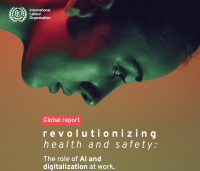
Occupational health and AI : The
ILO has just published a report
looking at how artificial intelligence (AI), digitalisation, robotics and automation
can help to improve occupational safety and health (OSH). At the same time, the
report emphasises the need for proactive policies to tackle the new types of risk
posed by these technologies. It lists numerous attempts to oversee the use of these
technologies, whether through legislation or social dialogue, and calls for the
adoption of new measures covering robot safety and man-robot interaction, the right
to disconnect, and better algorithmic management of work, telework and platform
work.
|
|
|











