 |
| |
IR Notes 252 – 14 May 2025
www.irshare.eu
|
|
|
| |
| |
A question for…
Tonje Brenna, Norwegian Minister of Labour and Social Inclusion

You recently supported the bill to
raise the age at which an employer can force an employee to take
retirement, from 70 to 72. What do you expect this measure to
achieve?
Social
legislation (the law on the working
environment) sets an age limit at which the law ceases to provide
protection for employees against dismissal. It allows the employer
to unilaterally terminate the employment relationship when the
employee reaches a specific age. On 1 July 2015, this age limit was
raised from 70 to 72 in the private sector – in the past, it had
been set at the age of 67. However, municipalities and businesses
can set their own age limits below the age of 72, i.e. impose
internal age limits.
The government’s current proposal involves: 1/ abolishing the option of setting
company-specific age limits; and 2/ raising the age limit in the public sector
(as well as the private sector), to retirement at 72. This means
that in principle, a single age limit will apply to the working
population in Norway. This proposal follows on from an agreement
concluded at the National Assembly (the Storting) in 2024, to raise
the public sector age limit to 72. Many workers aged over 70 are
both capable of carrying on working and want to do so. This change
will benefit both the individual and society, if it is introduced.
Norway’s economy, like that of many other countries, will face a
growing labour shortage in the coming years. A public consultation
was held on the proposal to abolish company-specific age limits, and
for the most part, this was supported by the trade unions and the
employers. The trade unions’ support can perhaps be explained by the
fact that these changes have no effect on pension rights. Quite the
contrary in fact, as working beyond the age of 70 means that
employees can draw a higher pension.
No specific new policies
designed to keep older workers in employment have been introduced in
parallel with this bill, but the government is working with social
partners on ways to create a more inclusive working life. A basic
principle of our employment policy is to recognise that
sector-specific preventive measures must be adapted and implemented
in the workplace. For example, we note that some employers are now
offering special arrangements for older workers, such as tasks
suited to their abilities, so that these employees can stay on with
them for longer.
(Photo credit: Simen Gald)
|
|
|

|
|
|
|
|
| |
Who we are ?
IR Notes is a
fortnightly newsletter produced by IR
Share and its
network of experts, and is available in several European languages
(English, French, German, Italian, Spanish). It offers Europe-wide
monitoring of employment law, labour relations and employment policy. It
is available by subscription for 273 euros per year .
The team This issue
was producaed by Fiona Bernard,
Inès Bollet,
Victoria Fonseca, Ambre
Grenier-Boley, Laura
Renucci, Iris
Turlan and Frédéric
Turlan.
Find
out more about the IR Share team
on our website.
Subscribe to IR Notes
Via the
IR
Share website or by calliang us on:
+33 (0)6 81 41 53 95
or
E-mail: frederic.t@irshare.eu
Legal notice.
Publisher: IR Share SARL – 5, Les Compères – 89520 Fontenoy, France –
Tel.: +33 (0)6 81 41 53 95 – share capital 1,500 euros – commercial
register (RCS Auxerre): 512 567 959. Managing editor: Frédéric Turlan.
Hosting: ALTEO by Damien Cornillet – Château – 89500
Villeneuve-sur-Yonne. CPPAP no.: 0626 Z 93933.
|
|
|
|
|
| |
Follow us on LinkedIn!

Why not connect to the IR Notes LinkedIn page, so that you can keep up with
developments in the issues we’re covering, between two editions?
You’re welcome to follow us! There are already 694 of you following
us!
|
|
|
|
|
| |
European Industrial Relations Dictionary

In case reading IR Notes inspires you to
explore this subject further, we are providing links to the European
Industrial Relations Dictionary published by Eurofound. This is updated at
regular intervals by IR Share, which publishes IR Notes. The term
definitions are available in English and can easily be converted
into other languages using on-line translation tools.
|
|
|
|
|

|
|
|
Lead
story
A European
“quasi-agreement” on third-party violence

Offering evidence that European-level sectoral dialogue may be more fruitful than
cross-industry social dialogue, on 6 May, following six months of
negotiations, European social partners from several sectors of activity signed a
revised version of the multi-sectoral guidelines to prevent and tackle
third-party violence and harassment related to work (TPVH) (see Harassment and violence at work) (see joint press release). These guidelines,
which replace the 2020 version, cover 50 million employees
working across central government sectors (including the prison service), local and
regional government, hospitals, education and the hotel and catering industries.
Special attention has been paid to gender-based violence, including domestic
violence, digitalisation and cyberviolence, and risk assessments covering the fields
of health, support to victims and holding perpetrators liable.
At the time the
document was signed, Jan Willem Goudriaan, General Secretary of the European Public
Service Union (FSESP), made a pledge to go one step further in the context of the
forthcoming negotiations of the cross-sectoral social dialogue workplan, to include
the revision of the autonomous agreement on violence and harassment (2007) and make
it legally binding, taking into account TPVH (see EPSU press release). The document highlights
the key elements of a TPVH prevention policy; practical tools and measures for
health risk assessments; and definitions and principles on fostering a culture of
respect and zero tolerance of violence and harassment.
A website sets out practical examples of
policies and collective agreements. The text, which merits recognition as a European
agreement, may act as a source of inspiration for other actors involved in social
dialogue, including at the level of multinational companies and European Works
Councils seeking to prevent psychosocial and physical risks linked to this growing
phenomenon.
|
1. European
Union
Social
update

Non-compliance with EU law : On
7 May, the European Commission sent a reasoned opinion to France for failing to comply
with regulation (EC) no. 1072/2009 on common rules for access to the international
road haulage market. The Commission considers that French legislation, which imposes
a ban on spending daily and weekly rest periods inside Light Commercial Vehicles, is
in breach of EU law. It takes the view that this rule unjustifiably and
disproportionately restricts the freedom to provide road transport services in
France and runs counter to the objectives of the internal market.
The
Commission has decided to open an infringement procedure against Austria for failing to comply
with the EU rules on working time, as its legislation provides for less favourable
working conditions for workers of the partly state-owned companies Post and Telekom
when it comes to minimum daily rest, holiday replacement workers, sick leave and
paid annual leave.
It has also opened an infringement procedure against Czechia for failing to comply
with the principles of non-discrimination against part-time workers and of equal
treatment between men and women. The Commission condemns a situation in which
full-time workers who work overtime enjoy a right to supplementary pay from the
first hour worked beyond their normal working hours, whereas part-time workers are
not entitled to the same benefits when working beyond their contractually agreed
hours.
Another letter of formal notice has been sent to France and Luxembourg for failing to bring
their national legislation into line with the Enforcement Directive on Posting of
Workers (see press release).
|
Sectoral
social dialogue

Road transport : On 7 May,
European social partners sent a letter to the European Commission,
“voicing once again” their “concerns about the lack of complete information on
remuneration levels in the EU Member States” (see ETF press release). The employers’
organisation IRU points out that Mobility Package 1 – the EU’s most ambitious reform
on social standards for drivers, adopted in 2020 – “specifies when a driver is
considered posted to a host country, which further requires a payment for that time
at a level no lower than the minimum remuneration in the host country” (see press release). However, in order to
apply it, Member States have to explain what minimum remuneration applies on their
respective territories. IRU is critical of the current state of affairs: “where
information exists, it is often fragmented across different websites, difficult to
understand, or not promptly updated, creating serious legal uncertainty for the
sector”. The signatories call upon the Commission to: 1/ Provide a simple common
template to Member States where they can fill in and update the necessary
information on the national remuneration of drivers. 2/ Create and make available to
employers a remuneration calculator and guidance on how to calculate the
remuneration of posted drivers.
|
2. Member
States
Spain

Shorter working hours : On 6
May, the Council of Ministers approved a draft law reducing the length of the
working week from 40 to 37.5 hours, with no cut in wages (see press release). It also includes a right
to disconnect. This law, which has been submitted to Parliament, follows on from an
agreement reached between the government and the main trade-union confederations,
including the CCOO and the UGT. The employers’ organisations, on the other hand,
such as the CEOE, are firmly opposed to it (see press release). Several sectoral
employers’ federations have published a joint manifesto opposing the reform. One
of the main arguments put forward by these organisations is that of defending the
primacy of collective bargaining at company and sector level. CEPYME, the
confederation representing SME, says that reducing working hours without cutting
wages could result in an increase of up to 6% in labour costs (see press release).
|
Finland

Financing trade unionism : As
part of its Fiscal Plan for 2026–2029 (see plan), the government intends to abolish
the tax-deductible status of subscriptions paid to trade unions and employers’
organisations. This measure is expected to generate an estimated annual saving of
around 144 million euros in 2026. Trade unions such as SAK and STTK have condemned
what they see as an attack on them, fearing it will limit their capacity to organise
labour (see article).
|
France

Accompanying parenthood : On 5
May, the National Assembly voted unanimously in favour of a draft law to protect persons planning to become a
parent, including those engaged in a medically assisted
procreation (medically assisted reproduction or MAR) or adoption procedure.
Protection against discrimination is being reinforced and extended to men who are
receiving treatment as part of a MAR procedure and to employees who are applying to
adopt a child. As justification for this change, French MEPs point out that at
present, the latter enjoy protection only when an adopted child joins their
household, “and not during the long procedure leading up that moment”. These workers
(men undergoing a MAR procedure and employees engaged in an adoption procedure) will
be granted leave of absence to enable them to attend appointments with medical
professionals and the authorities.
|

Class action to become easier :
Law no. 2025-391 of 30 April 2025 enacting various
provisions of French law to bring it into line with European Union
law amends a number of items of social legislation. It
substantially broadens the scope of application of class action in the field of
social affairs, in accordance with Directive no. 2020/1828. As a result, class
actions can now be brought not only in cases of discrimination and personal data
protection, but also to force an employer to meet its legal or contractual
obligations. Before bringing a class action based on a breach of the Employment
Code, trade unions or certain associations will have to issue a demand to the
employer to remedy the breach of its obligations. The employer in turn will then
have to notify the works council (CSE) and the representative trade unions within
one month, that it has complied. This law also makes the EU Blue Card work permit a
more attractive proposition for its holders and postpones the sustainability
reporting (CSRD) obligations imposed by Directive 2022/2464 by two years.
|

Employing experienced workers :
On 7 May, the government passed a draft law transposing a number
of domestic cross-industry agreements to promote the employment of experienced
workers (see press release and details of the plan). This law is
designed to: 1/ strengthen the
negotiation obligations applicable within branches and companies concerning the
employment of experienced workers; 2/ encourage the recruitment of
older workers by experimenting with a contract that places a value on their
experience, and which can be terminated when the employee reaches the age at which
they can retire on a full pension; 3/ improve the preparations for the
second half of employees’ careers by enhancing the link between medical examinations
and their mid-career appraisal, and by adding an extra appraisal conducted two years
before the employee reaches their sixtieth birthday; 4/ facilitate arrangements made
to assist an employee with the end of their career, including easier access to
part-time working as part of a gradual retirement plan – which will be available
from the age of 60 rather than 62 as at present – and by allowing an employee who
moves to part-time working to either remain on full pay or to have the shortfall in
their pay made up by taking retirement benefits payable in accordance with the
methods defined by agreement.
|
Netherlands

Deductions from the minimum wage :
The Minister of Social Affairs and Employment, Eddy van Hijum,
has published a plan to undertake a public consultation concerning deductions made
from the minimum wage to cover accommodation costs (see press release). At the present time,
employers can deduct up to 25% of the minimum wage to cover these charges. However,
there has been criticism of this practice, as employers sometimes use it for their
own ends to make money, and it increases the dependency of migrant workers on their
employer. The proposal sets out to cut this deduction by 5 percentage points each
year, until it is abolished completely in 2030. The trade-union confederations CNV
and FNV are fully aware of these abuses but do not agree on the solution to be
adopted (see letter). The FNV wants to abolish the
deduction altogether, whereas the CNV’s view is that the current arrangement, which
requires employers to offer accommodation, may continue to be a benefit for migrant
workers.
|
Psychosocial support guide : The
National Centre for Psycho-traumatology (ARQ) has published, on behalf of the
Ministry of Justice and Security, a guide to help employers to organise the
workplace induction and monitoring (see guide) of employees in high-risk
occupations (ambulance staff, firefighters, police, etc.), i.e. those likely to face
attacks, threats, violence and other serious incidents during the course of their
work. The guide also applies to healthcare professionals (working in the fields of
mental health and safety) and first-aid workers, who may not only be targeted
personally, but may also encounter victims who have been seriously injured (see press release).
|
Poland
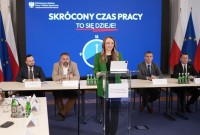
Shorter working hours : On 28
April, the government unveiled a pilot programme aimed at reducing working hours.
The scheme, which is voluntary and open to businesses and public bodies, will enable
various arrangements to be tried out – a four-day week, shorter days and additional
holidays – without cutting wages or jobs (see press release). Poland’s Minister of
Employment, Agnieszka Dziemianowicz-Bąk, comments proudly that “this will be the
first pilot plan to reduce working hours in this part of Europe”. The Ministry has
emphasised that Poland is one of the most overworked nations in Europe. The aim is
to cut annual working hours by 20%. Although there are already a number of local
positive examples, such as at Włocławek and Herbapol Poznań, some voices among the
employers remain skeptical, citing demographic and economic tensions.
|
Romania

Banking sector : Following
discussions on the National Tripartite Council for Social Dialogue in November 2024,
the collective labour agreement covering the banking sector (45,000 employees) has
now been extended to encompass all employers, and came into force on 1
May (see press
release). This is the first collective bargaining agreement applicable to
all employees in the sector, regardless of which trade union they belong to or which
employers’ organisation their bank is affiliated to. It guarantees a monthly
minimum wage higher than the one laid down by government decree, which, as at 1 May,
was 4,500 lei (882.44 euros). It also introduces a chapter on equal opportunities,
non-discrimination and prohibiting harassment, based on ILO Convention 190. Among other things,
it offers benefits such as a mandatory retirement bonus, financial support for
special events, redundancy payments and the option of receiving meal vouchers and
medical services.
|
Sweden
Working without losing sickness benefits :
The Ministry of Health has proposed a new measure that will
enable employees to go back to work while continuing to receive their sickness
benefits (see press release). The aim is to facilitate
a gradual return to work for the employee. For a short period (two weeks),
individuals can assess their fitness for work without being at risk of losing their
sickness benefits (see
press release). Every employee will be
entitled to undertake this experiment twice a year.
|
3.
Companies
European
Works Councils

Restructuring : On 1
April, the tyre manufacturer Bridgestone announced a
restructuring (see press release) which, according to the
trade unions, could result in 546 redundancies at its Spanish plants at Basauri
(Basque Country) and Puente de San Miguel (Cantabria). According to IndustriAll
Europe (see press release), a trade-union delegation
received at the European Parliament on 29 April highlighted “the lack of proper
information and consultation, both at national level and within the European Works
Council (EWC)”. “Workers were only informed of the decision on 1 April – after it
had already been made” says IndustriAll Europe, which believes this is “a clear
violation of workers’ rights to information and consultation”.
|

Support for the creation of EWCs :
At the beginning of May, the European Public Service Union
(EPSU) organised a second training session for employee representatives of the
Norwegian childcare company Dibber
(12,000 employees). This
one dealt with the negotiation process involved in creating a EWC and the subjects
to be covered in these agreements. This training course was delivered as part of a
European Commission-funded project seeking to establish EWCs within groups providing
social, healthcare and other care services within the EU (see press release). A
similar project is underway at
DomusVi (47,000 employees), a company that provides
care for the elderly (see press release).
|

Brexit : On 19 March, the US
chemical company Aptar (13,000
employees) and its EWC signed Addendum No. 1 to their 2021 European Works Council agreement ,
confirming that its British representatives will remain on the EWC. The addendum
stipulates that “the United Kingdom will continue to be fully covered by this
agreement”, that the EWC “is competent to deal with all transnational matters linked
to the United Kingdom” and that British members will “enjoy the same prerogatives,
rights and protection as other EWC members”.
|
|
|











