 |
| |
IR Notes 253 – 28 May 2025
www.irshare.eu
|
|
|
| |
| |
A question for…
Camilla Kring, founder of Super Navigators

In your latest book (*), you draw
on your experience of acting as a consultant to organisations to
advocate adopting a flexible work culture, which moves beyond
simply alternating telework and office work. How can a corporate
culture like this be created?
A culture of flexible working hours, which
I’ve been trying promote for the past 20 years, ever since I set up
my own company Super Navigator, attempts to take three factors into
account: the obsolescence of the predominant way in which working
time has been organised during the industrial era; the diversity of
family structures; and the circadian rhythms of each one of us. For
example, 80% of people in our societies are “late risers” and “night
owls”. They’re woken up in the morning by an alarm clock, which has
negative effects on their health (diabetes, coronary heart disease,
mental health). Given that value creation by companies is now
primarily an intangible activity, we must create new work rhythms,
designed around people. If people can acquire greater autonomy and
greater freedom by combining their work with their family
constellation and their body clock – i.e. synchronising these
rhythms with their daily lives – you can improve both the company’s
productivity and the health and well-being of its workers.
Our
work organisation patterns offer just one model to everyone. This
was viable in industrial societies because there was a great deal of
similarity between family structures and forms of work. However,
intellectual work can’t fit into a model where you have to start at
9am and finish at 5pm, because people are productive at different
times of day and have a variety of different family
responsibilities. That’s why there’s no point in trying to protect
employees by banning the sending of emails after 6pm. If you’re born
with the circadian cycle of a night owl, this model simply doesn’t
work for you. We should allow people to start work later, and the
same goes for the education system – and for teenagers in
particular. We need to construct alternative working time
architectures, and this is something that can only be done through
collective discussion within organisations, via workforce
representatives or collective bargaining, so as to remain as close
as possible to the ground and achieve a win-win balance. Employers
would then be able to offer an appealing working environment, while
the increased autonomy gained by employees – with more “control over
their own lives” – would have a net impact on their well-being. One
of the key factors is that management must be able to trust the fact
that employees will still do their work, in order to nurture this
flexible work culture.
(*)
Camilla Kring, Chronoleadership, LID, 2025, 160 p. £12,99
|
|
|

|
|
|
|
|
| |
Who we are ?
IR Notes is a
fortnightly newsletter produced by IR
Share and its
network of experts, and is available in several European languages
(English, French, German, Italian, Spanish). It offers Europe-wide
monitoring of employment law, labour relations and employment policy. It
is available by subscription for 273 euros per year .
The team This issue
was producaed by Inès
Bollet, Victoria
Fonseca, Ambre
Grenier-Boley, Iris
Turlan and Frédéric
Turlan.
Find out more
about the IR Share team on our
website.
Subscribe to IR Notes
Via the
IR
Share website or by calliang us on:
+33 (0)6 81 41 53 95
or
E-mail: frederic.t@irshare.eu
Legal notice.
Publisher: IR Share SARL – 5, Les Compères – 89520 Fontenoy, France –
Tel.: +33 (0)6 81 41 53 95 – share capital 1,500 euros – commercial
register (RCS Auxerre): 512 567 959. Managing editor: Frédéric Turlan.
Hosting: ALTEO by Damien Cornillet – Château – 89500
Villeneuve-sur-Yonne. CPPAP no.: 0626 Z 93933.
|
|
|
|
|
| |
Follow us on LinkedIn!

Why not connect to the IR
Notes LinkedIn page, so
that you can keep up with developments in the issues we’re covering,
between two editions? You’re welcome to follow us! There are already
703 of you following us!
|
|
|
|
|
| |
European Industrial Relations Dictionary
In case reading IR Notes inspires you to
explore this subject further, we are providing links to the
European
Industrial Relations Dictionary published by Eurofound. This is updated
at regular intervals by IR Share, which publishes IR Notes. The
term definitions are available in English and can easily be
converted into other languages using on-line translation
tools.
|
|
|
|
|

|
|
|
Lead
story
White smoke
emerges after the latest conclave on revision of the EWC directive
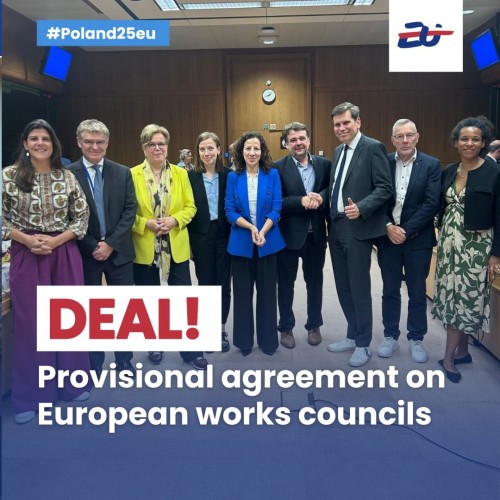
On 21 May, European Parliament and Council negotiators reached a provisional
agreement on the proposal for a directive to revise European Works Council
legislation. Although the updated text is not yet available, the press
releases issued by both institutions state that it is intended to provide a clearer
definition of what comes within the scope of transnational matters, so that
decisions substantially affecting workers in more than one EU Member State will
trigger an obligation to inform and consult an EWC, “without this being extended to
day-to-day decisions or issues that only affect employees in a trivial way” (see Council
and Parliament
press releases). The final wording of the definition will reveal whether it delivers
clarity or introduces further ambiguities.
The directive provides for the
inclusion of a target aimed at promoting a more balanced gender representation on
EWCs, by assigning at least 40% of their seats to members of one or other sex. A key
addition to the revised text addresses a delicate question: the capacity of EWCs to
assert their rights via legal means, “including by ensuring that costs relating to
legal representation and participation are covered”. In other words, employers will
have to pay the legal costs if a EWC decides to take legal action. In addition,
Member States – and Ireland in particular – will have to adapt their domestic law to
ensure that EWCs can actually exercise this right. Companies will also be required
to grant access to relevant information and to justify any refusal to disclose this,
especially in cases where they cite confidentiality reasons.
To ensure that
EWCs’ rights are properly applied, the Council has emphasised that the financial
penalties imposed “should be sufficiently dissuasive, while also taking into account
different factors such as the gravity, duration, consequences, and intentional or
negligent nature of the offence”. Parliament, which wanted the level of these
penalties to be based on those imposed by the GDPR regulation (fines of up to 4% of
the company’s global turnover), has had to revise its position. Nevertheless, it has
made progress in other areas, such as raising the number of EWC meetings from one to
two per year, with a clear stipulation that these meetings must be held “in person”.
MEPs have also strengthened the role of workers’ representatives “by making sure
that experts assisting EWCs, including trade union representatives, can attend
management meetings in an advisory capacity”. After the provisional agreement has
been scrutinised by lawyer-linguists, it will be submitted for formal approval by
the Council, possibly at the Employment and Social Affairs Council meeting on 19
June, and by Parliament, at the plenary session commencing on 16 June.
|
1. European
Union
Projects

Strengthening the single market :
On 21 May, the European Commission presented a communication
on a Single Market Strategy, which seeks “to create a more simple, seamless
and strong European home market” by tackling “the ‘Terrible Ten’ Single Market
barriers” identified by the Commission (see press
release and European single market). This
document, which is inspired by the recommendations contained in the Draghi
and Letta
reports, addresses a large number of topics, including some in the social field. The
communication adopts the idea of creating a 28th regime tailored to businesses
operating across the single market, with simplified rules applicable to relevant
areas of law, including “insolvency, labour and tax law”. The Commission suggests
several changes to be introduced by the 4th quarter of 2026, in order to facilitate
recognition of professional qualifications (faster procedures, automatic
recognition, etc.). The Commission plans to simplify posting procedures (see below),
including issuing A1 certificates to prove that posted workers have contributed to
the social security system in their country of origin. As previously indicated, it
wants to limit the information that large companies can ask SME in their value chain
to provide for inclusion in their sustainable development reports. It is also
announcing a recommendation on the Voluntary SME standard developed by the European
Financial Reporting Advisory Group (EFRAG), to be published by summer 2025.
|

Electronic declaration of posted workers :
On 22 May, the Council adopted its position (general approach)
on the proposal
for a regulation to facilitate the electronic declaration of posted workers.
This regulation is designed to reduce “the administrative burden for businesses by
fully digitalising the submission of posting declarations and for national
authorities by facilitating the monitoring of the compliance with the posting of
workers directive.” (see press
release). The Council is therefore mandating its presidency to commence
negotiations with Parliament, and these will start as soon as the latter has adopted
its own position. It should be borne in mind that this regulation is being contested
both by the European Trade Union Confederation (see position)
and by European social partners in the construction sector, who are critical of
plans to abolish the mandatory prior notification for posted workers (see joint
position).
|

Plans to simplify and cut SMEs’ costs :
On 21 May, the European Commission presented its Omnibus IV
package, which is intended to cut companies’ administrative costs by 400 million
euros per year (see press
release). One of its flagship measures is the creation of a new category of
company: small mid-caps (SMCs), i.e. companies with fewer than 750 employees and up
to €150 million in turnover (see the various
texts concerned). It is thought that 38,000 companies in the EU come into
this category. Companies in this intermediate category – i.e. between SME (fewer
than 250 employees) and large enterprises (from now on, those with at least 750
employees) – will have access to some of the existing SME benefits, such as specific
derogations under the General Data Protection Regulation (GDPR). The package also
postpones, by two years, the deadline for implementation of the due diligence
obligations applicable to companies in the battery industry, to 2027 (see proposal
for a regulation).
|
Social
update
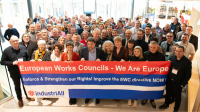
Revision of the EWC directive (reactions) :
The trade-union world has welcomed the provisional agreement
reached on 21 May in trilogue negotiations (see Lead story). Isabelle Barthès,
Deputy General Secretary of industriAll Europe said: “while restructuring is on the
rise and thousands of jobs are at risk everywhere in Europe, this should give
additional tools to our European Works Councils and empower them to effectively
exercise their rights to information and consultation.” (see press release).
However, IndustriAll Europe and the European Trade Union Confederation (ETUC) insist
that “a final assessment can only be made once the full text is available” (see press
release). The ETUC highlights three of its main requirements: more effective
sanctions; granting courts the right to suspend a decision taken by the employer;
and a guarantee that EWCs will have the necessary legal standing and resources to
take their case to court. These positions are shared by IndustriAll Europe, which
moreover takes the view that “it is expected that important progress was made on
critical aspects such as the definition of transnational matters” and “limitations
on the use of confidentiality”. Neither of these two press releases, nor those
issued by Parliament and the Council, make any reference to the opening of a
renegotiation period for EWC agreements, for the purpose of bringing them into line
with the future directive. European employers’ organisations have not reacted to the
provisional agreement.
|

European Labour Authority : On
26 May, the European Commission presented its Evaluation
report on the European Labour Authority (ELA), aimed at learning lessons
from the first mandate of this body, which was established in 2020 (see European Labour Authority) but
without any of the powers normally devolved to an “authority”, as it is unable to
take almost any serious measures without the consent of Member States (see IR Notes 128).
The Commission suggests a revision of its ‘Founding Regulation’, so that the ELA can
enhance its capacity to handle personal date; strengthen its ability “to request
cooperation from Member States on concerted and joint inspections (CJIs)”; and
“better address the situation of third-country nationals” (see press
release). Isabelle Schömann, ETUC Deputy General Secretary, argues that the
report shows that the ELA “clearly needs more powers and resources to tackle the
huge scale of exploitation faced by cross-border workers” (see press
release).
|
Case law

Direct discrimination : When he
took his retirement pension, a Spanish former employee disputed the amount awarded
to him, which did not take account of the pension supplement provided for by social
legislation to reduce the gender gap. This supplement is intended to reduce the
existing gender gap in matters of social security by compensating for the financial
prejudice suffered by mothers in their professional career on account of the
prominent role they play in raising their children. Among other things, this
prejudice results in them paying lower contributions into the social security
system, and therefore receiving lower social security benefits. The retired
employee, who is a father of two children, believes that this legislation treats men
less favourably than it does women, insofar as women who benefit from a retirement
pension and have one or more children are automatically granted the pension
supplement, whereas men in a comparable situation have to meet a number of
additional conditions that take account, among other things, of any career break
they have taken and the contributions they have paid into the social security
system. In a judgment
dated 15 May, the Court of Justice confirmed that this represents direct
discrimination on grounds of sex and that it is not justified, especially given that
such a pension supplement “does not appear to compensate for the disadvantages to
which women are exposed by helping them in that career and, thus, to ensure full
equality in practice between men and women in working life.”
|
2. Member
States
Spain

A more flexible migration policy :
Royal Decree
155/2024 of 19 November 2024, which is intended to make the country’s
migration policy more flexible, entered into force on 20 May (see press
release). The changes introduced include extending the validity period of a
job seeker’s visa from 3 to 12 months; and introducing new integration criteria (an
arraigo) that will allow undocumented immigrants to be granted the right to
remain in Spain, taking account of factors such as social integration,
socio-professional development or vocational training, and their family ties. In
addition, in several cases, the minimum qualification period for applying for an
arraigo has been reduced from three to two years of residence. These
measures are intended to facilitate the social and professional integration of
foreign nationals who have links with Spain.
|
Finland

Labour market reforms : The
Ministry of Economic Affairs and Employment has set up three tripartite working
groups to make preparations for three measures being taken by the Government (see press
release). Firstly, it wants to cut the threshold at which employee
representation has to be put in place within a company, from 150 to 100
employees. Secondly, employers will be able to decide when employees can take their
carried-over holiday entitlement (this was previously a decision taken solely by the
employee). And thirdly, the government also wants to clarify the law governing
Protection of Privacy in Working Life and to reduce administrative burdens.
|
Netherlands
Greater security for temporary workers :
A draft law designed to make flexible jobs more secure is being
presented to Parliament (see press
release). Temporary workers should be entitled to enjoy the same working
conditions as employees who are on a permanent contract, thereby reducing the risks
of exploitation. This new law will limit companies to three temporary contracts of
employment during a 36-month period. It also seeks to replace zero-hours contracts
with contracts that stipulate a minimum and maximum number of hours. The difference
between the two must not exceed a figure of 130%. The sole exception concerns
secondary occupations for young people, such as students. If both chambers approve
the bill, it will pass into law in January 2027. The VCP trade union, and the
employers’ organisations VNO-NCW and MKB-Nederland, say that this is an important
stage in the new package of measures aimed at creating a better labour market (see
press releases issued by VCP
and VNO-NCW).
|
3.
Companies
European
Works Councils
A new EWC : Following the
purchase, in 2022, of some of the businesses owned by publishers Thomson Reuters in
Spain, and by Wolters Kluwer in Spain, France and Portugal, the Swedish publisher
Karnov has negotiated the
creation of a European Works Council covering its 1200 employees in the EU. The agreement,
which was signed on 12 March, is fairly brief and adopts the main provisions of the
directive. In the name of seeking to ensure that discussions are as open as
possible, it imposes limitations on the circulation of information. The rule agreed
is that everything is to remain confidential, unless management has explicitly
indicated, in writing, that a specific piece of information or document is not
subject to the confidentiality obligations in place. The EWC meets quarterly via
videoconferencing, without management being present (though the EWC can invite it to
attend if necessary), and once a year for a plenary session, held face-to-face.
Communication and exchanges take place solely in English.
|
Transnational agreements
Trade union recognition : On 14
May, the management of the Danish cooperative group Arla Foods (19,500 employees)
and the IUF trade union federation signed a memorandum
of understanding following on from an initial transnational
agreement to fight sexual harassment. In this new agreement, the two parties
“affirm their commitment to continue the meetings between senior Arla Foods labour
relations management and representatives of the IUF and its affiliates” in order to
“maintain a constructive ongoing dialogue”. They will meet twice a year. Arla Foods
acknowledges that collaboration with the IUF will help it to meet its human rights
and due diligence obligations under the European directive. Other subjects for
discussion may include climate change mitigation, sustainable employment,
occupational safety and health, forced labour, sexual harassment and gender
equality.
|
|
|











