 |
| |
IR Notes 255 – 25 June 2025
www.irshare.eu
|
|
|
| |
| |
A question for…
Vincent Vandeloise, Senior Research and Advocacy Officer at the NGO
Finance Watch

The Council and Parliament are in
the process of scaling down the ambitions of the corporate
sustainability reporting and due diligence directives, as they
examine the proposal for a directive published by the European
Commission, which is itself planning to water down the content
of the two directives in question. Is this cause for concern or
a welcome simplification measure?
This simplification process is a serious
matter in more ways than one. Firstly, whereas the Letta and Draghi
reports, which aim to boost the EU’s competitiveness, call for
harmonisation of the rules at EU level, the Commission is now moving
in the opposite direction, with a fragmentation of the rules. For
example, in the context of due diligence, the Commission has
abandoned the notion of public liability at EU level for the
companies concerned, and is letting each Member State decide its own
sanctions regime.
Secondly,
one of the sustainability report’s
objectives is to promote comparability between companies on a number
of data points. These could have been simplified and made more
consistent, but instead, the choice made has been to remove an
entire category of companies from the directive’s scope of
application. As a result, not only will we lack information on these
companies, which will no longer have to go to the trouble of
publishing data – including data on employment and the environment,
which is useful for workforce representatives – but the quality of
the available information won’t be as good, either. And in fact, the
information received by larger companies that remain within the
directive’s scope, from smaller companies within their own supply
chain that will then be outside of it, will be less accurate and
less reliable.
Thirdly,
the European institutions are emphasising the issue of cutting
businesses’ costs to justify taking this huge step backwards by
removing vast numbers of companies from the scope of application.
Bear in mind that the previous directive covering non-financial
information that companies are required to publish, applies to those
with more than 500 employees. Yet here, the new version of the text
adopted by the Council raises the threshold to 1,000 employees – or
even 3,000, in the case of the draft report being scrutinised by
Parliament. Removing 80% of companies from the directive’s scope of
application doesn’t mean removing 80% of costs! These smaller
companies will still have to provide information to the
multinationals they work for. Admittedly, the Commission is
proposing that they use EFRAG’s voluntary reporting model, which is
a simplified version. However, a number of their business partners,
such as their bank, social rating agencies and others, will require
them to provide a wide range of information. If these smaller
companies haven’t already prepared a sustainability report – which
admittedly is a demanding undertaking, though it adopts a
standardised format, they’ll then have to spend a great deal of time
and energy dealing with those requests. So all in all, it’s unlikely
that they’ll actually see their costs coming down!
> Find out more:
further information is available from the Council’s press
release and negotiating
mandate, the European
Parliament’s report
and the link to Finance Watch.
|
|
|

|
|
|
|
|
| |
Who we are ?
IR Notes is a
fortnightly newsletter produced by IR
Share and its
network of experts, and is available in several European languages
(English, French, German, Italian, Spanish). It offers Europe-wide
monitoring of employment law, labour relations and employment policy. It
is available by subscription for 273 euros per year .
The team : This
issue was producaed by Inès
Bollet, Victoria
Fonseca, Ambre
Grenier-Boley, Iris
Turlan and Frédéric
Turlan. Find out more about
the IR Share team on our
website.
Subscribe to IR Notes
Via the
IR
Share website or by calliang us on:
+33 (0)6 81 41 53 95
or
E-mail: frederic.t@irshare.eu
Legal notice.
Publisher: IR Share SARL – 5, Les Compères – 89520 Fontenoy, France –
Tel.: +33 (0)6 81 41 53 95 – share capital 1,500 euros – commercial
register (RCS Auxerre): 512 567 959. Managing editor: Frédéric Turlan.
Hosting: ALTEO by Damien Cornillet – Château – 89500
Villeneuve-sur-Yonne. CPPAP no.: 0626 Z 93933.
|
|
|
|
|
| |
Follow us on LinkedIn!

Why not connect to the IR Notes LinkedIn page, so that you can keep up with
developments in the issues we’re covering, between two editions?
You’re welcome to follow us! There are already 720 of you following
us!
|
|
|
|
|
| |
European Industrial Relations Dictionary
In case reading IR Notes inspires you to
explore this subject further, we are providing links to the European
Industrial Relations Dictionary published by Eurofound. This is updated at
regular intervals by IR Share, which publishes IR Notes. The term
definitions are available in English and can easily be converted
into other languages using on-line translation tools.
|
|
|
|
|

|
|
|
Lead
story
Europe likes
social dialogue but trade unions are falling out of favour
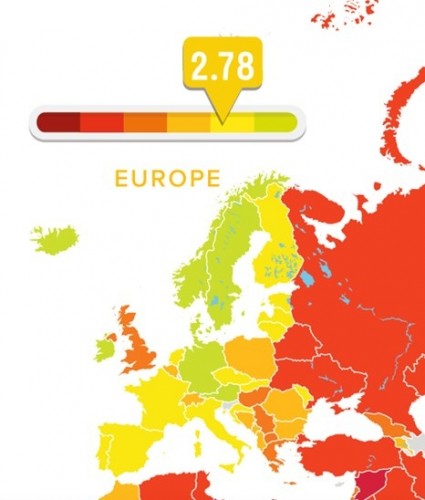
The twelfth edition of the Global Rights Index report produced by the International
Trade Unions Confederation (ITUC) highlights the deterioration in the rights enjoyed
by trade unions around the world (see report), such as the right to belong to a trade union, the
right to collective bargaining and the right to strike. Although Europe is still the
best ranked region, its current score is at its lowest level since the index was
created. In 2014, 18 European countries achieved the maximum possible score in terms
of trade union rights. Today, only 7 countries are in this category. The European
Union itself is not spared. Just five of its Member States achieve the highest
score, which is awarded to countries that witness only sporadic violations of trade
union rights. These are: Austria, Denmark, Germany, Ireland and Sweden. The other
two countries with the best rankings are Norway and Iceland. The category below this
– i.e. countries seeing repeated violations – includes 12 EU Member States, one half
of which are in Eastern Europe. The others are Finland, France, Spain, Italy and the
Netherlands. Finnish trade unions deplore the fact that two years have already gone
by since their country fell out of the top category, primarily because tripartite
cooperation between employees, employers and government representatives has turned
into a mere formality under the Orpo government: “trade unions no longer have any
real influence over reforms affecting workers’ lives” (see press release issued
by SAK and STTK). The next category is countries that are witnessing
regular violations of trade union rights. It includes four Member States: Belgium,
Bulgaria, Poland and Romania. First place goes to Hungary, which is the only EU
Member State to feature among the countries seeing systematic violations of trade
union rights – a category that also includes the United Kingdom.
According to
the report, the deteriorating performance of European countries is due in large
measure to the rise of the far right. This is leading to a wave of repressive
policies directed against trade union movements, as emphasised by Wolfgang Katzian,
President of the Austrian trade union confederation (ÖGB) and the European Trade
Union Confederation (ETUC) (see press release). The report points the finger at the
governments led by Orpo in Finland, Meloni in Italy and De Wever in Belgium. The
measures introduced by the latter’s coalition government include criminalising acts
perceived as infringing the authority of the State during demonstrations. The report
also condemns acts of repression imposed during strikes and demonstrations (in
France, Belgium, Finland), and abusing the notion of “essential services” in order
to limit the right to strike (Hungary, UK). This anti-worker dynamic has also been
accompanied by the creation of “yellow unions” supported and controlled by
employers, in an attempt to compete with or even replace traditional trade unions,
as observed in Greece and the Netherlands.
In point of fact, in Europe, 73% of
countries violated the right to strike; 56% of countries violated the right to
collective bargaining; 54% limited or prevented workers having access to justice;
and 41% restricted the right to join or establish trade unions. These results have
not prompted any official reaction at EU level, despite its ongoing advocacy of
stronger social dialogue, after rediscovering the virtues of collective bargaining.
Yet social dialogue requires active trade unions and protection for workers’ rights,
if it is to work effectively. The European Commission should take this reality into
account when preparing the forthcoming Quality Jobs Roadmap that it plans to unveil
at the end of the year.
|
1. European
Union
Projects
“Traineeships” directive : On 19
June, the Council adopted its position on the directive
on improving and enforcing working conditions of trainees and combatting regular
employment relationships disguised as traineeships (see press
release) (see Traineeship). The directive
applies to trainees who have an employment relationship with an employer (whether or
not formalised by a contract of employment), but whose traineeship is not of a
compulsory nature. It does not apply either to traineeships undertaken within the
national education or training framework, or to those organised within the framework
of active labour market policies. When it comes to “working conditions, including
pay”, the directive calls on Member States to ensure that “trainees are not treated
in a less favourable manner than comparable employees”, “unless different treatment
is justified on objective grounds, such as different tasks, lower responsibilities,
work intensity or the higher weight of the learning and training component”. At
national level, the social partners are given the option of “upholding or concluding
collective agreements establishing the objective grounds that are considered to
justify a different treatment”. Member States must carry out checks and inspections
“to identify and combat false traineeships”, based on three criteria (rather than
the six contained in the proposal for a directive): 1/ absence of a training
component; 2/ excessive
duration of the traineeship or multiple and/or consecutive traineeships undertaken
with the same employer by the same person; 3/ equivalent levels of tasks,
responsibilities and intensity of work in relation to comparable employees. The
Council’s text removes the clause listing the information that employers may be
called on to provide when checks are made. If national law permits, workers’
representatives will be entitled to engage, on behalf of trainees, in any judicial
or administrative proceedings in order to defend or enforce their rights and
obligations. Once Parliament has adopted its position, a trilogue will be
established, with the aim of reaching agreement on a text at first reading, opening
the way to definitive adoption of the directive, which will then be transposed by
Member States within two years. The Commission, which put forward this proposal for
a directive on 20 March 2024 (see IR Notes
227), hopes that the trilogue may be able to raise the level of ambition set
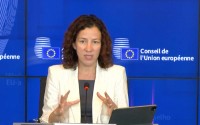
by the text further still, as emphasised by Vice-President Roxana Mînzatu (picture)
at the Employment and Social Affairs Council meeting. The Commission will be able to
rely on the support of the European Trade Union Confederation, which has criticised
the compromise and called on Parliament to intervene in order “to provide the
European vision that national governments have failed to offer.” (see press release).
|
Revision of the European Works Council directive
: At a quick round table session devoted to current
legislative initiatives during the Employment and Social Affairs Council meeting on
19 June, two countries expressed their satisfaction with the provisional agreement
reached by the trilogue, on 21 May, on revision of the EWC directive (see IR Notes
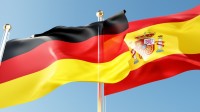
253). Germany described it as a “very important” text and Spain, which would
have liked to see a “higher level” text, stated that this revision should merely be
viewed as “an initial step towards an in-depth review of the European framework for
informing and consulting workers, and enabling worker participation”. The Polish
presidency of the EU explained that the provisional agreement was now in the hands
of lawyer-linguists, and that it would be back before the Council “after the summer
break” for formal adoption, concomitant with its scheduled adoption at a European
Parliament plenary session.
|
Social
update
Danish presidency of the EU :
Denmark, which takes over the presidency of the EU on 1 July,
has set out its political priorities and its programme.
The Presidency wants to “promote social cohesion, combat social exclusion, and
ensure inclusion for all citizens”. The Danish government, which brought an action
for annulment of the directive on adequate minimum wages before the Court of
Justice, warns that any initiatives will be taken “while respecting national labour
market and welfare models, as well as the role and autonomy of social partners”.
This means that no major legislative progress should be expected. The programme
mentions several employment-related matters: free and fair movement, including for
posted workers and third-country nationals; the sixth revision of the directive on
exposure to carcinogens, mutagens and reprotoxic substances at work; the
recommendation and the directive on better working conditions for trainees; social
dialogue between social partners; the forthcoming Quality Jobs Roadmap; and the
voluntary digital declaration for the posting of workers.
|
European Pillar of Social Rights :
On 18 June, the European Commission opened a public
consultation, lasting until 10 September, on the 2021
action plan to implement the European Pillar of Social Rights (see European Pillar of Social
Rights), and a call
for evidence on the launch of a new action plan by the year end, in parallel
with consultations undertaken with European social partners. The consultation
questionnaire seeks to identify the “main barriers or emerging challenges for
improving working conditions”, by asking respondents to rank five options according
to their level of relevance. These options are: increased stress at work; inadequate
information and consultation about job dismissals; inadequate wages (including
minimum wages); use of AI tools for monitoring, surveillance, evaluation and task
assignment; and insufficient support for cross-border mobility. Based on the same
principle, respondents are invited to rank the “most burning social issues” that
need to be addressed by the future action plan. The proposals include: addressing
automation and AI in the workplace; introducing a right to disconnect; and
addressing mental health at work. All citizens are entitled to respond to this
consultation, as are employers’ organisations and trade unions, works councils,
European Works Councils, etc.
> See
also: The European Economic and Social Committee has adopted
an own-initiative opinion calling for an ambitious new action plan (see press
release) which, among other things, includes “a directive on psychosocial
risks and the right to disconnect”.
|

Gender equality in the AI age :
On 19 June, the Council adopted Conclusions
on Advancing Gender Equality in the AI-Driven Digital Age (see press
release). The text calls on Member States to take appropriate measures to
ensure that AI systems “do not produce discriminatory outputs”, including “by
ensuring the use of clear, representative, high-quality data in a transparent
manner, by regularly evaluating AI systems” and “by installing human oversight”.
|

Artificial intelligence : After
the European Economic and Social Committee published its opinion
on “pro-worker artificial intelligence” on 22 January this year, it is now the
European Parliament’s turn to intervene on this issue, with the preparation of a resolution
on “recommendations to the Commission on digitalisation, artificial intelligence and
algorithmic management in the workplace”. The resolution is accompanied by a
proposal for a directive that “lays down minimum requirements for the transparent
use of algorithmic management in the workplace”. Among other things, this text would
oblige employers to provide, on or before the first working day of the employment
relationship, a number of items of information concerning the use of algorithms,
such as “a clear indication of whether the data collected is used to carry out
automated decision-making, and, where applicable, a description of the nature and
scope of such decisions.”
|
Sectoral
social dialogue
|
2.
International news
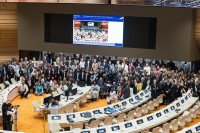
A new ILO convention : At the
113th International Labour Conference (ILC), held in Geneva from 2 to 13 June,
Member States of the International Labour Organization (ILO) adopted Convention
no. 192 concerning prevention and protection against biological hazards in the
working environment. This is supplemented by a non-binding recommendation
providing detailed guidelines for its implementation. According to the ILO, these
two instruments “offer a powerful, adaptable framework to prevent biological risks
in every type of workplace, now and into the future”. It is expected that they will
be supplemented, at the 2027 ILC, by a new convention on exposure to bacteriological
risks. The next ILC, which is due to be held in 2026, is expected to complete the
work that began earlier this month in Geneva, with a view to adopting a convention
on decent work in the platform economy, to be supplemented by a recommendation. The
ILC also adopted a resolution
to reduce informality and support the transition to formal work. This text
calls for urgent action to improve working conditions, extend social protection and
create decent jobs. Opportunely, at a time when the EU is seeking to pare back the
directive on due diligence, the text highlights the importance of respect for the
principle of due diligence in supply chains. (see ILO press
release). One issue that produced heated debate at the ILC during the
adoption of the ILO’s budget, was pressure from a number of countries, led by the
USA, for any mention of “gender equality” to be systematically removed and replaced
by the wording “equality between men and women”.
(Photo: adoption of ILO convention no. 192, Pierre
Albouy / ILO)
|
3. Member
States
Spain
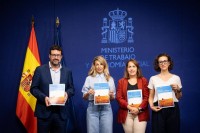
Preventing exposure to excessive heat in the
workplace : On 9 and 10 June, the Ministry of Employment
sent out 112,260 letters to businesses operating in certain sectors, especially
those most exposed to high temperatures (i.e. laundries, street cleaning services,
catering). Fines of up to one million euros can be levied if these companies fail to
comply with the legislation. With a view to ensuring health and safety in the
workplace, the government issued a total of 11,500 fines in 2024, compared to just
704 in 2021. The Ministry of Employment has also published a guide
to taking action for the benefit of the inspection authorities (see press
release).
|
Finland

Platform workers : The Supreme
Administrative Court has handed down a decision declaring that food delivery riders
and drivers are employees within the meaning of employment contract law (press
release). In this particular case, the occupational health and safety
authority had asked the platform to keep a register of hours worked and wages paid
to these delivery workers, in the same way as this has to be done for employees.
Among other considerations, the Court took into account EU Court of Justice case
law, which concluded that the concept of an “employee” should not be interpreted
restrictively (see press
release).
|
Portugal

Labour market reforms : A
vigorous debate began in Parliament on 17 June concerning revision of the Employment
Code, around proposals that were absent from the election manifesto of the head of
government, Luís Montenegro. The measures envisaged include: changes to the right to
strike, i.e. seeking to restrict the right to exercise this in certain key sectors
(in response to a nationwide rail strike by Comboios, the Portuguese rail operator);
granting employees the right to “sell” their days of paid leave, in exchange for
remuneration; and simplifying dismissal procedures.
|
4.
Companies
European
Works Councils

Sustainability reporting :
European trade union federations have published joint
recommendations on sustainability reporting, aimed at trade union
coordinators and members of European Works Councils or European company Works
Councils, to help them respond to the European Commission’s plans to water down the
directives on sustainability reporting and due diligence. These recommendations also
contain advice on how to ensure that workers’ representatives are involved in the
process of compiling a company’s sustainability report, inviting EWCs to use all of
the tools available to them (the services of experts, training, contacts with other
EWCs, etc.).
|
Renegotiation : On 14 April,
Bouygues group (200,000
employees) management and EWC members signed a European
Works Council renewal agreement, following the acquisition in 2022 of Equans (75,000 employees), a
subsidiary of the Engie group. The new agreement provides for the creation, by no
later than 2026, of three committees forming part of the EWC: two of these are
subject-specific (Health-Safety and Climate-Environment) and the third is tasked
with monitoring the social undertakings given by Bouygues’ management at the time of
Equans’ acquisition. The agreement provides for a new consultation procedure
applicable to proposed social undertakings given at European level on cross-cutting
issues, which might give rise to the conclusion of a European agreement with the
European trade-union federation EFBWW.
|
5. Studies
and reports
Employee directors : On 16 June,
the Centre d’étude de l’emploi et du travail [‘Centre for Research into
Employment and Labour’] (CEET-Cnam)
published a study
examining the extent to which employee representatives sitting on boards of
directors in France are able to influence the strategic directions taken by their
company. Riyad
Manseri, a post-doc researcher at CEE-Cnam, notes that “when all is said and
done, their powers appear to be limited, and decision-making largely remains in the
hands of directors representing shareholders and, to an even greater extent, with
companies’ executive management”.
> See also: His previous study of employee
directors’ compensation.
|
|
|











