 |
| |
IR Notes 258 – 24 September 2025
www.irshare.eu
|
|
|
| |
| |
A question for…
Georg Brynjarsson, General Manager of the Icelandic trade union Viska

Your union Viska is shaking up the
Icelandic trade union landscape and has seen its membership rise
by 20% in just a short time to nearly 6,000 members, it’s now
the country’s 6th-largest trade union. What are the reasons
behind this success?
Firstly, let me say a few words about trade
unionism in Iceland. Union membership here is very high, at over
90%, given that some health insurance and vocational training
schemes are managed by the trade unions. To get insurance, you need
to belong to a union. In addition, employers deduct union dues from
employees’ pay at the same time as their health insurance
contributions. These are very unusual conditions, compared to the
rest of the world. The downside is that we have too many trade
unions here: almost 140 of them, i.e. more than Denmark, even though
they have over 4 million inhabitants and we have just under 500,000.
Moreover, trade unions don’t have to make much effort to retain
their members and are content to manage health insurance and
negotiate collective agreements.
In 2020, I became the manager of five trade
unions representing employees with university degrees, who shared an
office. I came to realise that the fragmented nature of our unions
meant that they didn’t have enough power to negotiate good salaries
and working conditions for our members. So I then made contact with
similar Nordic trade unions (Samfunnsviterne in Norvway, Akavia in
Sweden, etc.) that offer their members much more and better services
(advice, benefits such as negotiated insurance rates, etc.) than
Icelandic unions do. I was inspired by their practices. As a result,
in January 2024, we created Viska by merging three trade unions,
with two goals in mind: firstly, providing comprehensive services
throughout people’s working lives, from guidance for students
through to pension advice, and secondly, influencing collective
bargaining to improve their working conditions. And lastly, we also
want to take part in public debate by representing middle-class
employees, whereas previously, the media always used to turn to
trade unions representing manual workers or clerical staff to gather
the views of employees. We’ve now gained real visibility. Three
other trade unions have joined us since our union was created. Viska
has really shaken up the trade union landscape! Unions don’t enjoy a
good public image: young people see them as being old, boring, slow
and lacking in appeal. We’re different, and much more modern. We’ve
worked hard on building our image, setting up a nice website,
pleasant offices and meeting rooms for our members in Reykjavik and
providing effective services.
|
|
|

|
| |
Agenda
7 October
Brussels
The
European Commission sets out its new LGBTIQ equality strategy.
8
October
Strasbourg
The
European Parliament votes on revision of the European Works Council
directive.
16 and 17
October
Salamanca
International
seminar on “The
due diligence directive and human rights following the Omnibus
proposal”, organised by the University of Salamanca.
17 October
Brussels
Employment and Social Policy Council meeting
21
October
Brussels
The
European Commission sets out its new work programme.
22
October
Brussels
Tripartite
Social Summit
13
November
Brussels
A
conference jointly organised by the European Commission and the European
Economic and Social Committee (EESC), entitled: “Building
the workforce of tomorrow: inclusive participation and quality jobs
for a competitive Europe”.
19 and 20
November
Bordeaux
The
European Trade Union Institute (ETUI) is organising a training
seminar on the support that trade unions can provide to European
Works Council in the context of transnational restructuring.
1 December
Brussels
Employment and Social Policy Council meeting
|
|
|
|
|
| |
Who we are ?
IR Notes is a
fortnightly newsletter produced by IR
Share and its
network of experts, and is available in several European languages
(English, French, German, Italian, Spanish, Polish). It offers
Europe-wide monitoring of employment law, labour relations and
employment policy. It is available by subscription for 273 euros per
year .
The team: This
issue was producaed by Inès
Bollet, Victoria
Fonseca,
Ambre Grenier-Boley, Laura Renucci, Iris Turlan
and Frédéric
Turlan. Find out more about the IR Share team on our website.
Subscribe to IR Notes
Via the IR
Share website or by calling us on: +33 (0)6 81 41 53 95
or
E-mail: frederic.t@irshare.eu
Legal notice.
Publisher: IR Share SARL – 5, Les Compères – 89520 Fontenoy,
France – Tel.: +33 (0)6 81 41 53 95 – share capital 1,500 euros –
commercial register (RCS Auxerre): 512 567 959. Managing editor:
Frédéric Turlan. Hosting: ALTEO by Damien Cornillet – Château – 89500
Villeneuve-sur-Yonne. CPPAP no.: 0626 Z 93933.
|
|
|
|
|
| |
Follow us on LinkedIn!

Why not connect to the IR Notes LinkedIn page, so that you can keep up with
developments in the issues we’re covering, between two editions?
You’re welcome to follow us! There are already 738 of you following
us!
|
|
|
|
|

|
|
|
Lead
story
Court of
Justice strengthens protection for employees who are parents of a child with
disabilities

The EU Court of Justice has consolidated its case law on disability-related
discrimination, where the disability affects an employee’s child. In a 2008 judgment,
the Court of Justice ruled on the issue of direct discrimination ‘by association’:
Sharon Coleman, an employee who was recruited by a firm of solicitors in 2001 to
work as a legal secretary, gave birth in 2002 to a son, whose disability meant that
he needed specialised care, which she provided as his primary carer. After a period
of three years characterised by acts of harassment and vexatious measures (e.g. the
employer refused to grant her the same flexibility in her working hours and the same
working conditions as her colleagues), she accepted voluntary redundancy, but lodged
an appeal, alleging that she had suffered unfair constructive dismissal and had been
treated less favourably than other employees because she was the primary carer of a
disabled child. At that time, the Court of Justice held that Directive 2000/78
cannot be interpreted “strictly, that is, as prohibiting only direct discrimination
on grounds of disability and relating exclusively to disabled people”. The Court
stated that “the directive […] applies not to a particular category of person” but
by reference to the discrimination grounds it relates to, given that an
interpretation of the directive “limiting its application only to people who are
themselves disabled is liable to deprive that directive of an important element of
its effectiveness and to reduce the protection which it is intended to guarantee”.
The Court thus recognised the concept of direct discrimination ‘by association’,
preventing the employer from seeking to justify their actions or propose ‘reasonable
accommodation’.
In a further judgment
pronounced on 11 September, concerning a female employee who was responsible for
monitoring and supervising an underground station, this time the Court accepts the
concept of ‘indirect’ discrimination ‘by association’. The case concerns an employee
who asked her employer to appoint her, permanently, to a position with fixed working
hours, even if it was one requiring a lower level of qualification, to enable her to
care for her minor child, who has extensive and comprehensive needs arising from
disability and must follow a care programme at a fixed time in the afternoon. The
employer refused her requests but did provide her with some accommodation in respect
of her working conditions on a provisional basis, as compared to other station
operators, who are subject to alternating and rotating shifts. The employee alleges
that she was the victim of discrimination resulting from the application of a rule
governing working hours at the company. Despite being apparently neutral, this rule
did not take account of her special needs (hence the use of the term ‘indirect’
discrimination). In contrast to a situation involving direct discrimination, in the
event of indirect discrimination, the employer is entitled to demonstrate a
legitimate aim in order to claim exemption, or make ‘reasonable accommodation’.
Relying on the United Nations Convention on the Rights of Persons with Disabilities,
concluded on 13 December 2006, the Court holds that the employee “must be able to
provide, to his or her child who has a disability, the assistance that that child
requires, which implies an obligation, on the employer, to adapt the working
conditions of that employee”. A national court to which a case of this nature is
referred must however check “that that accommodation does not impose an unreasonable
burden on that employer” – which is questionable in light of the Court’s case law on
reasonable accommodation.
|
1. European
Union
Projects

Reform of public procurement :
On 9 September, within the framework of the European
Commission’s revision of the legal frameworks applicable to EU public procurement
contracts, which is scheduled for the first half of 2026, MEPs passed a resolution
on public procurement. They take up one of the findings reached by the
European Labour Authority (ELA): the preponderance of the lowest‑price criterion
“can exacerbate the occurrence of undeclared work and may undermine service or
product quality, sustainability and social standards”, particularly in
labour‑intensive sectors where staff costs dominate. MEPS recognise “the importance
of strengthening the ability of contracting authorities to give greater weight to
social and sustainability criteria, including environmental and climate-related
considerations”. They point out that the Court of Justice allows contracting
authorities “to include requirements based on national labour law in procurement
documentation, such as binding collective agreements, minimum employment standards,
equal pay provisions, and other relevant social criteria”. They call on “the
Commission to develop guidance and a legal framework” that will allow “contracting
authorities – within their own discretion – to apply such criteria without facing
disproportionate legal risks”. The UNI Europa federation’s view is that this
resolution “gives a clear mandate to the European Commission to link the awarding of
public contracts to respect for collective agreements”, which represents a core
demand of the trade union movement (see press
release). However, the European Public Service Union emphasises that “the
downside of the report is that there is not a strong call for mandatory criteria for
sustainable public procurement”: each authority will be left free to decide whether
or not to apply these criteria, and to continue opting for the lowest price (see press
release).
|

Quality traineeships : On 10
September, the European Parliament’s Committee on Employment and Social Affairs
adopted a number of compromise
amendments to the draft report on the proposal for a directive improving the
working conditions of trainees, as put forward in February, by MEP Alicia Homs Ginel
(S&D). The amended report defines a ‘traineeship’ as a “limited period of
entry-level work aiming to provide practical and professional skills through
significant learning and training to facilitate the transition from education to a
standard employment relationship or access to a profession”. To ensure that there
will be a proper training component and decent working conditions, the report
emphasises that a written contract must be handed over, before the traineeship
commences, setting out its duration, its pay, the learning objectives agreed and the
arrangements for mentorship and regular evaluation. The report is expected to be
adopted at a plenary session on 23 September, which will enable the Danish
presidency of the EU to launch negotiations between the Commission, the Council and
Parliament (the trilogue) with a view to adopting the directive.
|
Social
update

Quality jobs : On 10 September,
the President of the European Commission, Ursula von der Leyen, made a brief
announcement to MEPs concerning a Quality Jobs Act, with very vague outlines. In her
State
of the Union Address, she was in all likelihood referring to the Quality
Jobs Roadmap, whose adoption has already been announced for the end of the year. The
terms used appear to confirm that it will contain a legislative component, with
proposals for a directive, i.e. with binding rights. The European Trade Union
Confederation (ETUC) welcomed the announcement of a legislative initiative on
quality jobs but also expressed regret that this followed a nine-month wait since
the start of President von der Leyen’s second term, “a period during which a raft of
deregulation measures has been proposed”. In its press
release, the ETUC sets out its expectations of this initiative (directives
on telework and the right to disconnect, algorithmic management, a just transition,
etc.). In her speech
at the opening of the Porto Social Summit, on 18 September, the European
Commission’s Vice-President, Roxana Mînzatu, confirmed that “at the heart of that
roadmap will be a Quality Jobs Act” and set out three goals: 1/ to uphold and strengthen labour
rights, so that every worker enjoys “fair pay, safe conditions and dignity at work”.
2/ to harness the digital
revolution “while guarding against its risks: of job insecurity and weaker
protections”. 3/ to prepare for change, by helping “workers and
employers alike [to] navigate transitions”.
|
Cross-industry social dialogue

Telework and the right to disconnect :
Following the European social partners’ failure, in November
2023, to reach an agreement on telework and the right to disconnect (see IR Notes
219), the European Commission relaunched a first-stage consultation of
social partners in April. On 25 July, it launched the second-phase consultation,
with a very comprehensive document
setting out the various instruments that could be adopted. Responses are expected by
6 October. The Commission will then be free to put forward a proposal for a
directive, probably accompanied by recommendations to Member States.
|
2. Member
States
Luxembourg

Labour market reforms : On 3
September, the government convened a meeting of social partners but failed to reach
a tripartite agreement on its main proposed reforms. However, it abandoned some of
these measures, such as proposed changes to collective bargaining rules, and altered
some of its plans, such as adapting Sunday working hours in the retail sector. The
plan now is to increase Sunday working hours from four to a maximum of eight hours,
subject to a sectoral collective agreement (CCT) or a cross-industry agreement being
reached (see press
release). OGBL, the main trade union confederation, is pleased about these
climb-downs, but expresses concern at “a paradigm shift” that calls into question
“the tripartite social model based on equal negotiations in search of compromise”
(see press
release). The employers’ organisation UEL acknowledges that “total
convergence couldn’t be achieved” at this meeting, but nevertheless views the
ongoing discussions regarding possible measures to improve the legal framework
governing the organisation of working time as a positive sign (see press
release).
|
France
Due diligence : On 18 September,
the Paris court issued an order
requiring the oil company TotalEnergies to disclose a number
of key internal documents relating to plans for oil extraction at Tilenga in Uganda
and construction of a crossborder pipeline (EACOP) to pump crude oil to the port of
Tanga in Tanzania. By rejecting the confidentiality claims filed by TotalEnergies,
which had submitted only extracts from certain reports and studies used in its
defence, the court specified for the first time in a due diligence case that
claimants are entitled to ask the defendant’s parent company directly to release
evidence, without having to communicate via its subsidiaries. In addition, research
reports produced by external consultancy firms must be passed on to claimants where
the company relies on them for its defence. This is therefore an important decision
made by this court, which is specialised in due diligence compliance, as it
establishes that a company in sole possession of evidence of wrongdoing has a legal
responsibility to release this.
|
3.
Companies
European
Works Council

Information confidentiality : On
20 February 2025, the management of the Air
Liquide group and trade union representatives on its
European Works Council signed an amendment
to the European Works Council agreement of 9 November 2023, amending the provisions
covering confidential information. This confidentiality obligation now “also applies
to the members of the Bureau vis-à-vis the elected members of the European Works
Council”. The signatories acknowledge that “in certain cases, the sensitive and
confidential nature of the information to be sent to the European Works Council is
not compatible with informing the elected representatives 15 days before the date of
the meeting”, as provided for by the EWC agreement. In this case, “in agreement with
the secretary of the European Works Council, sensitive and confidential information
likely to be of interest to third parties and/or to have major internal or external
repercussions may be communicated to the elected representatives on the day of the
meeting”. This provision covers for example “information likely to have an impact on
the markets or projects, the scale or nature of which justifies maintaining the
strictest confidentiality.” If the European Works Council secretary does not accept
this arrangement, the signatories agree that “documents and presentations containing
sensitive and confidential information” will be sent “to the members of the Bureau
only, within 7 days from the date of the Meeting” of the EWC. These documents “may
be presented to the other members of the European Works Council during the
preparatory meeting, before the plenary or the extended Board meeting. The
confidential nature of those documents must be complied with.”
|
4. Studies
and reports
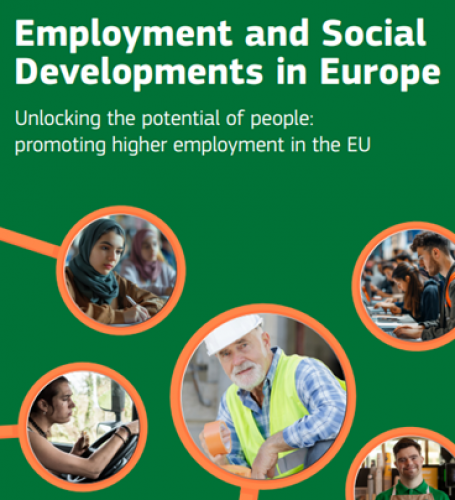
Boosting labour force participation :
On 16 September, the European Commission published its annual
report on Employment
and Social Developments in Europe, which deals with the issue of labour
force participation among under-represented groups, such as women, older persons,
migrants and persons with disabilities. Around 51 million people currently find
themselves outside the EU labour market, according to the report. Facilitating
access to the labour market for under-represented groups would help to reach the
EU’s 2030 target of a 78% employment rate (the current figure is 75.8%). The report
contains a chapter on measures implemented with a view to improving access to the
labour market for these groups.
|
Risks posed by the 28th regime :
In her State of the Union address on 10 September, the President
of the European Commission confirmed that a “28th regime” was under preparation,
with the aim of promoting ‘innovative’ companies, by allowing them to benefit from a
simplified commercial, fiscal and social framework. In a policy
brief, the European Trade Union Institute (ETUI) warns of the risks inherent
in creating a legal framework of this nature. The authors cite the failed attempts
previously made to create a status of this kind, the active lobbying undertaken by
EU-Inc.org – the European organisation representing innovative companies – and the
ways in which European company (SE) status has been used to circumvent existing
rights. They conclude by setting out a series of safeguards that should accompany
the creation of this 28th regime, such as guarantees ensuring that workers’
participation cannot be frozen or evaded.
|
|
|











