Lead story
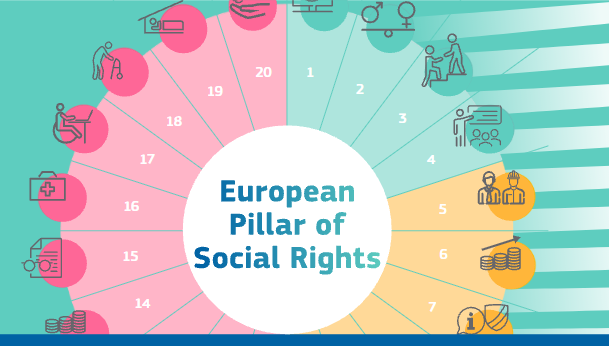
New directions for the European Pillar of Social Rights
On 22 July, the European Commission published a communication reviewing the progress made by the action plan on the European Pillar of Social Rights. This communication, which sets new priorities, is accompanied by a working document produced by the Commission’s services, detailing whether or not the action plan’s targets have been met (see press release). Reading these texts offers scant reassurance regarding the Union’s social ambitions.
The picture revealed by the action plan’s progress is uneven, and even somewhat gloomy. Of the three major targets set for 2030, only the first one, relating to employment rates, looks achievable: the employment rate (76.1% in 2025) is well on the way to reaching its 78% target. Some countries, however, have fallen well behind: Belgium, Romania and Italy are between 5.4 and 7.2 points below their national target for 2030. Along with the 7 other Member States that “are within 4 pps of their national targets”, these countries “will require significant efforts [...] in the remaining part of the decade”. The sub-target of halving the gender employment gap is also a long way off being met. The working document emphasises that this gap “has only narrowed slightly since 2021, from 10.0 percentage to 9.6 percentage points”.
The second main target, that of adult learning, is flatlining. The very moderate rise achieved (from 37.4% in 2016 to 39.5% in 2022) “is insufficient to achieve the EU headline target of 60% of adults participating in learning every year by 2030”. The sub-target of basic digital skills, which 80% of adults should possess by 2030, is also progressing too slowly: it stood at 55.6% in 2023, compared to 53.9% in 2021.
Lastly, the third target, that of poverty reduction, is beyond reach. The EU target is for 15 million people to be lifted out of poverty or social exclusion by 2030, but the Commission notes that so far, only 3.5 million have been. It emphasises that “an average annual reduction of more than 2 million would be required to reach the target by 2030”, which will demand “a significant acceleration of efforts during the remainder of the decade”.
In light of this finding, the Commission’s response seems rather feeble. Whereas the action plan gave rise to 7 directives and 8 regulations, the communication contains only two flagship measures that have already been announced, namely an Affordable Housing Act (which was due to be presented on 9 September) and the Quality Jobs Act, which is already undergoing the second-phase consultation of European social partners (see below). These partners are also being consulted on “the possible direction of EU action on activation of persons facing significant barriers to enter the labour market” (see consultation document). The remainder of the communication goes through a list of actions (some of which have already been announced) but it is hard to see how they will remedy the situation.
For example, when it comes to tackling the issue of AI, the Commission announces the setting up of a High-level Experts Group tasked with developing “scenarios for the potential long-term trajectory for EU employment” and examining how these impacts “can be anticipated and managed most effectively”. In short, the “Pillar” is still regarded as a “compass of a strong and resilient social Europe”, but its implementation is now only a shadow of its former self. Worse still, in its communication, perhaps fearing that it will be criticised for being too daring, the Commission explains that it is “strengthening efforts to ensure that the social acquis remains fit for purpose”, which “includes stress-testing existing legal frameworks […] in order to identify practical obstacles to implementation and opportunities for simplification”. In other words, it is paving the way for a possible “omnibus” directive in the social field, seeking to simplify the EU acquis.

 Legislation
A Frequently Asked Questions (FAQ) document on pay transparency: On 6 August, the European Commission published a FAQ document, which is intended to facilitate implementation of the Pay Transparency Directive. Among other things, the Directive states that payments and benefits in cash or in kind that are not subject to any eligibility criteria and are collectively paid to all employees without any exceptions (such as lunch vouchers, smartphones or laptops) do not have to be included. The FAQ document states that the views expressed in it are “the preliminary views of the European Commission” and do not constitute its official position.
Social update
European Parliament committee adopts a report on psychosocial risks: On 2 September, the Committee on Employment and Social Affairs adopted the own-initiative legislative report submitted by Estelle Ceulemans (S&D), by a large majority (41 votes in favour, 12 against and 4 abstentions). The text, which is accompanied by a proposal for a directive, calls for a directive that will set common minimum standards on issues such as: recognising psychosocial disorders as occupational diseases; overseeing algorithmic management and AI; and guaranteeing the right to disconnect (see press release). The European Trade Union Confederation has expressed satisfaction at the adoption of this report, and is calling for binding legislation (see press release).
A report on application of the Minimum Wage Directive: On 23 July, the European Commission published the first report on application of Directive (EU) 2022/2041 on minimum wages, based on data provided by Member States and their action plans for promoting collective bargaining when the collective bargaining coverage rate in their country is below the threshold of 80%, which is currently the case for 18 countries. As at 15 June 2026, the Committee had received action plans from 12 Member States. All of them comply with the requirements set out in the directive.
Aid with restructuring: On 24 July, the European Commission announced a proposal to earmark more than 410,000 euros from the European Globalisation Adjustment Fund for Displaced Workers (EGF) to support 235 workers dismissed by the contract car manufacturer Valmet Automotive in Finland (see press release).
Commemorating accidents at work: On 7 August, the Executive Vice-President of the European Commission, Roxana Mînzatu, announced a proposal to make 8 August an annual “European Day in Remembrance of the Victims of Accidents at Work”. On 8 August 1956, 262 workers of 12 different nationalities perished in the Bois du Cazier coalmine disaster at Marcinelle, in Belgium (see press release).
Cross-industry social dialogue
Reactions to consultation on the Quality Jobs Act: On 20 July, the European Commission launched the second-phase consultation of European social partners on the future Quality Jobs Act, giving them until 28 September to respond (see press release). In the consultation document, which is accompanied by a working document produced by its services, the Commission sets out the courses of action envisaged in five areas: the right to disconnect and telework; algorithmic management; occupational health and safety (psychosocial, ergonomic, heat and screen-related risks); protection of workers in subcontracting chains; and just transitions. The text also looks at ways to improve the application of existing rules and promote social dialogue. The European Trade Union Confederation believes that these proposals lack ambition and is calling for binding legislation, rather than merely guidelines on these five areas, covering among other things, a right to training, the right to disconnect and strict supervision of subcontracting (see press release). The employers’ organisations, for their part, have not reacted to the launch of this second consultation but their position remains unchanged from the first one: they want a more effective application of the existing law, simplification of the social acquis and the use of non-binding instruments.
Sectoral social dialogue
A working programme for private security services: On 27 May, European social partners in the private security sector adopted a 2026-2028 working programme in which they announce that they want to give their full backing to revision of the legislation governing public procurement contracts, so that invitations to tender will include social and quality criteria, and will demand compliance with labour law and collective labour agreements, instead of simply being price-driven (see UNI Europa and CoeSS press releases).
Across Europe

 Germany
An action plan to strengthen collective bargaining: On 22 July, the federal government adopted a national action plan to strengthen collective bargaining, in line with the requirement set by the Minimum Wage Directive for Member States whose collective bargaining coverage rate is below 80%. Germany is a long way off reaching this threshold, after seeing its rate fall from 79% in 1996 to 49% in 2024 (see press release). The measures include the federal Bundestariftreuegesetz law, which has been in force since 1 May and makes federal public procurement contracts worth more than 50,000 euros dependent on compliance with working conditions laid down by a collective agreement; and a future right of digital access to workplaces for trade unions. Professor Thorsten Schulten believes that this plan will not turn the situation around: even the Bundestariftreuegesetz, which is by far the most significant measure, comes with a scope of application so modest that its effects will be felt only within a very limited perimeter.
 Denmark
Professional ID card to become mandatory on large construction sites: On 3 September, Parliament adopted the government bill (see IR Notes 278) requiring workers on construction sites whose contract value exceeds 100 million Danish crowns (approx. €13.4m) to carry a professional ID card, with a view to combatting undeclared work, exploitation of foreign labour and social dumping (see press release).
 Spain
Spain
Firm to be punished for continuing to make deliveries during a heatwave: The Catalonia labour inspectorate has prosecuted Glovo for maintaining its delivery service on 8 July, in Barcelona, while a red weather alert was in force (40°C). The inspectorate says that the company breached both its own internal protocol requiring work to be suspended during extreme weather – under the terms of this protocol, riders making deliveries on bikes, scooters or motorbikes had to be stood down during a red alert – and the regulations requiring work to be halted when protecting employees’ welfare cannot be guaranteed. The offence, which is classified as serious, renders Glovo liable for a fine of between 2,451 and 49,180 euros (see article in El País).
Company updates

 European Works Council
Aer Lingus trade unions call for consultation with IAG’s EWC: The trial of strength at the Irish airline Aer Lingus over the company’s redundancy plan is gaining momentum. The IAG group subsidiary is planning to cut up to 500 jobs (around 70 pilots, 140 cabin crew and 290 head office staff), with a view to restoring its operating margins to the 12-15% target level set by its parent company. On 11 August, the Irish Air Line Pilots Association (IALPA) called for the plan to be referred to IAG’s EWC, claiming that the restructuring was “transnational” in nature, as it was part of a profit margin policy decided on at group level (see article in The Irish Times). Management rejected this claim, arguing that the job losses concerned only Irish personnel, whose contracts were governed solely by Irish labour law. On 25 August, negotiations with pilots came to an abrupt end when management branded the EWC’s intervention a “stunt” (see article in The Irish Times). The next day, the trade union Fórsa (which represents head office staff) followed suit by calling for national consultations to be stalled pending the outcome of EWC consultations (see article in The Irish Times). The trade unions are relying on a legal precedent: a ruling handed down by the Audiencia Nacional de Madrid on 18 September 2023, which held that the job losses decided on by IAG in 2020 (12,000 jobs at British Airways and 500 at Aer Lingus) constituted a “transnational” measure within the meaning of the agreement establishing the group’s EWC, and that IAG had breached its obligation to inform this body. The position taken by management in this context, where a refusal to involve the EWC can only be harmful to social dialogue and to the restructuring’s implementation, is astonishing.
Global framework agreement
Pressure to renew a global agreement: In a letter sent on 29 July to more than 80 investors, and using the multinational’s “reputation” as leverage, the Uni Global Union federation urged shareholders in the global call-centre giant TP (formerly Téléperformance) to call on management to renew its global framework agreement signed in 2022. After citing several breaches of trade union rights committed by the company, UNI Global points out that “a business carrying such a high risk of controversy over labour matters needs engagement with a global union.” UNI Global emphasises that investor engagement “was instrumental in bringing the company to the table to secure the original pact in 2022”, and the union is convinced that their support “is once again critical to encourage a return to constructive dialogue”.
Data and reports

 First assessment of progress made by the Minimum Wage Directive
On 23 July, the European Commission published the first report on application of Directive (EU) 2022/2041 on adequate minimum wages in the EU. The document, which is based on data submitted by Member States, covers both trends in minimum wages in the Twenty-Seven and an evaluation of action plans designed to strengthen collective bargaining in countries where fewer than 80% of employees are covered by a collective bargaining agreement. The first part is less comprehensive than the Eurofound annual review (due to be published later this month), but the evaluation of these action plans shows the way forward in terms of relaunching collective bargaining. Eighteen Member States are currently below the 80% coverage threshold set by the directive – with Poland (11.6%) bringing up the rear. Only 12 of them have submitted an action plan to the Commission. Nevertheless, the Commission’s view is that it is too early to assess their actual effectiveness, which can be measured only in terms of progress made in coverage rates.
Key Statistic
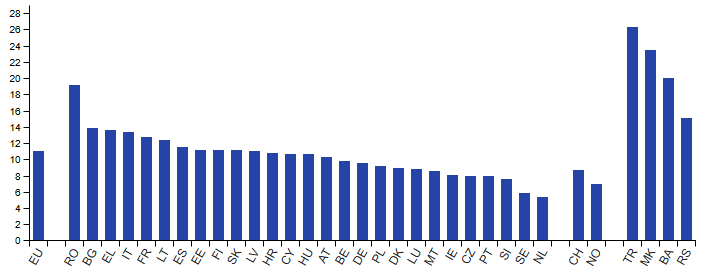
11 %
In 2025, 11% of young people in the EU aged 15-29 were neither in employment nor in education or training (NEET).
The EU has set itself a European target for this age group, and wants to reduce the proportion of “NEETs” from 12.6% in 2019 to 9% by 2030 (see press release). The lowest rates were to be found in the Netherlands (5.3%), Sweden (5.9%) and Slovenia (7.6%). In 2025, ten countries recorded NEET rates above the EU average. Of these, the highest were in Italy (13.3%), in Greece (13.6%), Bulgaria (13.8%) and Romania (19.2%).
Young people (aged 15-29) neither in employement nor in education and training, 2025
Three questions for…

Mikael Hansson
Associate Professor of Labour Law at Uppsala University
On the end of the Tesla strike in Sweden
“The trade unions simply came up against an opponent whose size and strength matched their own, and who was equally prepared for a fight”.
Following a strike that had lasted nearly three years, called with the aim of persuading Tesla to sign a collective bargaining agreement for its business in Sweden, the metalworkers’ union IF Metall announced on 19 August that it was calling off the strike. How did this strike come to an end?
In concrete terms, Tesla’s management seems to have reached a negotiated agreement with all of the striking employees who belonged to the IF Metall union. This prompted the latter to suspend strike action, as it no longer had any members employed at Tesla. So in the end, Tesla won its trial of strength with IF Metall through individual negotiations with each of the employees concerned.
Does this case represent a failure for the Swedish trade union model?
It’s certainly not a victory for IF Metall, but nor can it be said that the Swedish industrial relations model has been called into question, given that this dispute was exceptional in nature. Firstly, because of how long it lasted: no dispute of this kind in the modern era had gone on for so long. Secondly, on account of the scale of the financial resources mobilised by Tesla for the purpose of achieving its objectives, namely avoiding having to conclude a collective bargaining agreement with the IF Metall trade union. Usually, when a private-sector employer who is not affiliated to an employers’ organisation refuses to apply a collective agreement, the union manages to impose its viewpoint by resorting to strikes, which are often supported by trade unions in other sectors coming out on strike in sympathy, and exerting so much financial pressure on the company that it ends up capitulating. In Tesla’s case, IF Metall had clearly come up against a heavyweight opponent. Tesla spent a lot of money on this dispute, and for whatever reason, decided that this cost was worth it. It’s unlikely that such a scenario will arise again in the future, as it’s too costly for both parties.
Nevertheless – as with the measures taken by Tesla at its plant near Berlin, to prevent IG Metall from establishing itself as a trade union there – is the US carmaker using this dispute to show that if you’re willing to spend enough money, it’s possible to circumvent national industrial relations systems?
Indeed it is, and that’s what makes this such a special case. Under the Swedish industrial relations model, where collective bargaining holds sway, trade unions use their economic heft to force small businesses to join the negotiation system. However, in this particular case, they simply came up against an opponent whose size and strength matched their own, and who was equally prepared for a fight: so in a way, rather than the Swedish model being circumvented, what we saw here was merely this model of labour market regulation in action. One of them had to surrender. And in this case, it was IF Metall.
IR Dictionary

The Laval and Partneri case
On 18 December 2007, the European Court of Justice delivered a judgement in a case concerning collective action taken by a Swedish building workers' trade union to compel a Latvian company, which had posted workers to a Swedish construction site, to sign the collective agreement in force in the sector so that the Latvian workers would be paid at the same rate as Swedish workers, thus avoiding any social dumping.
The Court recognised that the right to strike was a fundamental right of the European Union, which was immediately applauded by the trade union movement. However, a little further on, the judgement asserted that the exercise of this right is not such as "to render Community law inapplicable to such action": it must be reconciled with other fundamental rights, such as the freedom of establishment or the free movement of services. This position caused outrage among the trade unions.
Upcoming Events
11 September
Brussels
Understanding the 28th regime
The European Trade Union Institute (ETUI) is organising an Expert Forum around the proposal for a 28th regime, including an analysis of taxation and social aspects.
15 September
Strasbourg
Fair Labour Mobility package
The European Commission is due to unveil the Fair Labour Mobility package, which includes a proposal for a “European Social Security Pass”, a proposal for a regulation to strengthen the European Labour Authority and an initiative to promote skills portability (see agenda).
16 to 18 September
Oslo
Inequality in the labour market
A conference organised jointly by IWPLMS and IREC: How can trends towards inequality in the labour market be counteracted and what role can actors and institutions play?
19 October
Luxembourg
Employment and Social Affairs Council
The team
This edition has been prepared by Inès Bollet, Victoria Fonseca, Sea Ange Gonebo, Ambre Grenier-Boley, Frédéric Turlan, Iris Turlan and Paula Villalobos. You can read about everyone in the IR Share team on our website.
To find out more about the IR Share team, please consult our website, LinkedIn or IR Notes.
www.irshare.eu
Publisher: IR Share SARL - 5, Les Compères - 89520 Fontenoy - France
Share capital: 1500 euros
Business registration: RCS (Auxerre): 512 567 959.
Publication Director: Frédéric Turlan
Tel.:+33 (0)6 81 41 53 95
Hosting: OVH - 2 rue Kellermann - 59100 Roubaix
CPPAP no.: 0626 Z 93933.
> The IR Notes newsletter is recognised as an “online press service” under Article 1 of Law no. 86-897 of 1 August 1986. In addition to the quality of IR Notes being recognised, “online press service” status allows us to charge a lower rate of VAT (2.1%) on subscriptions to IR Notes.

European social update