 |
| |
IR Notes 30 – 22 April 2015
www.irshare.eu
|
|
|
| |
| |
Who we are?
IR Share is a
provider that shares information, documentation and expertise for HR
managers and employee representatives. The IR Share agency operates by
way of online publications, working groups, training devoted to relevant
topics and a network of experts.
The team
This issue was produced by Alain Lefebvre and Frédéric Turlan.
Find out more about the IR Share
team on our website
Subscribe to IR
Notes Via the IR
Share website or by calling us on:
+33 (0)6 81 41 53 95 or
E-mail: frederic.t@irshare.eu
|
|
|

|
| |
Interview
Tristan Lormeau, Director of resources and skills of the Renault
group

What is the significance of the
recent amendment to the original installation agreement of the
Renault group works council?
This revised agreement marks a turning point
in the history of international social dialogue in the group. It is
both the culmination of previous developments – which explains why
we have concluded an amendment – and the precursor of a new era, in
the sense that we are going to set up a special negotiating body
whose task will be to negotiate a new agreement.
So the forthcoming group works
council agreement is likely to lose its anticipatory
character?
Towards the end of the negotiations on the
amendment, the question arose of maintaining the anticipatory
agreement. The installation agreement of the Renault group works
council was signed by Belgian, Spanish and French trade unions. In
the meantime, another country of major importance has emerged in the
form of Romania, which has nearly 20,000 employees. And this country
is not represented among the signatories because, to retain the
character of anticipation, the amendment must be signed by the
original signatories. Furthermore, the gap between our agreement and
the provisions of directive 2009/38 has become minimal. There is no
real basis for maintaining the anticipatory character of the
agreement, and it is for this reason that the negotiators have
decided initially to sign an amendment clarifying the different
dimensions of the group works council and then, at a second stage,
to set up an SNB in order to arrive at a new agreement.
The revised agreement affirms the
group’s global dimensions…
The amendment is the result of an updating
process which reflects developments at Renault. It takes into
account the international dimension, already expressed by our 2013
global framework agreement, increases the representation of
employees from outside the EU and grants their representatives the
status of group works council members rather than observers as
before. In addition, the amendment extends the range of expertise to
which the Renault group works council has access beyond the
accounting dimension, to include social, commercial and
environmental issues across the entire group.
|
|
|
|
|
| |
Editorial
The entire IR Notes team has, for several weeks, had the pleasure of
counting among its readers the members of the European works council of
the Atos SE group.
The European trade union
institute (ETUI) has also joined our
subscribers. You can also contribute to our development and especially
to preserving our independence by helping us to spread the word about IR
Notes in your networks. All suggestions and words of advice welcome! We
would be delighted to hear from you directly.
|
|
|
|
|
|
|
|
|

IR Notes is a fortnightly
newsletter produced by IR
Share and its network of experts, and is available in
several European languages. It offers Europe-wide monitoring of employment law,
labour relations and employment policy. It is available by subscription for 15
euros per month ; 150 euros per year (excluding tax), via the IR Share website. IR Share
is a privately- owned, independent, apolitical company whose aim is to inform
and assist all players involved in social dialogue within and outside Europe. It
has been the correspondent organisation for France and Luxembourg of the Dublin
Foundation since 2009 and for Bulgaria since 2014.
|
|
|
Lead
story
Commission
opens the “Pandora’s box” of information and consultation

On 10 April the European Commission sent a consultation
document on “a consolidation of the EU Directives on information and
consultation of workers” to the European social partners. The initiative
follows on from the “fitness check” published in July 2013, which found that the
three directives granting employees the right to information and consultation at
national level (transfers of undertakings, framework directive on I&C,
collective redundancies), were “fit for purpose (…) relevant, effective, coherent
and mutually reinforcing”. Nevertheless, the Commission singled out certain
shortcomings which it regarded as justifying amendments, in particular a
harmonisation of the definitions of information and consultation. It is therefore
seeking the views of the social partners on the merits of “consolidating” the
directives by means of a “recast”, which implies “the adoption of a new legal act
which incorporates in a single text both substantive amendments to (an) earlier
act(s) and the unchanged provisions of that act(s)”. The European social partners
have until 30 June to reply to the Commission and give their opinion on the
different options, and to state whether they would consider initiating a dialogue on
any of the issues identified. Failing this, the Commission will be able to launch a
second consultation phase in which it will unveil its proposal for a directive, at
which stage the social partners will still have the option of negotiating on this
subject. The chances of a negotiation are extremely slim, however, given the gap
between positions on this issue – especially since the discussion is likely to
extend to the definitions of information and consultation in the European works
council and European Company (SE) directives, even if the Commission has stated that
these texts are different in nature. (The three I&C directives operate at
national level, whereas the other two documents are transnational in approach.) In
reality, apart from the Commission, which is promoting its better regulation
programme, few players, including the member states, appear truly motivated by this
issue, preferring the convenient status quo. In other respects, the Commission also
wishes to launch an evaluation of directive 2009/38 on European works councils in
order to ascertain whether the new provisions of the directive are effective and
relevant.
|
1. European
Union
Social
update
- The Council of Europe adopts a
recommendation on the treatment of employees’ personal
data: The Council of Europe
on 2 April adopted a recommendation
on the processing of personal data in the context of employment which
should encourage the 47 member states to update their national legislation
concerning the processing of personal data of employees and job candidates (see
press
release). The document aims to avoid unjustifiable and unreasonable
interference with employees’ right to a private life in the workplace, stating
that this principle is applicable to all information technologies (monitoring of
internet use, monitoring of electronic communications, use of video
surveillance, geolocation, genetic tests etc.).
- Employers take a stand on working time
directive review: Having replied to the public
consultation launched by the European Commission on revising the legislation on
working hours, ten European sectoral organisations representing employers as
well as the BusinessEurope umbrella organisation have sent a joint
letter to the European commissioner responsible for this dossier,
Marianne Thyssen. The signatories regard the directive as a text that aims to
protect workers’ health and safety and believe that the current provisions
sufficiently meet this objective. There are no grounds for its revision, they
argue, apart from in targeted areas to create greater legal certainty to deal
with the practical problems caused by the European Court of Justice rulings,
such as a clear stipulation that inactive on-call time is not counted as working
time; or, in cases when a worker is on-call but does not need to be present at
the workplace, that this standby time does not count as working time unless the
worker is called to actively perform his work.
|
Case law
- Issue of banning the wearing of Islamic
headscarves at work referred to the European Court of
Justice: In a ruling delivered on 9 April, the French
supreme court (Cour
de cassation, judgement of 9 April 2015, No. 13-19855) has referred to
the Court of Justice of the European Union a case concerning the dismissal of a
female employee who refused to remove her Islamic headscarf when deployed to
work for a client company. Directive 78/2000 of 27 November 2000 in particular
prohibits discrimination “based on religion or belief”. However, it accepts that
a “difference of treatment” does not constitute discrimination “where, by reason
of the nature of the particular occupational activities concerned or of the
context in which they are carried out, such a characteristic constitutes a
genuine and determining occupational requirement, provided that the objective is
legitimate and the requirement is proportionate”. The senior French judges have
consequently referred the matter to the European Court, asking if “the wish of a
client of an IT consultancy that the IT services being provided by the
consultancy should no longer be delivered by a female design engineer wearing an
Islamic headscarf” comes under the category of “genuine and determining
occupational requirements”, allowing a difference of treatment to be authorised
which could ultimately justify the female employee’s dismissal. The European
Court of Justice is expected to issue a ruling within a period of 12 to 18
months.
- Can the fact that his wife does not work
prevent a husband from taking parental leave? A case has
been brought before the European Court of Justice concerning a Greek civil
servant who was denied the right to take parental leave on the grounds that his
wife was not in work and therefore able to look after the child. This decision
by the administration complies with Greek national legislation. For the Advocate
General of the European Court of Justice, who has now delivered her conclusions
(CJEU,
conclusions, 16 April 2015, case C-222/14), the framework agreement on
parental leave implemented by directive 96/34, and article 14 of directive
2006/54 are at odds with the contested regulation, which provides that “if the
civil servant’s wife does not work or exercise any profession the male spouse is
not entitled to parental leave, unless it is considered that due to a serious
illness or injury the wife is unable to meet the needs related to the upbringing
of the child”.
|
2. Member
states
Finland
- An online counter calculates the cost of
long-term unemployment: The STTK trade union federation
has launched a counter on its website which automatically works out the cost of
long-term unemployment in Finland. The figure appears on the website home page. The cost per day is
around 18.7 million euros, which includes unemployment allowances, other social
benefits and lost taxes on income and pension contributions. The federation’s
economists consider that a person who belongs to the group of long-term
unemployed costs society 600,000 euros on average, given the fact that 70% of
people classified as long-term unemployed have little chance of returning to
work and that they are aged 48 on average when they join this group.
|
France
- Draft law aimed at reforming social
dialogue in companies: Following the failure of talks by
the social partners to modernise social dialogue in companies, the minister of
labour on 22 April presented a bill
relating to social dialogue and employment (see press
release, in French). The principal new features are as follows: 1. The
creation of joint regional bodies in order to permit representation of employees
in very small enterprises (up to 10 employees). 2. The expansion of the “single
staff delegation” which until now has allowed this employee representative body
to be formed in companies with fewer than 200 workers by combining the works
council and the staff delegates. The draft law provides for this option of
creating a single body to be extended to include companies with up to 300
employees, and to incorporate the committee responsible for health and safety.
3. The possibility of merging the staff representative bodies by collective
agreement – signed by one or more trade unions representing at least 50% of the
workforce – in companies having 300 and more employees.
|
Germany
- Expert body to advise IG Metall:
The IG Metall trade union for Germany’s metalworking industry has set up
an advisory body on the future of work comprising 27 experts from metalworking
companies and the worlds of academia and politics. In particular, they include
the chairmen of the central works councils of Daimler and Robert Bosch. They
will be tasked with advising the trade union on managing the digitisation of
industrial work practices and finding answers to the questions about the future
of jobs and for workers in Germany (see IG Metall press
release ).
|
Great
Britain
- Minimum wage to go up: The
government decided on 17 March to increase the minimum wage for adults from
£6.50 to £6.70 per hour with effect from 1 October 2015, following the
recommendation made by the Low Pay Commission (see press
release). By contrast, it disregarded the opinion of the Low Pay
Commission regarding pay for apprentices: their minimum wage will go up by 57
pence to a rate of £3.30, the largest ever increase granted to apprentices.
According to the government, this is the largest real-terms increase in the
national minimum wage since 2007, and it will directly benefit more than 1.7
million people.
- Shared parental leave becomes
law: Since 5 April it has been possible for employees to
choose to share parental leave following the birth of their child or an adopted
child’s arrival in the home. The scheme makes it compulsory for mothers to take
two weeks maternity leave following the birth (or 4 weeks if they work in a
factory). Beyond this, parents eligible to take part in the scheme (which is
conditional in particular on a period of continuous employment with the same
employer of 26 weeks) can share up to 50 weeks of Shared Parental Leave and 37
weeks of Statutory Shared Parental Pay, which is set at £138.18 per week (or 90%
of the weekly wage where lower). The parents can take their leave together or
consecutively. They can also take it all at once or – with the employer’s
consent – it can be split into blocks. The government has published several
guides to explain the scheme to employers
and to parents
, also allowing them to calculate their leave
and pay online.
|
Greece
- Tripartite consultations on the minimum
wage and the collective bargaining system: On 15 April
the government opened consultations with the social partners on its plan to
increase the minimum wage in two stages between now and the end of 2016, raising
it from its current value of 580 euros to 650 euros on 1 October 2015 and then
to 751 euros in July 2016 – the level promised by Syriza during the election
campaign. The talks will also address the reinstatement of collective agreements
revoked in conjunction with various austerity plans adopted since 2010.
|
3.
Companies
World works
council
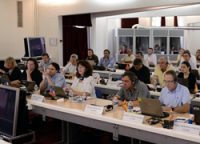
Renault: The French carmaker
Renault on 24 March concluded a revised
agreement on the Renault group works council (CGR), which was signed by the
representatives of the employees in the main European countries and the
representative French federations for the metalworking industry. The chair,
co-chairs of the select committee and IndustriALL Global Union also signed the new
accord. The revised agreement states the different formations in which the CGR can
meet: 1. The world works council brings together 40 employee representatives from 18
countries (including 9 members from non-EU countries) or groups of countries once a
year. 2. The select committee of the group works council brings together 11 members
(a chair and ten co-chairs, elected from among the European members) several times a
year, depending on current developments in the company. 3. The group works council
at European level brings together the 31 members of the European Economic Area in
the case of exceptional decisions. On top of this, the “learning session” allows the
members of the select committee once a year to visit a country in which the group
has operations to obtain information about the social, economic and cultural aspects
and gain a better understanding of the issues for Renault in that country (Morocco
in 2013, Brazil in 2014).
|
European
works councils
- Gestamp: The Spanish
automotive supplier Gestamp (nearly 19,000 employees in the EU) on 29 January
signed an agreement on the creation of a European works council. It is one of
the rare agreements to explicitly provide for the EWC to “negotiate” with
management on all matters concerning the employees. The agreement provides a
visiting right to sites to meet the workers or their representatives in order
jointly to identify transnational issues going beyond the sphere of competence
of staff representatives at local level. The works council has 21 members, of
whom 6 are Spanish, 5 German, 3 British and 2 French. A select committee is
informed in the event of exceptional circumstances affecting employees’
interests in at least two countries and can invite the representatives of the
locations concerned or decide to convene a plenary meeting. The signatories also
created a working party dedicated to the topic of health and safety.
- Alcatel-Lucent / Nokia:
The coordination between the staff representatives of the Alcatel-Lucent and
Nokia groups, which have announced they are to merge, should be facilitated by
the fact that the trade union representatives of the two companies are already
based at the ICT sector committee of the IndustriAll European trade union
federation. “The chairs of the two European works councils know each other,”
adds Philippe Saint-Aubin, national secretary of the FGMM-CFDT. Information
about the merger was provided to the European works council on 17 April.
|
Trade
unions
- BNP-Paribas / Société
générale: The UNI Global Union international trade union
federation has announced the creation of two global trade union alliances within
the two banking groups following a meeting attended by the trade union
representatives of its affiliates on 14 April, in Marrakesh (Morocco). The UNI
press
release presents the two documents with details of each of the two
alliances. The federation underscores that negotiation of an international
framework agreement at Société Générale is on track.
|
4. Studies
and reports
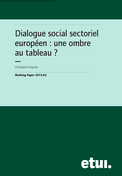
Social dialogue or European social
lobbying? A study by the European Trade Union Institute (ETUI,
“Dialogue social sectoriel européen : une ombre au tableau ?”, Christophe
Degryse, Working Paper 2015.02 ; (“European sectoral social dialogue: a
shadow on the picture?”, in French) retraces the evolution of European social
dialogue, with its current total of 43 sectoral social dialogue committees, bringing
together the European social partners in the sectors concerned. A mixed picture is
revealed: while some committees are dynamic, others are gripped by a “profound
lethargy” (insurance sector, banks, gas, footwear). In addition, if sectoral social
dialogue from 1999 to 2009 primarily produced reciprocal commitments between the
partners, it has been transformed since 2010 into a “social dialogue mainly of joint
lobbying”. “There has not been a single new agreement negotiated in 2011, or in
2013, or in 2014,” notes Christophe Degryse. The fact is that the change in attitude
of the European Commission – which subjects such agreements and the
representativeness of the signatories to detailed scrutiny, thus delaying or even
preventing their implementation by way of directives – does little to encourage the
social partners to continue down this path.
|
Phrase of
the fortnight
Autonomy of
the social partners
The study published by the European Trade Union Institute (see above) refers to the
control exercised by the European Commission over agreements concluded by the
European social partners. Certain experts query the legitimacy of a power of control
resting with the Commission, with a reminder that article 152 of the Lisbon Treaty
states that the European Union shall “facilitate dialogue” between the social
partners, “respecting their autonomy”. In addition, as article 155 explains, this
dialogue “may lead to contractual relations, including agreements” which shall be
implemented “at the joint request of the signatory parties, by a Council decision on
a proposal from the Commission”. In this event, “the European Parliament shall be
informed”. In other words, the Treaty appears to allow the Commission only to use
the text in the form of a proposal for a decision for the Council to adopt (or not
as the case may be) or to adopt unanimously if the subject matter of the agreement
comes under the unanimity rule. The question is whether the Treaty grants the
Commission a degree of discretion, or whether the principle of the parties’ autonomy
in the framework of social dialogue bars its intervention.
|
|
|











